Why Your Professional Services Website Is Your Most Powerful Business Asset
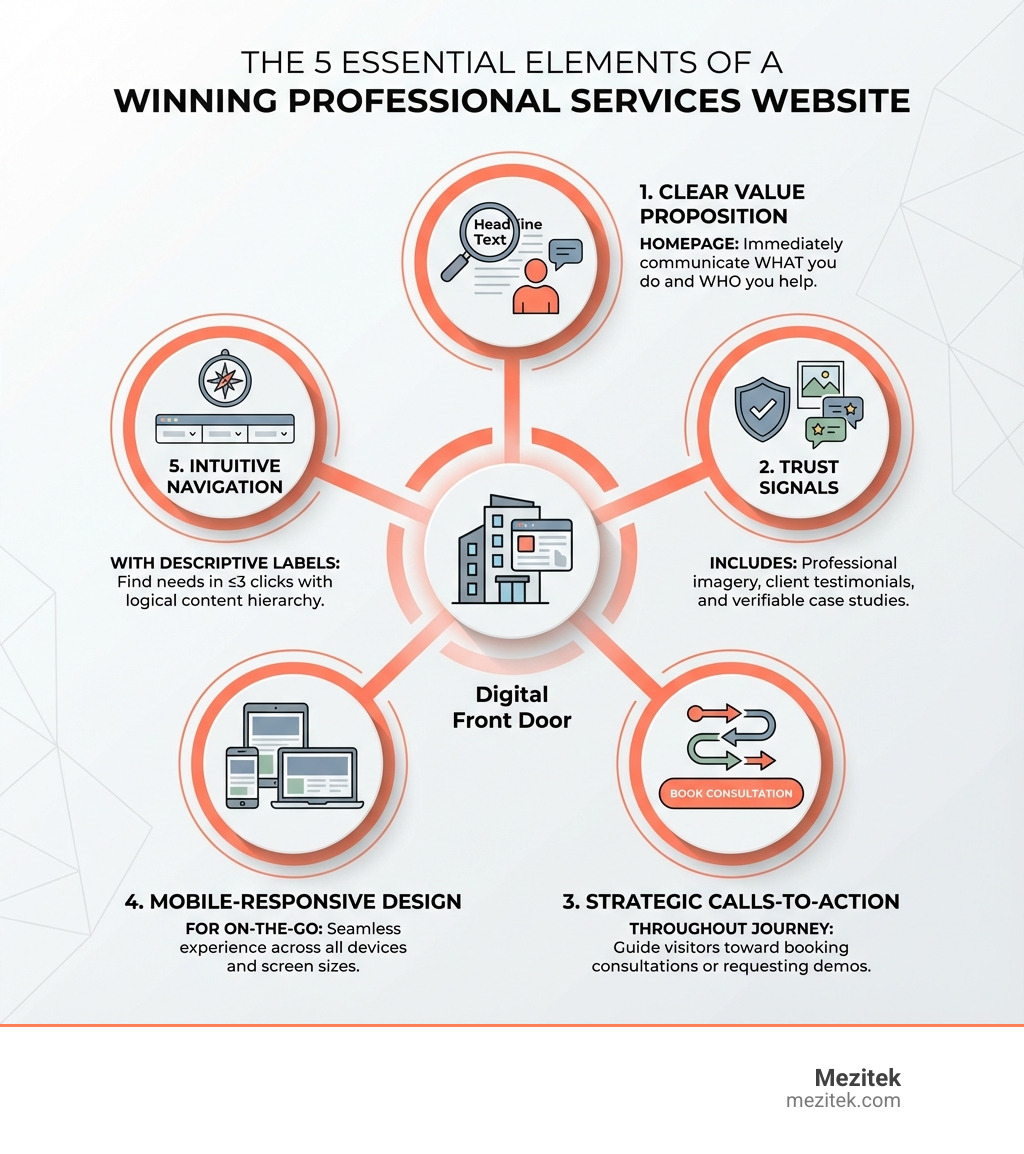
A professional services website is more than an online presence—it’s the digital front door to your business. For consultants, agencies, and other service providers, your website is often the first impression a potential client will have of your firm.
Key Elements of a Winning Professional Services Website:
- Clear Value Proposition – Immediately communicate what you do and who you help
- Trust-Building Elements – Professional photography, client testimonials, and case studies
- Strategic CTAs – Guide visitors toward booking consultations or requesting demos
- Responsive Design – Seamless experience across desktop, tablet, and mobile devices
- Intuitive Navigation – Help visitors find what they need in three clicks or less
The difference between a site that generates leads and one that doesn’t comes down to strategic design. According to research on web credibility, a well-designed website establishes credibility and builds trust. For service-based companies, thoughtful navigation, clean layouts, and responsive design create a user experience that converts visitors into clients.
Yet many firms treat their website as a digital brochure, not a sales tool, missing opportunities because their site isn’t designed with their audience in mind. Understanding effective web design principles will help you create a site that attracts the right clients and guides them toward working with you.
Professional services website helpful reading:
The Blueprint: Strategic Planning for a High-Performing Website
Before considering colors or layouts, the most crucial step in creating a successful professional services website is strategic planning. This defines what your website will do. A high-performing site is a powerful business asset that communicates brand value, builds credibility, and captures leads. Our aim is to build a digital tool, not just a brochure.
First, we define the website’s core purpose and business goals. Is it for lead generation, brand awareness, client education, or recruitment? Every element must align with these objectives for your professional services website to succeed.

Understanding Your Audience and Defining Your Goals
Thorough audience research is paramount. We identify your ideal clients, their needs, and their online searches by creating detailed buyer personas. Understanding their language and questions helps us tailor the solutions you offer.
Once we know your audience, we map their buyer’s journey—the steps they take from problem awareness to choosing your service. Your website’s content and structure should support each phase, guiding prospects toward conversion.
For a professional services website, common goals include:
- Lead Generation: Attracting and converting visitors into qualified leads through clear calls-to-action and valuable content. For real estate, a custom approach to Property Lead Generation Websites can make a huge difference.
- Brand Awareness & Authority: Establishing your firm as an expert through insightful content and a consistent brand message.
- Client Education: Providing information that helps clients understand their problems and your solutions.
- Recruitment: Attracting top talent to your team.
A well-defined purpose and deep audience understanding are the bedrock of an effective professional services website. Learn more about our approach in our insights on Innovative Web Solutions.
Custom Design vs. Website Templates: What’s Right for Your Firm?
A key decision is choosing between a custom-designed website or a pre-made template. Both have merits for professional services firms.
A custom-designed website offers total uniqueness and flexibility. It’s built from scratch to match your brand, services, and business goals, ensuring a distinctive online presence. This is often our preferred route for clients seeking a unique brand identity and long-term flexibility. We believe in Custom Designed Business Websites that reflect your unique value.
On the other hand, website templates offer a quicker, more cost-effective solution. They provide a professional starting point with many responsive designs available. While they offer less customization than a custom build, modern templates can be flexible and allow for branding elements to be incorporated.
Here’s a quick comparison to help you weigh your options:
| Feature | Custom-Designed Website | Template-Based Website |
|---|---|---|
| Branding | Fully unique, reflects exact brand identity | Customizable within template constraints, may resemble others |
| Scalability | Highly scalable, built for future growth and features | Scalability depends on template flexibility and platform |
| Cost | Higher initial investment, but greater long-term ROI | Lower initial cost, but potential for hidden customization fees |
| Uniqueness | One-of-a-kind, stands out from competitors | Less unique, might blend in with similar businesses |
| Control | Complete control over design, functionality, and code | Limited by template framework and platform capabilities |
| Timeline | Longer development cycle | Faster to launch |
For professional services, where trust is paramount, a custom design often provides a stronger foundation for a memorable brand. It allows us to craft a user experience aligned with your client journey and business objectives, giving you a distinct advantage.
Core Design and Content Strategy for Your Professional Services Website
Once the blueprint is in place, we dive into the core design and content strategy. This is where your brand’s personality meets functionality, creating a seamless and engaging experience for visitors.
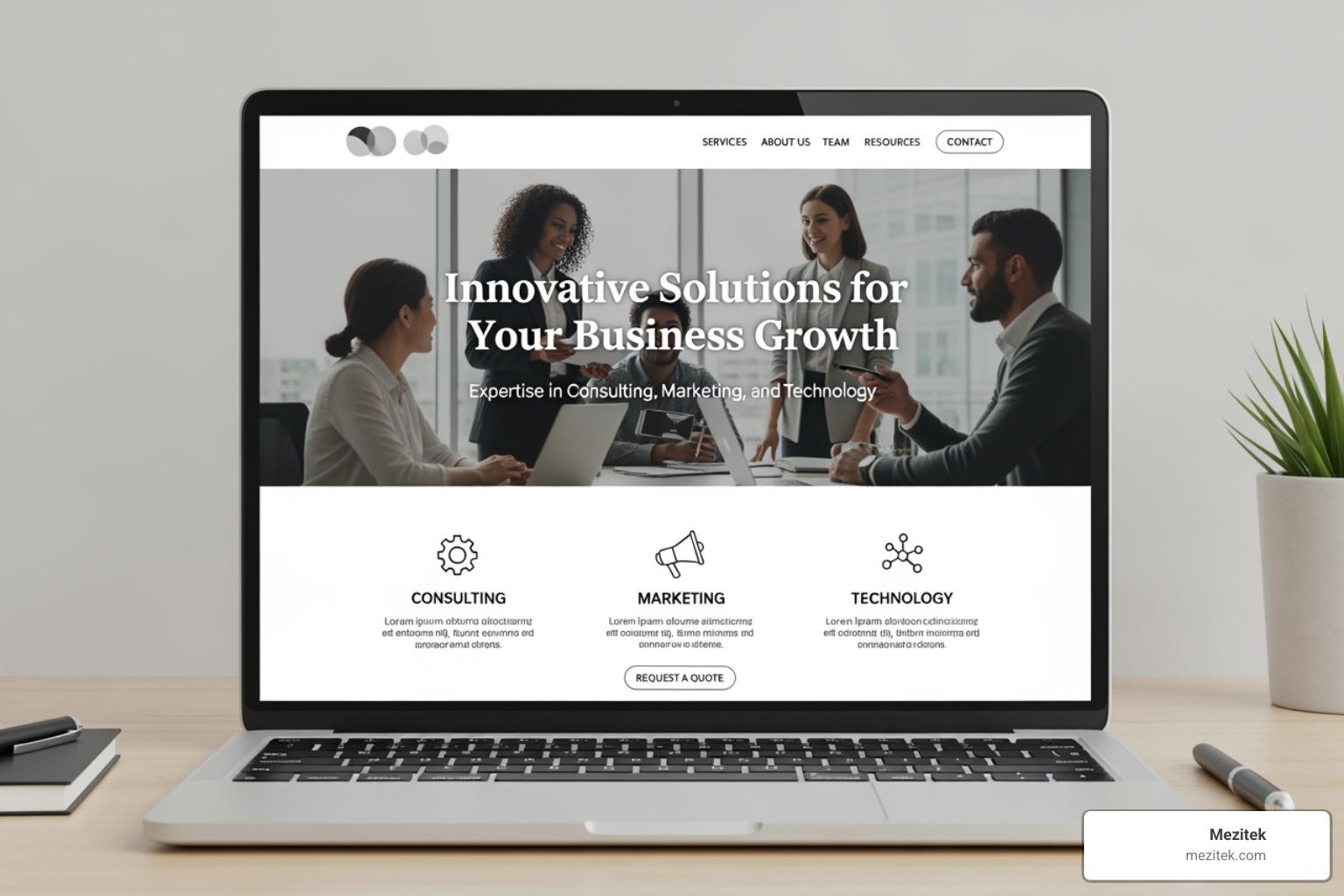
For a professional services website, design principles are particularly important. Visual hierarchy guides the user’s eye to important information first. Branding consistency across colors, fonts, and imagery reinforces your professional identity. Responsive design is non-negotiable; your site must function flawlessly on all devices. Fast load times are also critical to prevent high bounce rates.
Integrating SEO from the ground up is also key. Your website needs to be found, not just look good. A strong content hierarchy and well-structured pages are essential for search engine visibility.
Essential Elements that Build Trust and Credibility
Trust is the cornerstone of any successful professional services firm. Your website must be crafted to instill confidence. Here’s what we focus on:
- Professional Photography: Generic stock photos can erode credibility. We recommend investing in high-quality photos of your team and office to humanize your brand.
- Detailed Team Bios: Showcase the expertise and personalities of your team. Include qualifications, experience, and a personal touch to build rapport.
- Clear Contact Information: Make it easy for clients to reach you. Prominently display your phone number, email, address, and a user-friendly contact form.
- Security Badges and Certifications: Display SSL certificates and privacy policy links to reassure visitors about data security.
- Human-Centered Design Principles: An intuitive site that anticipates user needs fosters a sense of care and professionalism, creating a positive user experience (UX).
- Testimonials and Case Studies: These are powerful forms of social proof. Integrate client testimonials strategically. Develop in-depth case studies that outline a client’s problem, your solution, and the measurable results to tell a compelling story of your success.
Showcasing Expertise Through Strategic Content and Navigation
Your professional services website is your platform to prove your value and demonstrate expertise.
- Detailed Service Pages: Each service needs a dedicated page explaining what it is, who it’s for, and the benefits. Use clear, persuasive language.
- In-depth Case Studies: Case studies are gold. They create a narrative of success, detailing client challenges, your strategies, and positive outcomes. This is how you show, not just tell, your expertise.
- Insightful Blog Posts/Resource Section: A blog or insights section is crucial for thought leadership and SEO. Regularly publishing high-quality content positions your firm as an authority and engages your audience.
- Intuitive Navigation Menu: A confusing menu is a major turn-off. Your navigation should be logical and easy to understand, with limited top-level options. Use descriptive labels and ensure mobile-friendly menus are implemented. Our philosophy for Innovative Web Solutions always emphasizes intuitive navigation.
- Visual Elements: Use strong brand imagery, professional photography, and custom illustrations to lift your brand. Icons and infographics can break down complex information. Consider embedding videos, but be sure to optimize all visuals for fast load times.
Driving Action: Conversion Optimization and Best Practices
A beautiful website is great, but a beautiful website that converts visitors into clients is better. This section focuses on guiding your visitors toward taking that crucial next step.
Conversion-focused design means strategically placing elements to encourage specific actions. This is where user experience (UX) and user interface (UI) design shine. A thoughtful UX reduces friction, making the user journey smooth, while a compelling UI makes it visually appealing. For professional services, these strategic choices can be the difference between a visitor bouncing and becoming a client.
Social proof, like testimonials and case studies, plays a huge role here, reinforcing trust and encouraging action.
The Critical Role of Calls-to-Action (CTAs)
A clear call-to-action (CTA) is the lifeblood of a converting professional services website. Without it, visitors won’t know what to do next.
- CTA Placement: CTAs should be placed where they are most relevant.
- Above the Fold (Homepage): A primary CTA should be immediately visible (e.g., “Request a Consultation”).
- Service Pages: Each service page should have a relevant CTA (e.g., “Learn More About This Service,” “Schedule a Findy Call”).
- Blog Posts: After providing value, offer a related CTA (e.g., “Download Our Free Guide”).
- Contact Page: This page is a CTA hub. Ensure clear buttons for “Send Message” or “Book an Appointment,” multiple contact methods, and a brief form.
- Action-Oriented Language: Use strong, active verbs that tell the user what will happen. Instead of “Submit,” try “Get Your Free Assessment.”
- Primary vs. Secondary CTAs: Offer secondary CTAs for visitors not ready for the primary one. For example, pair “Schedule a Consultation” with “Download Our Brochure.”
- A/B Testing: Don’t guess what works. A/B test different CTA colors, text, and placement to optimize conversion rates. This data-driven approach helps refine your site for maximum impact. To truly maximize potential, we recommend focusing on Increase Landing Page Conversion Rate strategies.
Learning from the Best: What Winning Websites Do Differently
We constantly analyze what makes a professional services website exceptional. The best sites don’t just look good; they perform. They share several common traits:
- Clear Value Proposition: They immediately communicate what they offer and why it matters, setting a clear expectation for visitors.
- Minimalist Design & Visual Storytelling: Top-tier sites often use clean, uncluttered layouts that focus on impactful visuals and compelling narratives rather than overwhelming text.
- Seamless Mobile Experience: They prioritize responsive design, ensuring their site adapts fluidly and loads quickly on all devices.
- Showcasing Expertise and Social Proof: They prominently feature client success stories, testimonials, and awards to build credibility.
- Intuitive Navigation: Visitors can easily find what they’re looking for, whether it’s practice areas, client news, or contact information.
- Personality and Authenticity: The best sites convey their firm’s unique culture, often through team photos or a compelling “About Us” story.
- Strategic Use of Content: They integrate insightful blog posts and resources that establish thought leadership and engage their audience.
From these examples, we learn that a professional services website is a powerful sales tool. User experience, strategic branding, and responsive design are essential elements that distinguish high-performing sites. We apply these lessons to every project, ensuring our clients achieve similar success, as seen in our approach to Custom Law Firm Website Design.
Ensuring Long-Term Success and Avoiding Common Pitfalls
Launching your professional services website is just the beginning. To ensure it remains a high-performing asset, ongoing attention is crucial. A website is a living entity that needs regular care. Neglecting it can lead to security vulnerabilities, outdated content, and slow performance, negatively impacting your professional image and lead generation.
Key Considerations for Ongoing Website Maintenance
A structured maintenance plan protects your investment and ensures a positive visitor experience. Here’s what is essential for any professional services website:
- Software Updates: Regularly update your site’s core software, themes, and plugins for security patches and new features.
- Security Monitoring: Implement robust security measures like firewalls and malware scans, and monitor for suspicious activity.
- Automated Backups: Schedule regular, automated backups so you can quickly restore your site if anything goes wrong.
- Performance Optimization: Continuously monitor and optimize your site’s speed through image compression and database cleanups.
- Uptime Monitoring: Use tools that alert you immediately if your site goes down, ensuring it’s always accessible.
- Form and Integration Checks: Periodically test all contact forms and integrations to ensure leads are being captured correctly.
- SEO Audits & Analytics Reviews: Regularly review site performance with analytics and conduct SEO audits to identify areas for improvement.
By staying on top of these tasks, you protect your investment and ensure your professional services website continues to serve as an effective tool for your business. If you need assistance with ongoing support, Contact us.
Common Mistakes to Avoid with a professional services website
Being aware of common pitfalls can save you time, money, and missed opportunities.
- Poor Navigation: A confusing menu frustrates visitors. If users can’t find what they need in a few clicks, they’ll leave.
- Generic Stock Photos: These lack authenticity and can make your firm seem impersonal. Invest in unique, high-quality imagery.
- No Clear Call-to-Action (CTA): Without clear CTAs, visitors won’t know what to do next. Guide them explicitly.
- Slow Loading Speeds: A slow site leads to high bounce rates and hurts search rankings. Optimize images and scripts for better performance.
- Not Being Mobile-Friendly: A huge portion of your audience browses on mobile. Your site must adapt seamlessly to all devices.
- Lack of Fresh Content: A static site signals neglect. Regularly update content to keep your site vibrant and relevant.
- Ignoring SEO: A beautiful site is useless if no one can find it. Integrate SEO best practices from the start.
By avoiding these common mistakes, you can ensure your professional services website works harder for your business.
Frequently Asked Questions about Professional Services Websites
Here are answers to common questions firms have about their online presence.
How can my website stand out from others in the industry?
To stand out, your professional services website must be memorable and distinctive.
- Unique Value Proposition: Clearly state what makes your firm different and better. This should be evident on your homepage.
- Custom Design: A custom design allows for a unique aesthetic and user experience that aligns with your brand, helping you leave a lasting impression.
- Niche Content Strategy: Focus on creating valuable, specialized content for a specific niche to position yourself as the go-to expert.
- Showcasing Personality: Let your firm’s culture shine through with team videos, an engaging “About Us” page, or a distinctive tone of voice.
- Exceptional User Experience (UX): An easy-to-use, fast, and visually appealing site will always stand out and reinforce professionalism.
What are the essential features for a modern professional services website?
A modern professional services website should include these key features:
- Responsive Design: Your site must function perfectly on all devices.
- Fast Load Times: Optimize images, code, and hosting for speed.
- SSL Certificate (HTTPS): Essential for security and SEO.
- Clear Contact Forms: Easy-to-use forms with multiple contact methods.
- Testimonials and Case Studies: Social proof to build trust.
- SEO-Friendly Structure: Clean code, proper tags, and optimized images.
- Blog/Resource Section: For thought leadership and SEO benefits.
- Integrated CRM/Lead Management: To efficiently capture and manage leads.
- Accessibility Features: Ensure your site is usable by people with disabilities.
How does user experience (UX) impact my site’s effectiveness?
User experience (UX) is how a visitor feels when interacting with your professional services website. Good UX has a profound impact:
- Reduces Bounce Rate: An intuitive site encourages visitors to stay longer.
- Increases Time on Page: Engaging content and a good UI make visitors explore more.
- Guides Users to Conversion: A well-designed UX creates clear pathways to your CTAs.
- Builds Trust and Credibility: A polished, easy-to-use site signals competence.
- Improves SEO Rankings: Search engines prioritize sites with a good user experience.
- Boosts Brand Perception: A positive UX reinforces your brand as reliable and client-focused.
UX and UI are strategic tools that directly impact your site’s ability to attract, engage, and convert clients.
Conclusion: Transform Your Website into a Client-Generating Asset
Your professional services website is more than a digital placeholder; it’s a dynamic asset capable of driving significant business growth. We’ve explored how to plan, design, and maintain a site that performs as a client-generating machine.
We emphasized strategic planning, understanding your audience, and defining clear goals. We’ve dug into core design principles, trust-building elements like case studies, the pivotal role of CTAs, and the need for ongoing maintenance.
A well-designed website is a powerful sales tool that builds trust and drives conversions by combining great user experience, strategic branding, responsive design, and SEO.
By investing in a thoughtfully crafted professional services website, you’re not just creating an online presence; you’re building a digital front door that transforms prospects into loyal clients.
Are you ready to turn your website into your most effective business development tool?