Introduction: Your Roadmap to More Conversions
Marketing funnel optimization is the process of improving each stage of your customer’s journey—from first awareness to final purchase—to increase conversions. It guides potential customers through a clear path toward becoming paying clients.
However, most funnels leak. Prospects drop off at every stage, leaving money on the table. For example, nearly 70% of online shoppers abandon carts due to complicated checkout processes.
The good news is that small improvements can create massive results. A well-optimized funnel doesn’t just increase sales—it builds relationships, reduces customer acquisition costs, and turns one-time buyers into loyal advocates.
As a freelancer or small agency owner, you don’t need a huge budget. You need a clear understanding of your customer’s journey and strategic improvements at key touchpoints. This guide breaks down 10 proven strategies to transform your marketing funnel from a leaky bucket into a conversion machine.
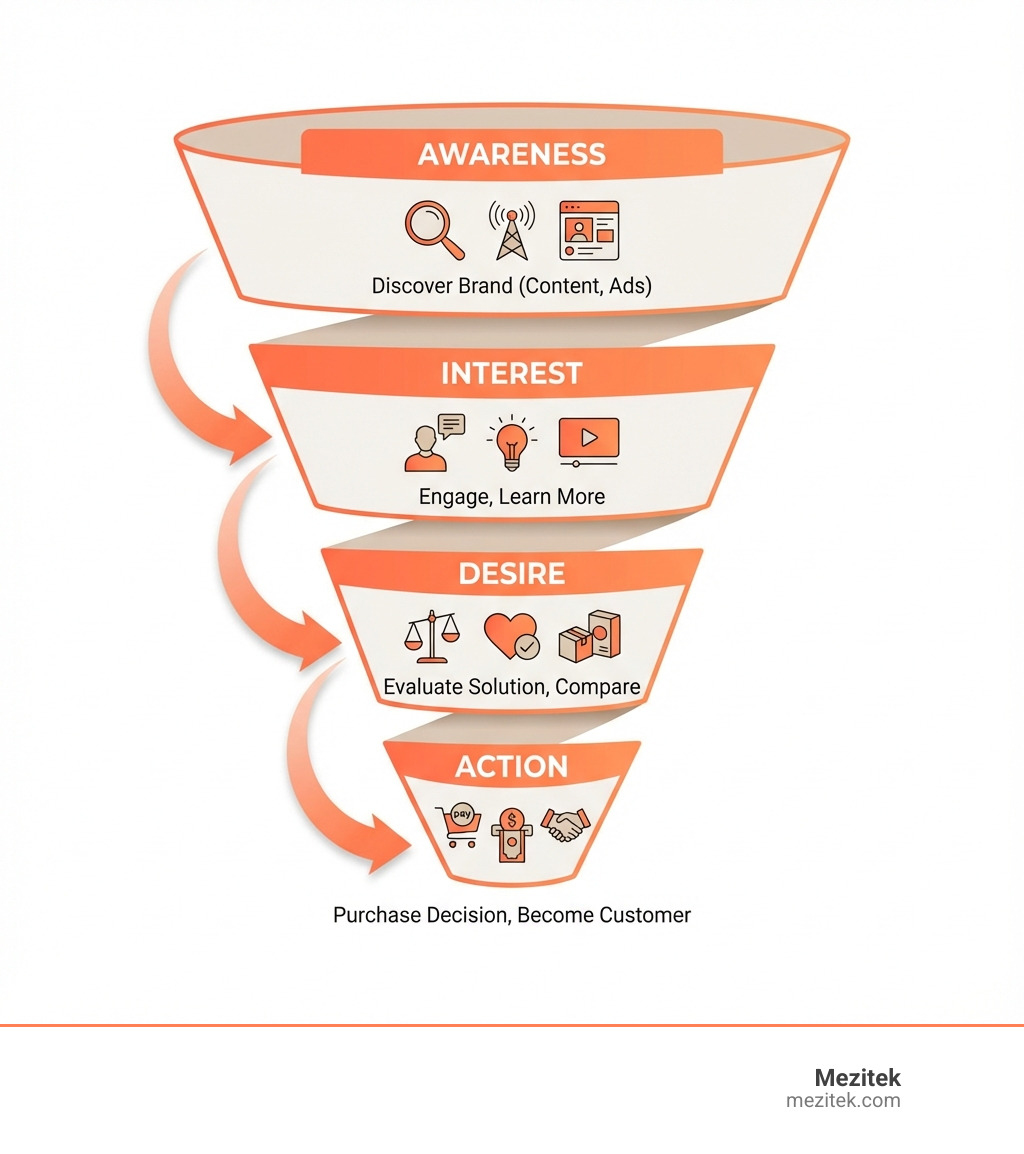
The concept of the marketing funnel, particularly the AIDA model, was created by Elias St. Elmo Lewis to describe the customer-business relationship. While modern customer journeys are less linear, the core idea of guiding people through phases of engagement remains true.
Though often used interchangeably, marketing, sales, and conversion funnels have subtle differences:
- Marketing Funnel: Focuses on generating awareness and interest (lead generation).
- Sales Funnel: Guides engaged leads through the final purchasing process.
- Conversion Funnel: Refers to the specific steps a user takes to complete any goal (e.g., a purchase or sign-up).
For our purposes, marketing funnel optimization encompasses all these aspects to improve the entire journey from findy to loyalty.
Why is marketing funnel optimization crucial for your business?
Optimizing your marketing funnel directly impacts your bottom line with several critical benefits:
- Increased ROI (Return on Investment): Optimization ensures every marketing dollar works harder, helping you generate more conversions and increase your ROI.
- Improved Lead Generation: A well-oiled funnel attracts more of the right people by using content that resonates at the top of the funnel to capture quality leads.
- Better Customer Retention & Brand Loyalty: Optimization extends beyond the first sale to nurture relationships, turning customers into repeat buyers and brand advocates.
- Competitive Advantage: In a crowded market, an efficient funnel allows you to outmaneuver competitors by converting more prospects with fewer resources.
Part 1: Building the Foundation (Ways 1-2)
Before we dive into specific tactics, let’s lay the groundwork. The most effective marketing funnel optimization starts with a deep understanding of who you’re trying to reach and what content they need at each step.
1. Deeply Understand Your Target Audience
Many businesses create marketing content without truly understanding who they’re talking to. This is where buyer personas come in.

A buyer persona is a semi-fictional profile of your ideal customer based on market research and real data. It helps you understand their demographics, behaviors, and goals so you can decide who you’re trying to reach more effectively.
How to get started:
- Identify Demographics: Age, location, income, job title.
- Uncover Needs and Pain Points: What problems are they trying to solve? What are their frustrations? You must consider the needs and frustrations of your customers to create helpful content.
- Understand Goals: What do they hope to achieve?
- Research Behaviors: Where do they get information? What social media do they use? What influences their decisions? Find out which marketing avenues your customers respond to best.
Why this matters for your funnel:
Understanding your audience allows you to create relatable content that speaks directly to their needs. This pulls them deeper into your funnel and allows for more personalized messaging at every stage. According to the Sprout Social Index, 45% of consumers are more likely to consider a product when it’s relatable.
2. Map Your Content to Each Funnel Stage
Once you know who you’re talking to, you need to decide what to say and when. Different stages of the AIDA funnel (Awareness, Interest, Desire, Action) require different types of content.
-
Top-of-Funnel (TOFU) – Awareness: Here, prospects are finding your brand or realizing they have a problem. They aren’t ready to buy and are looking for information. The goal is to attract and educate a broad audience.
- Content Types: Blog posts, social media, infographics, short videos, podcasts, and checklists.
- Example: This video we created at Mezitek is a prime example of awareness-stage content, educating viewers on a relevant topic.
-
Middle-of-Funnel (MOFU) – Interest & Desire: Prospects understand their problem and are actively researching solutions. They’re comparing options to see if you’re the right fit. The goal is to nurture leads and build trust.
- Content Types: Case studies, whitepapers, webinars, detailed guides, comparison charts, and testimonials.
- Example: A case study showing how your website design helped a client achieve specific business goals.
-
Bottom-of-Funnel (BOFU) – Action: Prospects are ready to decide and just need a final push. The goal is to convert leads into customers by reducing perceived risk.
- Content Types: Free trials, consultations, detailed pricing pages, personalized demos, and direct sales pages.
- Example: Offering a free 30-minute consultation for a website design project.
By strategically mapping your content, you provide value at every stage, building authority and keeping prospects engaged. To see how different web solutions fit into a content strategy, consider our Innovative Web Solutions.
Part 2: Attracting & Nurturing Leads (Ways 3-6)
With a solid foundation of audience understanding and content strategy, we can now focus on actively attracting and nurturing those leads through our funnel.
3. Optimize the Top of the Funnel (TOFU) to Maximize Reach
The top of your funnel is all about getting noticed. It’s where potential clients first become aware of your brand, your services, or the problem you solve. Maximizing reach here means being visible where your target audience spends their time online.
- SEO (Search Engine Optimization): When someone searches for “freelance web designer” or “small business website,” you want to appear high in the results. This involves using relevant keywords, creating high-quality content that answers common questions, and ensuring your website is technically sound. Investing in Best Practices for Website Architecture is crucial for SEO success.
- Social Media Marketing: Social platforms are great ways to engage with potential customers, build your brand, and grow your audience. No matter what line of business you’re in, social media is an important tool for driving conversions. Share your educational TOFU content here.
- Digital Advertising: Platforms like Google Ads or social media ads can put your message directly in front of your target audience. Use highly targeted campaigns to introduce your brand and educational content.
- Educational Content & Thought Leadership: Position yourself as an expert. This could be through blog posts, guest articles, or even short video tutorials. The goal is to provide value, not to sell directly. When you educate, you build trust and become a go-to resource.
By optimizing your TOFU, you ensure a steady stream of new prospects entering your funnel, ready to learn more about what you offer.
4. Nurture Leads in the Middle (MOFU) to Build Relationships
Once prospects are aware of you, the middle of the funnel (MOFU) is where you deepen their interest and build a relationship. This is about demonstrating value, not pushing a sale.
- Email Marketing: After capturing an email with a lead magnet, send a series of valuable emails with case studies, webinar invites, or exclusive content. Personalize by segmenting lists based on interests.
- Case Studies & Whitepapers: These detailed pieces showcase success stories and provide social proof, demonstrating your capabilities without being overtly promotional.
- Webinars & Workshops: Live or recorded sessions where you teach a valuable skill are excellent for building authority and engaging your audience directly.
- Building Trust: Approach this process with the intent to build trust and long-lasting relationships with customers. Focus on being helpful and transparent for greater success.
- Personalization: Use your buyer personas to tailor content. If a prospect downloaded a guide on e-commerce design, send them case studies about your e-commerce clients. For more on lead generation, see our SaaS Lead Generation Strategy.
5. Craft Irresistible Calls-to-Action (CTAs)
A CTA is your signpost, guiding users to the next step in their journey. Without clear, compelling CTAs, even the best content can leave prospects wondering what to do next.
- Action-Oriented Language: Use strong verbs that tell the user exactly what will happen. Instead of “Click Here,” try “Get Your Free Guide,” “Start Your Project,” or “Book a Consultation.”
- Clarity and Value: The user should instantly understand what they’re getting and why it’s beneficial.
- Placement: CTAs should be strategically placed where they make sense contextually. For TOFU content, they might lead to another educational resource. For BOFU, they’ll lead to a purchase or contact form. Test different positions to see what works best.
- Visual Design: Make your CTAs stand out. Use contrasting colors, appropriate sizing, and enough white space. We’re testing different colors and styles in our A/B tests to see what resonates.
- A/B Testing CTAs: Don’t guess which CTA will perform best – test it! Experiment with different wording, colors, sizes, and placements. As the research suggests, test different calls to action to see which drives more traffic to your site, and also test their position.
- Guiding Users: Each CTA should subtly move the user further down the funnel. From “Learn More” at TOFU to “Get Started Now” at BOFU. For example, optimizing your CTAs can significantly impact your Registration Success rates for webinars or newsletters.
6. Leverage Social Proof to Boost Credibility
In today’s skeptical world, people trust other people more than they trust brands. This is where social proof becomes incredibly powerful in your marketing funnel optimization efforts.

- Customer Reviews & Testimonials: These are golden! Positive feedback from happy clients is incredibly persuasive. A whopping 90% of prospects trust suggestions from family and friends, and online reviews often function in a similar way. Display them prominently on your website, landing pages, and even in your email marketing.
- Case Studies: More in-depth than testimonials, case studies tell a story of how you helped a client overcome a challenge and achieve success. They are fantastic for MOFU content.
- User-Generated Content (UGC): If your service or product inspires users to create content (e.g., social media posts, videos), share it! This authentic content is highly relatable. The Sprout Social Index found that 45% of consumers are more likely to consider a product or service when it’s relatable.
- Trust Signals: Badges, awards, certifications, or even showing how many clients you’ve served can build confidence.
By showcasing authentic social proof, we reduce perceived risk and build immense credibility, making it easier for prospects to move from interest to desire and action. We want people to know that others have tried our products or services and loved them.
Part 3: Advanced Marketing Funnel Optimization Strategies (Ways 7-10)
Now that we’ve covered the essentials, let’s explore some more advanced techniques that can truly boost your funnel and convert more prospects into paying customers.
7. Perfect Your Landing Pages for Conversion
Your landing pages are critical conversion hubs. They are where prospects land after clicking an ad or a link, and their sole purpose is to drive a specific action. A poorly optimized landing page is like having a leaky bucket at the most crucial point of your funnel.
- Clear, Compelling Headlines: Your headline is the first thing visitors see. It must grab their attention and communicate your unique value proposition instantly. Test different headlines to see which resonates most.
- Concise and Benefit-Oriented Copy: Focus on the benefits for the user, not just features. Use clear, simple language. Less is often more.
- Form Optimization: If your landing page includes a form, optimize it for conversion. Only ask for essential information. Long forms can be a major deterrent.
- Mobile Responsiveness: A significant portion of web traffic comes from mobile devices. Your landing pages must look and function perfectly on all screen sizes.
- Page Speed: Slow loading pages kill conversions. Optimize images, leverage browser caching, and minimize code to ensure your pages load quickly. Every second counts!
- Visual Appeal: Use high-quality images or videos that support your message. Ensure the design is clean, professional, and guides the eye towards your call-to-action.
By perfecting your landing pages, you significantly improve the chances of a visitor taking the desired action. To dive deeper into making your landing pages work harder, explore our guide on how to Increase Landing Page Conversion Rate.
8. Simplify the Sales and Checkout Process
Don’t let a clunky sales or checkout process derail your hard work. Reducing friction at this final stage is paramount for marketing funnel optimization.
- Minimize Form Fields: Nearly 70% of shoppers abandon carts due to long forms. Ask only for essential information, pre-fill fields where possible, and offer a guest checkout option.
- Streamline Steps: Reduce the number of clicks or pages required to complete a purchase. A multi-step process can feel overwhelming.
- Offer Diverse Payment Options: Provide popular and secure payment gateways to build trust and cater to different preferences.
- Visual Progress Indicators: If you have multiple steps, show users their progress (e.g., “Step 1 of 3”) to manage expectations.
- Build Trust: Display security badges, clear return policies, and contact information to reassure wary consumers.
- Mobile Optimization: Ensure the entire checkout process is seamless on mobile. Tiny buttons or difficult forms are conversion killers.
Simplifying the path to purchase directly impacts conversion rates. Your overall site structure, as detailed in our Best Practices for Website Architecture, also influences this critical stage.
9. Use A/B Testing for Data-Driven Decisions
Guesswork is the enemy of marketing funnel optimization. A/B testing (or split testing) helps you make data-driven decisions that improve results.
- What is A/B Testing? It’s a method of comparing two versions (A and B) of an element, like a headline or button, to see which performs better. By showing each version to a different audience segment, you can A/B test to see what encourages more action.
- What to Test: Test high-impact elements like headlines, button colors, CTA wording, images, layout, and form fields.
- Test One Element at a Time: To accurately determine what caused a change, only alter one variable between your A and B versions.
- Ensure Statistical Significance: Don’t jump to conclusions. Use enough data to ensure your results are statistically significant and not due to random chance. Online calculators can help determine the necessary sample size.
- Continuous Improvement: A/B testing is an ongoing process. Regularly test new hypotheses to keep your funnel optimized as market conditions evolve.
By systematically testing, you eliminate assumptions and make changes proven to drive better results.
10. Implement Retargeting to Re-engage Lost Prospects
Not everyone converts on their first visit, and that’s perfectly normal. Retargeting (or remarketing) is a powerful marketing funnel optimization strategy that allows us to re-engage those who showed interest but didn’t convert.
- How it Works: Retargeting uses pixel tracking (a small piece of code on your website) to anonymously follow visitors who leave your site without converting. You can then show them targeted ads on other websites or social media platforms.
- Why it’s Effective: These prospects are already familiar with your brand and have shown some level of interest. They’re much warmer leads than cold traffic, making them more likely to convert when presented with a relevant ad.
- Audience Segmentation: Segment your retargeting audiences for maximum impact. For example, show ads for specific services to people who visited those service pages. Or offer a small discount to those who abandoned their cart.
- Strategic Messaging: Your retargeting ads should acknowledge their previous visit and offer a compelling reason to return. Remind them of the value, address potential objections, or offer a limited-time incentive.
Retargeting helps us recapture interest and guide prospects back into the funnel, turning near-misses into conversions and improving your overall funnel performance.
Measuring Success: Analytics, Metrics, and Tools
How do you know if your strategies are working? Effective marketing funnel optimization relies on monitoring key metrics and using the right tools.
Key Metrics for Marketing Funnel Success
- Conversion Rates: The percentage of visitors who complete a desired action. Track this for your main goal and for micro-conversions at each funnel stage.
- Cost Per Acquisition (CPA): The cost to acquire one new customer (total marketing spend / new customers). A primary goal is to lower your CPA.
- Customer Lifetime Value (LTV): The total revenue you expect from a customer over their entire relationship with your business.
- Click-Through Rate (CTR): For ads and CTAs, this measures the percentage of people who click your link after seeing it.
- Engagement Rate: For TOFU content, this measures audience interaction (likes, shares, comments, time on page).
Consistently tracking these metrics helps identify bottlenecks and make informed adjustments.
Essential tools for marketing funnel optimization
Powerful tools don’t have to break the bank. Many offer free tiers perfect for small businesses.
- Analytics Platforms: Google Analytics 4 (GA4) is essential for tracking user behavior, traffic sources, and conversion rates to identify drop-off points.
- Heatmaps: Tools like Hotjar or Microsoft Clarity visually show where users click and scroll, offering qualitative data to understand engagement and find design flaws.
- Session Recordings: Watch recordings of user sessions to see exactly how they interact with your site, revealing pain points or confusion.
- Survey Tools: Use on-site surveys to ask users directly about their experience, what they were looking for, or why they didn’t convert.
Combining quantitative data from analytics with qualitative insights from these tools gives you a complete picture of your funnel’s performance.
Frequently Asked Questions about Marketing Funnel Optimization
What are the most common challenges in conversion funnel optimization?
Common challenges for freelancers and small businesses include:
- Low Traffic: Not enough people entering the top of the funnel, often due to weak TOFU strategies like SEO or advertising.
- High Drop-off Rates: A significant number of people leaving at a specific stage, indicating a bottleneck like confusing content or a clunky form.
- Misalignment Between Marketing and Sales: Marketing generates leads that sales deems unqualified, requiring better communication and shared goals.
- Resource Restrictions: Limited time, budget, or expertise. Overcome this by prioritizing key optimizations and leveraging affordable tools.
Overcoming these challenges requires a systematic, data-driven approach. Start small, test frequently, and learn from each iteration.
How does building customer relationships impact long-term funnel success?
Building customer relationships is a powerful long-term marketing funnel optimization strategy. It leads to:
- Customer Loyalty: Happy customers make repeat purchases, increasing their LTV without new acquisition costs.
- Brand Advocacy: Loyal customers become brand evangelists. Since 90% of prospects trust suggestions from family and friends, this word-of-mouth marketing is invaluable.
- Increased LTV: Fostering relationships extends the customer lifecycle, leading to more revenue per customer over time.
- Feedback and Improvement: Engaged customers provide valuable feedback to help you refine your services and funnel.
When you build trust and long-lasting relationships, you’ll ultimately see more success.
How often should I analyze and optimize my marketing funnel?
Marketing funnel optimization is a continuous process, not a one-time task.
- Regular Reviews: Review your funnel performance at least monthly using analytics tools to look for trends and issues.
- Data-Driven Triggers: Make adjustments when data reveals a problem (like a high drop-off rate) or an opportunity.
- Market Changes: The digital landscape is always evolving, so ongoing optimization is necessary to adapt.
- Testing Cycles: Plan A/B tests in cycles. Once a test concludes, implement the winner and move to the next hypothesis.
Continuous optimization makes your funnel more efficient and profitable over time.
Conclusion: Turn Your Funnel into a Conversion Machine
We’ve covered a lot of ground, from understanding your audience and mapping content to advanced strategies like A/B testing and retargeting. The core takeaway for marketing funnel optimization is this: every interaction a potential customer has with your business is an opportunity to guide them closer to becoming a client.
As a freelancer or small business owner, you have the agility to implement these changes quickly and the direct connection to your customers to understand their needs deeply. By focusing on building relationships, providing value at every stage, and making data-driven decisions, you can transform your marketing funnel from a leaky bucket into a powerful, revenue-generating machine.
Don’t let your valuable leads slip away. Take the next step in building a high-performing website for your business with our Custom Designed Business Websites. We’re here to help you design, build, and manage the digital foundation that supports your optimized marketing funnel and skyrockets your sales.