
Why a Strong SaaS Lead Generation Strategy Is Your Growth Engine
A SaaS lead generation strategy is the systematic process of attracting, engaging, and converting potential business customers into qualified leads for your software-as-a-service product. Here’s what makes it effective:
Core Components of a Winning Strategy:
- Define your Ideal Customer Profile (ICP) – Know exactly who benefits most from your product
- Balance inbound and outbound tactics – Combine content marketing, SEO, and cold outreach
- Leverage Product-Led Growth (PLG) – Use free trials and freemium models to let your product sell itself
- Focus on lead quality over quantity – Target MQLs, SQLs, and PQLs that actually convert
- Align sales and marketing teams – Share definitions, metrics, and unified reporting
- Measure and optimize constantly – Track CAC, LTV, and conversion rates by channel
If you’re running a B2B SaaS business—or building one for a client—lead generation isn’t just about getting traffic. The SaaS market grows 25% every year, which means competition is fierce. You need to attract the right leads, earn their trust, and convert them into long-term subscribers.
Unlike B2C, B2B SaaS lead generation involves longer sales cycles, multiple decision-makers, and savvy prospects who do their homework. That’s why strategies like cold outreach, content marketing, and free trials need to work together in a coordinated system.
The good news? You don’t need a massive budget to start. Whether you’re a freelancer building SaaS sites or a small agency helping clients grow, the strategies in this guide will show you how to generate qualified leads efficiently—from defining your ICP to optimizing conversion rates.
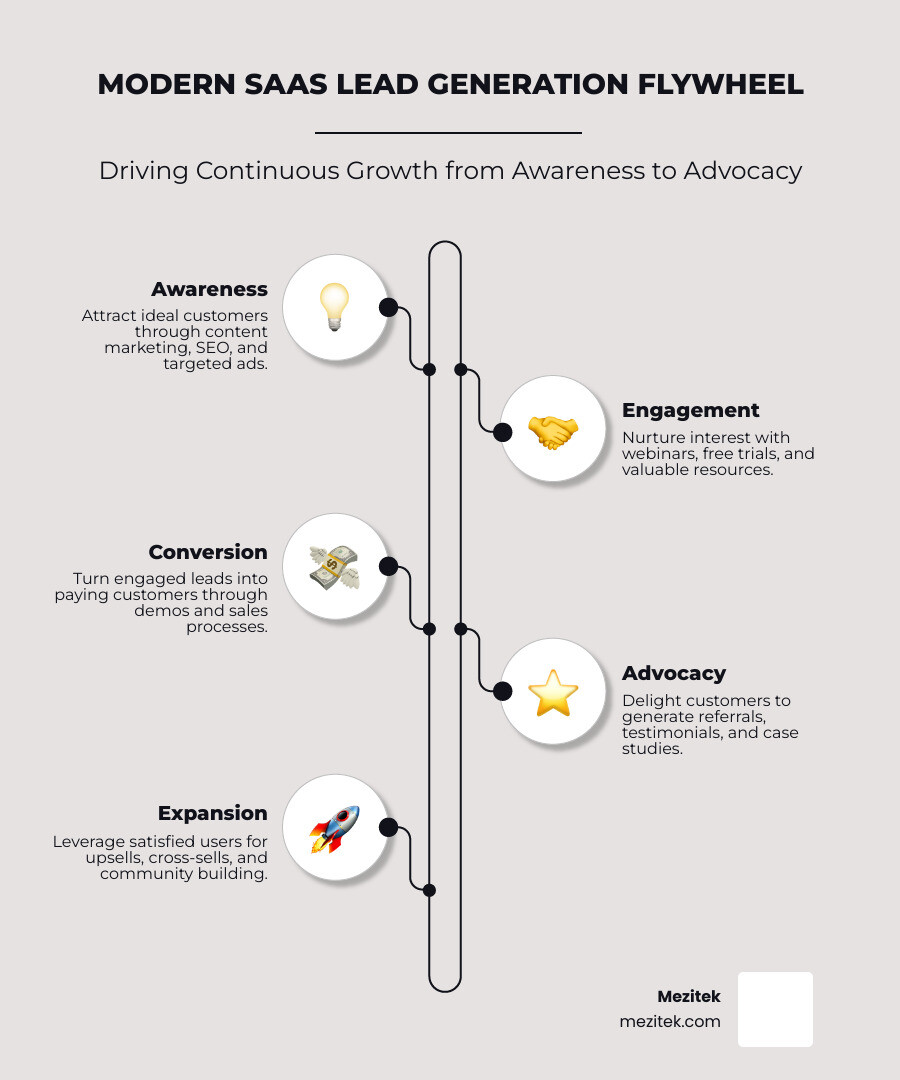
Foundations of a Winning SaaS Lead Generation Strategy
Before we dive into tactics, we need a solid groundwork. Think of it like building a house: you wouldn’t start framing walls before pouring the foundation, right? The same goes for your SaaS lead generation strategy. Our goal isn’t just to get a large number of leads; it’s to attract the right leads – those who are a good fit for our product and are likely to convert. In B2B SaaS, quality consistently outperforms quantity, creating a foundation for sustainable growth.
A crucial component here is the alignment between our sales and marketing teams. Misalignment can lead to our sales development reps creating prospects that don’t meet the expectations of sales teams, thus leading to missed sales opportunities. We want everyone pulling in the same direction!
Defining Your Ideal Customer Profile (ICP)
Our first step is to clearly define our Ideal Customer Profile (ICP) and buyer personas. This isn’t just a fancy exercise; it’s about understanding precisely who benefits most from our SaaS solution. An ICP is a detailed description of the type of company that would gain the most value from our product and, in turn, provide the most value to us.
To build our ICP, we need to consider:
- Firmographics: What’s their industry, company size, revenue, and location?
- Technographics: What technologies do they currently use? This can reveal compatibility or integration opportunities.
- Pain points: What specific challenges or problems does our product solve for them?
- Goals: What are their objectives, and how does our solution help them achieve these?
We gather this information from various data sources, including customer interviews, CRM analytics, insights from our sales team, market research, and third-party intent data. By thoroughly understanding our target market’s needs, pain points, and demographics, we can create detailed buyer personas that help us identify ideal prospects and tailor our messaging.
Understanding Key SaaS Lead Types
Once we know who we’re looking for, we need to understand the different types of leads and how they signal intent. Not all leads are created equal! Recognizing these distinctions helps us prioritize our efforts and nurture leads effectively.
Here’s a quick breakdown of the key SaaS lead types:
| Lead Type | Intent & Engagement | Next Steps |
|---|---|---|
| Marketing Qualified Leads (MQLs) | Warm leads; have shown interest (e.g., downloaded a case study, watched a demo video, participated in a webinar) but aren’t sales-ready. | Nurture with targeted content, personalized email campaigns, and timely follow-ups. If they seem ready, arrange a demo or presentation. |
| Sales Qualified Leads (SQLs) | The hottest leads; fit our ICP, have been contacted by sales, and are ready to buy. | Prompt outreach, confirm identity and interest, and guide them through the final stages of the sales process. |
| Product Qualified Leads (PQLs) | Unique to SaaS; have engaged with our product (e.g., used a free trial, freemium model) and experienced its value. | Focus on demonstrating further value, offering in-app assistance, and converting to a paid plan. |
| Expansion Leads | Existing customers with opportunities for upselling, cross-selling, or account expansion. | Engage with personalized offers, product updates, and demonstrate additional value. |
Product Qualified Leads (PQLs) are particularly valuable in SaaS. Their conversion rates consistently outperform other lead types because these prospects have moved beyond theoretical benefits to practical application. They’ve already experienced the core value of our product, making them strong candidates for conversion.
We also use a technique called lead scoring to identify which leads are most likely to convert. This process assigns a point value to each lead based on their demographics, interests, and behavior. This helps us prioritize our sales efforts, ensuring we spend our time on the leads with the highest potential.
Demand Generation vs. Lead Generation
While often used interchangeably, demand generation and lead generation are distinct but complementary efforts within a comprehensive SaaS lead generation strategy.
Demand Generation focuses on creating broad market awareness and interest in our product or category. It’s about educating the market, establishing thought leadership, and warming up our target audience before they even know they need a solution. Activities often include content marketing, brand building, public relations, and educational webinars. The goal is to create a pool of people who are aware of our brand and perceive us as a credible solution provider.
Lead Generation, on the other hand, is about capturing specific contact information from individuals who have shown explicit interest in our product. It’s the process of converting that broad market interest (created by demand gen) into identifiable leads. This involves specific calls to action like signing up for a free trial, downloading an ebook, or requesting a demo.
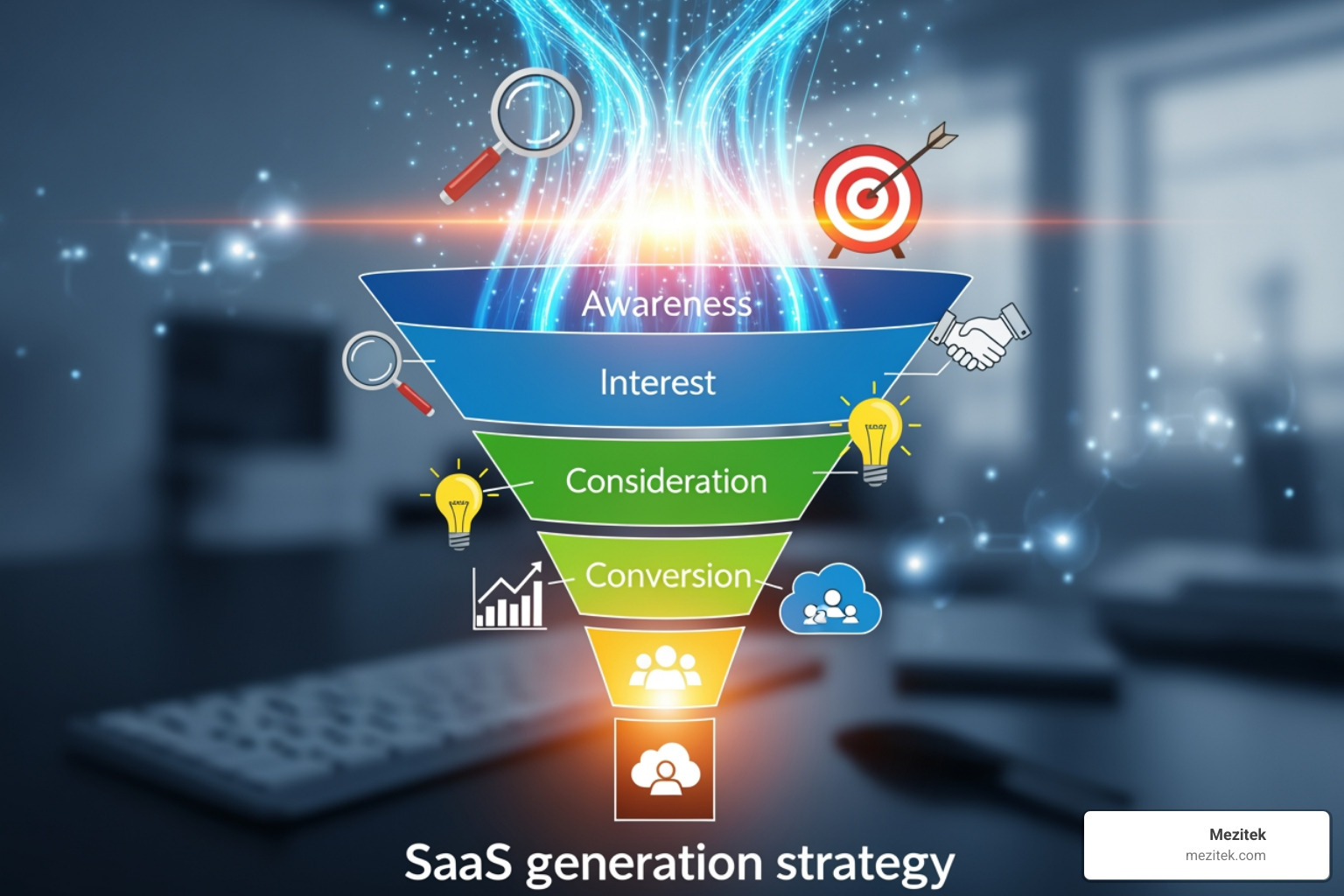
In a full-funnel strategy, demand generation acts as the wide net, building trust and interest, while lead generation is the narrower funnel, capturing and qualifying those interested individuals. They work together to ensure a continuous flow of high-quality prospects.
Inbound Strategies: Attracting High-Intent Leads
Inbound strategies are all about attracting potential customers to us by providing value. Instead of chasing leads, we create content and experiences that draw them in naturally. This approach builds trust and authority, positioning us as experts in our field.
Using Content Marketing for Your SaaS Lead Generation Strategy
Content marketing is a cornerstone of any effective SaaS lead generation strategy. It’s how we establish our expertise, educate our audience, and attract free organic traffic to our website. By consistently publishing valuable content, we position our SaaS business as a trusted authority.
- Blogging for Traffic: Creating and maintaining a blog is essential. Companies with regularly updated blogs generate 67% more leads per month on average. We should focus on topics our audience cares about, addressing their pain points and offering solutions. This helps us attract prospects actively searching for answers.
- Gated Content: For more in-depth resources, we can use gated content. This involves offering valuable assets like eBooks, whitepapers, or templates in exchange for contact information. Lead magnets pull in leads by offering something valuable (like an ebook or cheat sheet) in exchange for contact information. This is a great way to capture leads who are further along in their research.
- Webinars: Webinars are incredibly powerful for SaaS. 73% of B2B marketers confirm webinars are a top source of high-quality leads. They offer direct interaction, allowing us to demonstrate product value in real-time and establish thought leadership. Webinars should be intentionally designed to drive lead generation through promotion, landing page optimization, and follow-up.
- Case Studies: Case studies are crucial for demonstrating our product’s effectiveness through real-world examples. They showcase how other businesses have benefited from our SaaS solution, highlighting specific problems solved and results achieved. This builds confidence and provides social proof for risk-averse B2B buyers.
For those building and managing websites, understanding how content is organized and delivered is key. Learning about What is a CMS (Content Management Systems) Explained can greatly improve your content marketing efforts.
Mastering SEO for Sustainable Organic Growth
Search Engine Optimization (SEO) is indispensable for bringing free organic traffic to our SaaS website and generating valuable leads. It ensures our content is findable when our target audience is actively searching for solutions.
- Keyword Research: This is where it all begins. We need to pinpoint the terms potential customers use when looking for solutions. This includes problem-aware keywords (e.g., “how to manage customer support tickets”) and solution-aware keywords (e.g., “customer support software comparison”). Tools can help us find long-tail keywords, which often indicate higher intent.
- On-page Optimization: Once we have our keywords, we optimize our website content. This involves crafting compelling title tags and meta descriptions, using keywords naturally in headers and subheaders, producing high-quality content that thoroughly answers user queries, and incorporating internal linking to related content.
- Technical SEO: This ensures our website is crawlable and indexable by search engines. It includes aspects like site speed, mobile-friendliness, and a logical site structure. For those building websites, mastering Best Practices for Website Architecture is vital for SEO success.
SEO generates 34% of leads on average for B2B marketers. It’s a long-term play, but the benefits of consistent organic traffic are immense.
Leveraging Social Media and Online Communities
Social media isn’t just for cat videos; it’s a powerful tool for SaaS lead generation strategy, especially in the B2B space. It allows us to connect with our audience, establish thought leadership, and engage in social selling.
- LinkedIn for B2B Outreach: LinkedIn is the optimal social media platform for social selling due to its business-oriented nature. 40% of marketers say LinkedIn is the most effective for lead generation. We should use it to build personal brands, share relevant content, and provide value to potential buyers. It’s a great platform for reaching business decision-makers.
- Thought Leadership: By consistently sharing industry insights and engaging in discussions, we can position ourselves and our company as thought leaders. This builds trust and credibility, making prospects more receptive to our offerings.
- Engaging in Niche Communities: Don’t underestimate the power of online communities. Platforms like Reddit (e.g., the /r/B2BMarketing subreddit) and gated Slack or Discord communities (like Online Geniuses with over 35,000 members in digital marketing) are hives of B2B activity. Actively participating, providing helpful advice, and answering questions can generate significant visibility and leads.
Outbound & Product-Led Strategies: Proactive Growth Levers
While inbound strategies draw leads to us, outbound and product-led approaches involve proactively reaching out or letting our product do the talking. These are crucial for accelerating growth and targeting specific accounts.
Building an Outbound SaaS Lead Generation Strategy
Outbound lead generation is about taking the initiative and directly reaching out to potential customers who haven’t yet engaged with our brand. When executed thoughtfully, it can be incredibly effective.
- Cold Email Personalization: Cold email campaigns are an active approach. While it might sound old-school, a study by Backlinko found that 8.5% of cold emails receive a response. The key is personalization. We need to define our Ideal Customer Profile (ICP), gather contact details, and craft concise, personalized, and value-driven messages that address specific pain points.
- Cold Calling Strategies: Cold calling, when used strategically, can still yield results. It shouldn’t be our sole technique but can complement other efforts. We should focus cold calls on highly qualified prospects, use a well-prepared script to build rapport, and aim to book appointments rather than push for an immediate sale.
- Account-Based Marketing (ABM): ABM treats high-value accounts like they’re the only ones in the room. Instead of broadcasting messages, we focus our attention on key players within specific target accounts, personalizing our outreach to land those big fish. This hyper-targeted approach is excellent for longer sales cycles and winning over multiple decision-makers. Multichannel playbooks for SaaS outbound lead generation are an effective way to increase reach and start more sales conversations with good-fit leads.
Optimizing Paid Advertising for Immediate Impact
Paid advertising offers a way to get our message in front of our target audience quickly and at scale. It’s excellent for generating immediate leads and testing new markets.
- PPC Campaigns on Google: Pay-per-click (PPC) advertising on platforms like Google Ads is a top lead-generation strategy for B2B SaaS. 84% of brands see good results with PPC ads, and 79% agree it’s a significant factor in their growth. We should identify the search terms our audience frequently uses and create compelling ads that direct users to optimized landing pages.
- Social Media Ads: Platforms like LinkedIn, Facebook, and Twitter offer powerful targeting capabilities. LinkedIn, for example, allows us to target by job title, industry, and company size, perfect for reaching decision-makers. Facebook excels at targeting based on interests and activities.
- Retargeting Campaigns: These are crucial for nurturing leads who have already shown interest. By installing tracking pixels, we can show custom ads to website visitors who didn’t convert, keeping our brand top-of-mind and guiding them back to our offerings.
- Landing Page Optimization: No matter the platform, our landing pages must align with our ad content. They need concise headings, persuasive content, and compelling calls to action (CTAs) to motivate visitors to take the desired action. For guidance on building effective landing pages, check out our guide on How to Build a Website.
Using Product-Led Growth (PLG)
Product-Led Growth (PLG) is a powerful SaaS lead generation strategy where the product itself drives customer acquisition, conversion, and expansion. It lets our solution do the heavy lifting.
- Free Trials vs. Freemium Models: Most SaaS products today offer free trials or freemium packages. Free trials work, with an average sales conversion rate of nearly 20% for opt-in trials. They give potential customers hands-on experience, allowing them to assess value without monetary commitment. PQL conversion rates consistently outperform other lead types because these prospects have moved beyond theoretical benefits to practical application.
- In-App Messaging: We can use in-app messages to guide users through the product, highlight key features, and offer support. This helps them experience the “aha!” moment faster.
- Converting PQLs: For PQLs, the focus shifts from selling the product to demonstrating further value and making the upgrade seamless. Since they’ve already used the product, they’re much hotter leads than MQLs or even SQLs. Ahrefs, for example, seamlessly integrates product-led growth with deep content expertise, making their product a central component of their lead generation strategy.
Activating Referral & Advocacy Programs
Our happiest customers can be our best salespeople. Referral programs and customer advocacy play a significant role in a successful SaaS lead generation strategy because they leverage existing trust.
- Incentivizing Happy Customers: Referral marketing offers benefits such as reduced acquisition costs and increased conversion rates. We can nudge satisfied customers to recommend our product by offering incentives like discounts, extended features, or even cash rewards. Popular B2B reward-based referral programs include Google Workspace, HostGator, and Gusto.
- Word-of-Mouth Marketing: Referrals are a great source of organic, high-quality leads as they come from friends, colleagues, and family members. This word-of-mouth marketing can boost our lead-generation efforts and foster a sense of community. Customer referrals typically generate the highest-quality SaaS leads with significantly better conversion rates.
- Building a Community: Creating a space for our users to connect, share tips, and offer support can turn customers into advocates. This sense of community naturally leads to more referrals and brand loyalty. Happy customers are truly our best marketers!
Measuring and Optimizing for Success
A SaaS lead generation strategy is never a “set it and forget it” endeavor. To ensure continuous growth, we must constantly measure our efforts, analyze the results, and optimize our campaigns. Data-driven decisions are key to refining our approach and maximizing our return on investment.
Essential KPIs for Lead Generation
Key Performance Indicators (KPIs) help us understand what’s working and what isn’t. We need to define and monitor these metrics to gauge the health of our lead generation efforts.
- Customer Acquisition Cost (CAC): This tells us how much it costs to acquire a new customer. A lower CAC is always better.
- Lifetime Value (LTV): The total revenue we expect to generate from a customer over their entire relationship with our product. We want a high LTV relative to CAC for sustainable growth.
- Lead-to-Customer Conversion Rate: The percentage of leads that ultimately become paying customers. This is a critical indicator of lead quality and sales effectiveness.
- Channel-Specific Metrics: We also track metrics specific to each channel, such as open rates and click-through rates for emails, conversion rates for landing pages, and cost per click for paid ads.
By using data from marketing campaigns (open rates, click-through rates, conversion rates), we can inform our decisions and make necessary adjustments.
Aligning Sales and Marketing for Higher Conversion
As we mentioned earlier, alignment between sales and marketing teams is crucial for improving lead conversion rates. Misalignment can lead to missed opportunities and wasted effort.
- Shared Definitions: Sales and marketing need a common understanding of what constitutes an MQL, SQL, and PQL. This ensures everyone is on the same page regarding lead quality and readiness.
- Service Level Agreements (SLAs): Establishing SLAs between sales and marketing formalizes expectations. For example, marketing commits to delivering a certain number of MQLs, and sales commits to following up on them within a specific timeframe.
- Closed-Loop Feedback: Marketing needs feedback from sales on the quality of leads and what happens to them after handover. This allows marketing to refine its targeting and messaging.
- Unified Reporting: Building unified dashboards that display the entire funnel helps both teams track progress, identify bottlenecks, and work collaboratively towards shared revenue goals.
Frequently Asked Questions about SaaS Lead Generation
What are the best lead generation channels for a SaaS startup?
For a SaaS startup, the focus should be on capital-efficient channels that can generate initial traction and prove product-market fit without breaking the bank. Our research suggests:
- Content and SEO: Building a strong content foundation and optimizing for SEO provides long-term, organic growth. It’s a slower burn but incredibly cost-effective over time.
- Targeted Cold Outreach: This includes cold email campaigns and LinkedIn outreach. These methods allow us to directly target our Ideal Customer Profile and initiate conversations.
- Community Engagement: Participating in relevant online communities (Reddit, Slack groups, industry forums) allows us to establish thought leadership and connect with potential customers where they already congregate.
- Referral Marketing: Leveraging early adopters and happy customers for referrals can bring in high-quality leads with minimal acquisition costs.
While there are dozens of options, focusing on a few proven, capital-efficient strategies will yield the best results for a startup.
What are common mistakes to avoid in SaaS lead generation?
We’ve seen many businesses stumble, so learning from common pitfalls is a smart move:
- Prioritizing Volume Over Quality: This is perhaps the biggest mistake. The goal of lead generation isn’t just to get a large number of leads, but to attract the right leads—those who are a good fit for our product and are likely to convert. Quality consistently outperforms quantity.
- Poor Sales and Marketing Alignment: As discussed, misalignment between teams can result in marketing generating prospects that do not meet sales expectations, leading to wasted effort and missed sales opportunities.
- Ignoring Lead Nurturing: Generating a lead is just the first step. Effective lead nurturing strategies, such as personalized email campaigns and timely follow-ups, are crucial. Studies suggest lead conversion rates can reach as high as 50% when leads are properly managed and nurtured.
- Weak Attribution and Tracking: If we don’t know which channels and campaigns are generating the best leads, we can’t optimize our strategy. Robust tracking and attribution are essential to understand our ROI.
How do you measure the quality of a lead?
Measuring lead quality is paramount to an effective SaaS lead generation strategy. We use several indicators:
- Lead Scoring Models: This is a systematic approach where we assign points to leads based on their demographics (fit) and their behavior (intent). For example, a lead from a target industry might get 5 points, while downloading a whitepaper gets 10 points. Higher scores indicate higher quality.
- Fit vs. Intent: A high-quality lead usually has both a strong “fit” (they match our ICP) and high “intent” (they show active interest in solving a problem our product addresses).
- Conversion Rate to SQL: How many MQLs become SQLs? This conversion rate is a strong indicator of the initial quality of our marketing-generated leads.
- Ultimate Conversion to Paying Customer: The best measure of lead quality is whether they become a paying customer and, ideally, a long-term, high-value one. PQL conversion rates consistently outperform other lead types because these prospects have moved beyond theoretical benefits to practical application, making them a strong measure of intent.
Conclusion
Mastering your SaaS lead generation strategy is a continuous journey of learning, adapting, and optimizing. By combining robust inbound tactics (content, SEO, social media) with proactive outbound efforts (cold email, ABM, paid ads) and leveraging product-led growth, we create a powerful, hybrid approach. The competitive SaaS landscape demands that we prioritize lead quality over quantity, ensure seamless alignment between sales and marketing, and relentlessly measure and optimize our campaigns.
Regardless of where your SaaS business stands, there are always fresh, untapped opportunities to boost lead generation. As a freelancer or small business owner, applying these strategies to the websites you build with Mezitek can drive significant client growth, offering them tangible results that set you apart. By taking advantage of these insights, you’ll be well on your way to generating more qualified leads and achieving sustainable growth for your SaaS venture.
Ready to dive deeper into web design and lead generation? Explore our Web Design resources for more guides.