Why Your Website’s Growth Shouldn’t Be Its Downfall
A scalable website platform is one that maintains performance and reliability as traffic, content, and user demands increase. It adapts to growth without crashing, slowing down, or requiring expensive emergency fixes.
Key characteristics of a scalable website platform:
- Handles traffic spikes – Your site stays online during sudden surges in visitors
- Maintains speed – Page load times remain fast as your business grows
- Flexible infrastructure – Resources can be added or reduced based on demand
- Built for growth – Architecture supports expansion without major rebuilds
- Cost-effective scaling – You pay for what you use, when you use it
As your freelance business or agency grows, your website faces a critical challenge: can it keep up?
The numbers tell a harsh story. If a website takes more than three seconds to load, 53% of people will give up and try another site. Nearly 70% of online shoppers abandon slow websites entirely. Even a delay of just one-tenth of a second can cut your sales by seven percent. You can see more data on this in independent research on website load time and user behavior.
But here’s the thing most people miss: a slow website isn’t usually a design problem or a content problem. It’s a scalability problem.
When your site suddenly gets featured in a popular blog, when you launch a successful campaign, or when seasonal demand hits—these are the moments that reveal whether you built for growth or just built for launch. Your website shouldn’t punish you for success.
The good news? You don’t need a massive budget or a team of engineers to build a scalable platform. Modern tools have made scalability accessible to freelancers and small agencies. You just need to understand the fundamentals and make smart choices from the start.
This guide walks you through everything you need to know about building a website that grows with your business—without the technical jargon or enterprise-level complexity.
Scalable website platform further reading:
The Foundations of a Scalable Website Platform

Building a scalable website platform is much like constructing a sturdy building: you need a solid foundation and a flexible framework that can accommodate future additions without crumbling. It’s about making smart choices from the ground up, ensuring your digital home can expand and adapt as your business thrives. These foundational decisions, from infrastructure choices to architectural patterns, are what determine your website’s capacity for growth.
When we talk about infrastructure, we’re largely discussing the servers and networks that power your site. Cloud services have revolutionized this aspect, offering unprecedented flexibility. Coupled with thoughtful architectural patterns, these choices lay the groundwork for a truly robust and scalable online presence. To dive deeper into foundational concepts, explore our guide on Best Practices for Website Architecture. The hosting impact is paramount—it’s where the rubber meets the road for your website’s ability to handle demand.
Vertical vs. Horizontal Scaling: Scaling Up vs. Scaling Out
When it comes to making your website bigger and better, we primarily have two strategies: vertical scaling and horizontal scaling. Think of it like this:
-
Vertical Scaling (Scaling Up): Imagine your website is a single, hard-working chef in a kitchen. If they’re getting overwhelmed, vertical scaling means giving that chef better tools, a bigger workspace, or even a super-fast new oven. In technical terms, this means enhancing the capabilities of a single server. We might upgrade its CPU, add more RAM, or get faster storage. It’s about making one machine more powerful. A great example is upgrading your personal computer with a higher-end processor or adding more memory to handle resource-intensive tasks.
-
Horizontal Scaling (Scaling Out): Now, instead of one super-chef, imagine you bring in more chefs, each with their own station, all working together to serve the customers. This is horizontal scaling. It involves adding more servers or resources that run in tandem, distributing the load amongst them. Instead of making one machine immensely powerful, we add more machines to a pool of resources, spreading the workload.

Both have their place. Vertical scaling is often simpler initially but hits a ceiling—there’s only so much power you can pack into one server. Horizontal scaling offers virtually limitless growth potential, but it requires more complex management to ensure the workload is distributed efficiently. The ideal solution often combines both, building a robust infrastructure that can adapt to varying loads.
Architecture Deep-Dive: Monolithic vs. Microservices
The architecture of your website is its underlying blueprint, and the choice here significantly impacts how easily your platform can grow. The two main players are monolithic and microservices architectures.
-
Monolithic Architecture: Think of a monolithic application like a Swiss Army knife. All its functionalities—the blade, the screwdriver, the can opener—are bundled into a single, indivisible unit. It’s straightforward to build and deploy for smaller projects, making it a popular choice for many starting websites. However, as your website grows, this single unit becomes harder to manage. A small change in one part can affect the entire system, and scaling means scaling the entire application, even if only one component is experiencing high demand.
-
Microservices Architecture: In contrast, microservices are like a collection of small, independent tools in a well-organized toolbox. Each tool (or service) performs a specific function, like handling user authentication, processing orders, or managing product catalogs. These services communicate with each other but can be developed, deployed, and scaled independently. This approach makes your scalable website platform incredibly flexible. If your product catalog sees a surge in traffic, you can scale just that service without affecting the rest of your site. While more complex to set up initially, microservices offer superior scalability and development flexibility for larger, evolving projects.
For many small businesses and freelancers, a hybrid approach might be the most practical. We might start with a monolithic core for simplicity and gradually introduce microservices for specific, high-demand functionalities as the business grows. If you’re considering a custom build, our Custom Web Development Firm can help steer these choices.
The Role of Cloud Hosting and Infrastructure
When we talk about a truly scalable website platform, cloud hosting and its underlying infrastructure are game-changers. Gone are the days of being tied to a single physical server that you outgrow faster than a pair of shoes.
Cloud services provide incredible flexibility because resources like CPU, RAM, and storage can be allocated on-demand. This means your website can automatically scale up during peak traffic and scale down during quieter periods, optimizing performance and cost. This dynamic allocation helps us avoid the dreaded “throttling,” where a simple hosting plan might slow down or set strict limits on your website during a sudden increase in visitors to protect their systems. Imagine your site being choked just when it’s most popular! Cloud hosting helps avert this by providing the capacity you need, when you need it.
We always prioritize providers that offer high uptime reliability, often promising 99.9% uptime. This ensures your website remains accessible to users, which is crucial for maintaining trust and avoiding lost opportunities. For a deeper dive into choosing the right infrastructure, check out How to Choose a Host for Your Website. And if you’re weighing your options, our Top Web Hosting Providers Compared offers valuable insights.
Building for Performance: Key Optimization Strategies
Once the foundation is laid, the next step in creating a scalable website platform is to build with performance in mind. Scalability isn’t just about having the capacity; it’s about making sure that capacity is used efficiently. This involves a suite of optimization techniques aimed at maximizing website speed and enhancing the user experience. From streamlining your code to managing your database effectively and implementing smart caching mechanisms, every little bit helps. We’re always looking for Innovative Web Solutions to keep your site running at peak performance.
The Critical Role of Caching and Content Delivery Networks (CDNs)
Imagine your website has “muscle memory.” That’s essentially what caching does.
-
Website Caching: Caching is the process of storing copies of frequently accessed data in a temporary storage location, so future requests for that data can be served faster. Instead of your server having to fetch or generate the same information repeatedly, it can quickly pull it from the cache. This significantly improves website performance and scalability. We use various types of caching:
- Browser Caching: Your browser stores parts of a website (like images or CSS files) locally, so when you revisit, it loads much faster.
- Server-side Caching: This happens on the server itself, storing generated pages or database query results. Technologies like Redis or Memcached can be used for this, ensuring that dynamic content is delivered swiftly.
-
Content Delivery Networks (CDNs): Now, think globally. If your users are spread across the world, it doesn’t make sense for everyone to fetch content from a single server located in, say, North America. A CDN solves this. It’s a geographically distributed network of proxy servers and their data centers. When a user requests content, the CDN delivers it from the server closest to them. This drastically reduces latency, improves loading times, and takes a huge load off your main server. For any scalable website platform with a global audience, a CDN is non-negotiable. It ensures a fast, consistent experience for all users, regardless of their location.
Mastering Load Balancing and Database Management
Even with caching and CDNs, a single point of failure or bottleneck can bring a growing website to its knees. That’s where load balancing and meticulous database management come into play.
-
Load Balancing: Picture a busy intersection with a traffic cop efficiently directing cars. A load balancer acts as that traffic cop for your website. It distributes incoming network traffic across multiple servers. This prevents any single server from becoming overwhelmed, ensuring smooth operation and high availability. If one server goes down, the load balancer intelligently redirects traffic to the healthy ones, maintaining business continuity. This is a crucial component for any truly scalable website platform.
-
Database Scalability: Your database is the heart of your website, storing all your precious data—user profiles, product information, content, etc. As your website grows, the amount of data and the number of requests to the database explode. An inefficient database can quickly become the biggest bottleneck.
- Efficient Data Retrieval: We focus on optimizing database queries, ensuring they run quickly even with vast amounts of data.
- Distributed Database Services: For extreme scale, data can be spread across multiple servers or locations. This allows for horizontal scaling of your database, handling more read and write operations.
- Read Replicas: Often, websites have many more “read” operations (fetching data) than “write” operations (saving data). Read replicas are copies of your main database that can handle these read requests, offloading the primary database and improving overall performance.
How to Choose a Modern and Scalable Website Platform
Choosing the right platform is perhaps the most critical decision for building a truly scalable website platform. It’s about selecting tools that empower you to grow without constant headaches. Here are the key technical features we look for and recommend:
- Serverless Functions: These allow you to run backend code without managing servers. You write the code, and the platform handles all the infrastructure, scaling automatically with demand. This is incredibly efficient for specific tasks like form submissions or API calls.
- Git Integration: Seamless integration with version control systems like Git (GitHub, GitLab, Bitbucket) is essential. It enables automated build and deployment processes, so a simple
git pushcan trigger updates to your live site. - Automated Deployments: Your platform should handle the entire deployment process automatically, taking your code from development to production quickly and reliably.
- One-click Rollbacks: Mistakes happen. The ability to revert to a previous working deploy with a single click is a lifesaver, ensuring rapid recovery from any issues.
- Staging Environments: These are separate, non-production environments that mirror your live site. They allow you to test new features or updates thoroughly before pushing them live, minimizing risks.
- Managed Updates: For platforms like WordPress or Drupal, automated updates for the core system, patches, and plugins can save immense time and reduce security vulnerabilities. For content-driven sites, understanding What is a CMS? Content Management Systems Explained is key to choosing a managed solution.
- Integrating Third-Party Services: A truly scalable platform understands its limits and accepts external specialized services. By integrating third-party tools for specific functionalities—like payment gateways, email marketing, or scheduling—we offload heavy lifting from our core application. This frees up our resources and allows us to focus on our unique value proposition. For instance, letting clients book appointments directly through an integrated scheduling tool saves us from building a complex booking system from scratch.
The Business Case for Scalability: ROI and Future-Proofing
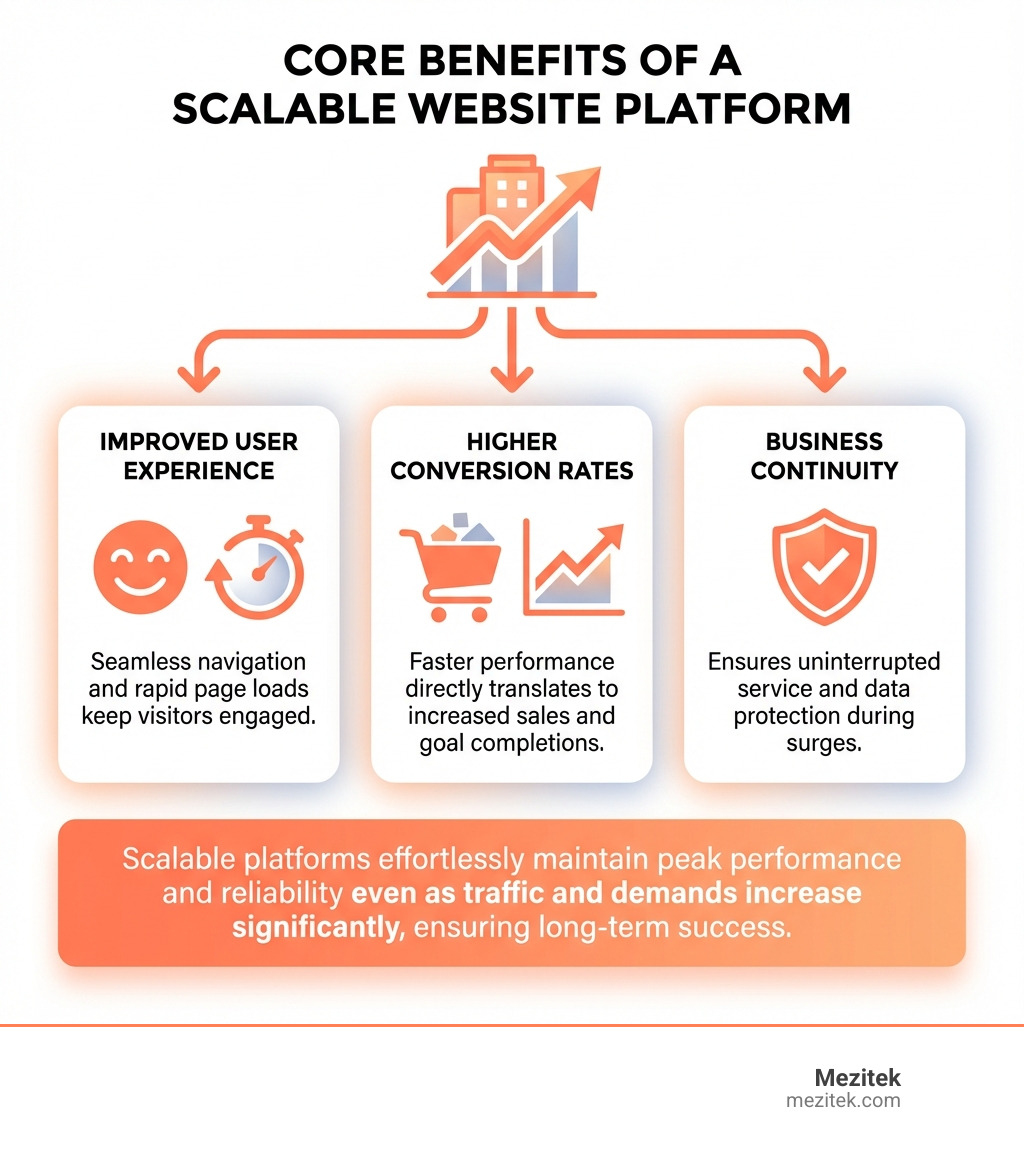
Investing in a scalable website platform isn’t just a technical decision; it’s a strategic business imperative. It’s about ensuring your online presence is an asset that drives growth, not a liability that hinders it. The return on investment (ROI) from a scalable platform is evident in improved customer retention, the ability to steer market fluctuations with ease, and ultimately, ensuring business continuity and a competitive edge.
How a Scalable Website Platform Improves User Experience and Retention
We’ve all been there: clicking on a link, waiting… and waiting… only to hit the back button in frustration. This isn’t just annoying; it’s detrimental to your business.
- Impact of Site Speed on Sales: The statistics are stark. If your website takes more than three seconds to load, over half your potential visitors will simply give up. Even more damning, nearly 70% of online shoppers abandon slow sites. This isn’t just about losing a single sale; it’s about damaging your brand’s reputation.
- User Frustration and Abandonment: A slow website translates directly into a poor user experience. Users equate speed with professionalism and reliability. If your site is sluggish, they’ll assume your service or product might be too.
- Customer Loyalty and Brand Reputation: Conversely, a fast, responsive, and consistently available website builds trust and fosters customer loyalty. A seamless user journey, free from frustrating delays or crashes, encourages repeat visits, longer engagement, and positive word-of-mouth. A scalable website platform ensures that as your user base grows, the quality of their experience doesn’t diminish, which is paramount for retention.
Achieving Long-Term Cost Efficiencies and Flexibility
While building a scalable website platform might seem like a significant upfront investment, it’s a proactive step that yields considerable long-term cost efficiencies and best flexibility.
- Investment vs. Cost: Think of it as investing in robust infrastructure rather than incurring recurring costs for emergency fixes. A non-scalable site will inevitably crash or slow down under pressure, leading to expensive, reactive troubleshooting, missed opportunities, and potential revenue loss due to downtime. Every minute your site is down can cost your business money.
- Preventing Downtime Costs: By building a scalable platform, we proactively prevent these costly outages. We avoid the panic, the rushed fixes, and the loss of customer trust that comes with an unreliable website.
- Adapting to Market Changes: Scalability provides unparalleled flexibility. Your business doesn’t operate in a vacuum; market trends shift, new opportunities arise, and seasonal demands fluctuate. A scalable platform allows you to rapidly adapt. Need to handle a massive influx of traffic during a holiday sale or a viral marketing campaign? Your platform can automatically scale up. Is there a quieter period? It can scale down, saving you resources.
- Business Continuity: This flexibility is crucial for business continuity. It ensures that your digital doors remain open and fully functional, regardless of external pressures or internal growth spurts. This resilience is a powerful competitive advantage.
Planning Your Hosting Scalability Strategy
Building a scalable website platform isn’t a “set it and forget it” task; it requires thoughtful planning, especially concerning your hosting. To ensure your website can handle future growth, we need a clear strategy.
- Traffic Projection: The first step is to anticipate. We use methods to project future traffic based on business growth goals, marketing campaigns, and seasonal trends. Understanding your user base—who they are and how they interact with your site—is critical for shaping design, functionality, and, crucially, scalability requirements.
- Resource Utilization Baseline: We establish a baseline of your current website’s resource usage (CPU, RAM, bandwidth). This helps us understand what your site needs under normal conditions and provides a benchmark for future growth.
- Growth Timeline: Aligning your scalability plan with your business’s growth timeline is essential. Are you launching a new product next quarter? Expecting a surge during the holidays? Your hosting needs to be ready.
- Budget Allocation: View scalable hosting as a key business investment. Allocate a realistic budget that reflects its importance for sustained growth and reliability.
- Implementation Roadmap: This includes planning for any necessary migrations (e.g., from shared hosting to cloud hosting). We outline pre-migration preparation, thorough testing protocols, data migration best practices, DNS management strategies, and post-migration verification to ensure a smooth transition. For assistance with tailoring your online presence for growth, consider our Custom Designed Business Websites.
Frequently Asked Questions about Website Scalability
How do I know if my current website is scalable?
It’s like asking if your car can handle a cross-country trip. Here are some tell-tale signs and checks:
- Performance During Traffic Spikes: The easiest way to tell is by observing your site during peak traffic. Does it slow down significantly? Do users report errors or timeouts? If so, it’s struggling. A scalable website platform should handle these surges gracefully.
- Hosting Plan Limitations: Review your current hosting plan’s specifications. Are there strict limits on CPU, RAM, or bandwidth? Many basic plans are designed for consistency, not for dramatic growth.
- Website Architecture: If your site is built on an older, monolithic architecture with tightly coupled components, it might be inherently less scalable than one built with modern, modular approaches.
- Slow Under Normal Load: If your site is already sluggish under typical traffic, that’s a major red flag. It indicates underlying inefficiencies that will only worsen with growth.
Can a small business afford a scalable website platform?
Absolutely! The landscape of web hosting has changed dramatically, making scalability accessible to businesses of all sizes, even freelancers and small agencies like ours.
- Modern Cloud Hosting and Serverless Platforms: These often operate on a “pay-as-you-go” model. You only pay for the resources you actually consume, which is incredibly efficient. You can start small and easily scale up as your needs grow, without massive upfront investments.
- Investing Early Saves Money: While there might be a perception that scalable solutions are more expensive, they often lead to long-term cost savings. Proactively building a scalable site prevents costly emergency fixes, lost revenue from downtime, and the need for expensive, complete rebuilds down the line.
- Flexible Plans: Many providers offer flexible plans that allow you to start with a modest setup and seamlessly upgrade resources as your traffic and data increase. Don’t be afraid to explore options, a slightly higher monthly hosting fee can save you thousands in lost business or emergency repairs. Check out our Best Budget Hosting Providers for options that balance cost and growth potential.
What is the difference between scalability and performance?
These two terms are often used interchangeably, but they represent distinct concepts, though they are closely related.
- Performance refers to how fast and responsive your website is right now, under its current load. It’s about how quickly pages load, how smoothly animations run, and how fast your server processes requests when you have, say, 100 visitors.
- Scalability is your website’s ability to maintain that high level of performance and functionality as traffic, data, and user demands grow. It’s about whether your site can still load quickly and function perfectly when you suddenly jump from 100 visitors to 10,000 visitors, or when your product catalog quadruples in size.
So, a website can be high-performing but not scalable (it’s fast for a few users but crashes under many). Conversely, a truly scalable website platform is designed to deliver high performance even under significant and increasing load. Scalability is the design principle that allows performance to endure over time and growth.
Conclusion: Build a Website That Grows With You
In today’s digital world, building a scalable website platform is no longer a luxury for large enterprises; it’s a fundamental necessity for any business aiming for sustained growth. Your website is your most valuable digital asset, and it should be built to withstand the pressures of success, not buckle under them.
By understanding the principles of vertical and horizontal scaling, making informed architectural choices, leveraging the power of cloud hosting, and implementing smart optimization strategies like caching and load balancing, we can future-proof your online presence. This proactive approach not only ensures a superior user experience and boosts customer retention but also drives long-term cost efficiencies and provides the flexibility needed to steer market fluctuations.
At Mezitek, we empower freelancers and small businesses to build for tomorrow. We believe your website should be a strategic business asset that evolves with you, not against you. For a modern, scalable alternative to traditional systems, explore our guide on the Best WordPress Alternatives. Let’s build a website that doesn’t just launch, but truly grows with you.