Why Web Development Trends Matter in 2025
Web development trends are reshaping how we build, manage, and experience websites at an unprecedented pace. If you’re a freelancer or small agency owner, understanding these shifts isn’t just helpful—it’s essential for staying competitive and delivering what clients actually need.
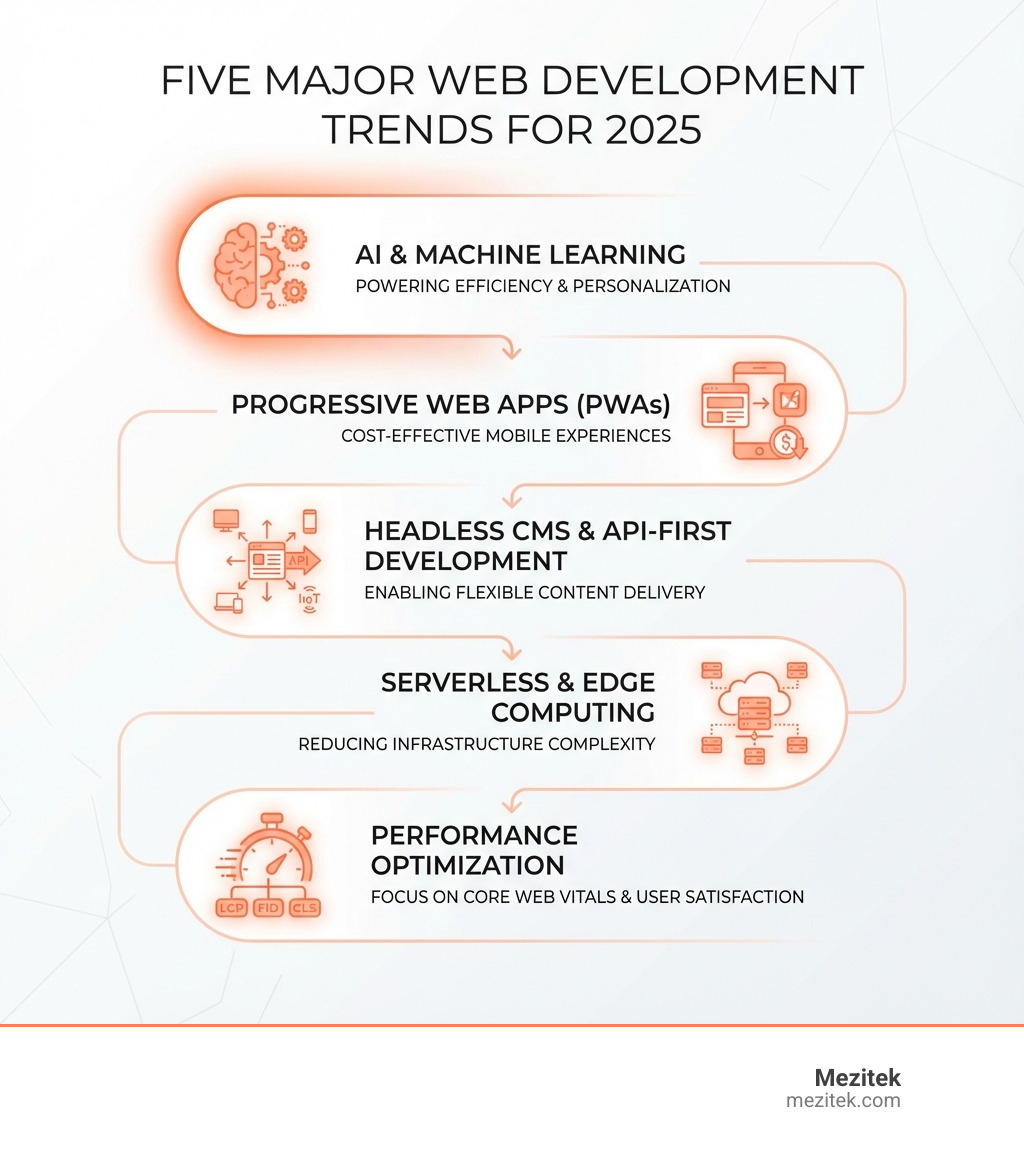
The top web development trends for 2025 include:
- AI and Machine Learning Integration – 82% of developers now use AI to write code, with tools automating debugging and personalizing user experiences
- Progressive Web Apps (PWAs) – Offering app-like experiences at 3-8x lower cost than native apps, with the market reaching $10.44 billion by 2027
- Headless CMS and API-First Development – Separating content from presentation for flexibility across multiple platforms
- Serverless and Edge Computing – Reducing infrastructure costs by 30% while improving performance
- Performance Optimization – Core Web Vitals becoming critical for SEO, with sites meeting benchmarks seeing 24% lower abandonment rates
The landscape has changed dramatically. As one industry report notes, “the web development world is ready for exciting advances in 2025, driven by a blend of innovative technology and evolving user preferences.” This isn’t about chasing every shiny new tool—it’s about understanding which technologies solve real problems for your clients.
AI isn’t replacing developers; it’s making them more efficient. Development tools now write code, suggest fixes, and optimize performance automatically. Meanwhile, architectures like headless CMS and serverless computing are making it easier to build fast, scalable websites without managing complex infrastructure.
For freelancers and small agencies, these trends present both challenges and opportunities. Low-code platforms are democratizing development, while AI tools are leveling the playing field. The key is knowing which trends to accept and how to apply them practically.
The future favors those who can balance new technology with fundamental web principles: fast loading times, mobile-first design, solid security, and genuinely helpful user experiences. You don’t need to master every trend—just the ones that help you build better websites faster.
The AI Revolution in Web Development
The integration of Artificial Intelligence (AI) and Machine Learning (ML) into web development is perhaps the most significant web development trend shaping our industry today. It’s not just a buzzword; it’s a transformative force that’s enhancing workflows, optimizing user experiences, and fundamentally reshaping how we build, maintain, and scale websites.
A 2024 study highlights just how deeply AI has permeated our daily tasks: 82% of web developers were already using AI to write code, 67.5% were using the technology to search for answers, and 56.7% were using AI to debug and get help with their code. This isn’t about replacing us; it’s about giving us superpowers! Generative AI, for instance, excels at creating written and visual content in response to prompts, saving us time and improving code quality—a win-win for our businesses and clients.
AI’s influence stretches across the entire development lifecycle. For performance monitoring, AIOps solutions from providers like New Relic and Dynatrace proactively monitor site performance, detect anomalies, and even recommend optimizations to prevent downtime and improve reliability. This means fewer late-night calls about a site being down!
Beyond the backend, AI is revolutionizing user experiences. Platforms like WordLift analyze user behavior to deliver custom content, boosting engagement and conversions. Imagine a website that intuitively knows what each visitor wants to see next. That’s the power of AI-driven personalization. While some developers in 2025 still expressed reservations about AI tool accuracy (around 46% of them), we believe that using AI as a powerful assistant, rather than a replacement for critical thinking, is the key to using its full potential.

The Impact of AI on Efficiency and Revenue
AI coding assistants like GitHub Copilot and Tabnine are already widely used to automate repetitive coding tasks. This frees us up to focus on more complex challenges and creative problem-solving. Think of it: less time spent on boilerplate code, more time innovating. This kind of efficiency flows straight to the bottom line. Global giants like Amazon, for example, have invested heavily in AI, with analysts predicting it will help drive a 9% to 10% higher profit margin for the company between now and 2034.
The benefits extend beyond just coding. AI tools can resolve up to 80% of customer inquiries through chatbots and voice assistants, significantly reducing operational costs for businesses. The chatbot and conversational commerce market is projected to exceed $30 billion by 2027, showcasing the immense value these AI-powered tools bring to customer support and sales. Furthermore, AI-driven design has achieved 30% higher conversion rates, and fast-growing organizations generate 40% more revenue from personalization than their slower competitors. These statistics aren’t just numbers; they represent tangible business growth opportunities for our clients.
AI’s Role in Content Management and SEO
For those of us working with content-rich platforms like WordPress, AI is becoming an indispensable ally. Tools like Jetpack AI Assistant integrate directly into the block editor, helping us draft posts, rewrite sections, or brainstorm ideas without switching tools. This is a game-changer for content creators and webmasters.
But it’s not just about content generation. AI is also reshaping how websites handle search and user engagement. Tools like Rank Math AI provide real-time SEO suggestions based on live keyword data, helping our clients stay ahead in search rankings. Developers are even using AI integrations like CodeWP or OpenAI to scaffold plugin logic, write custom functions, and generate inline documentation, speeding up custom feature development.
On the user-facing side, advanced search solutions such as WP Engine’s Smart Search AI leverage natural language processing (NLP) to provide intuitive, highly relevant search results. This means visitors can find what they’re looking for faster, leading to a much smoother user experience. AI-powered chatbots further guide visitors and improve conversions, acting as 24/7 customer support agents.
Architectures and Frameworks Defining the Future
The way we structure and build websites is evolving, moving towards more flexible, scalable, and interconnected systems. This shift is driven by a desire for faster content delivery, easier integrations, and robust performance.
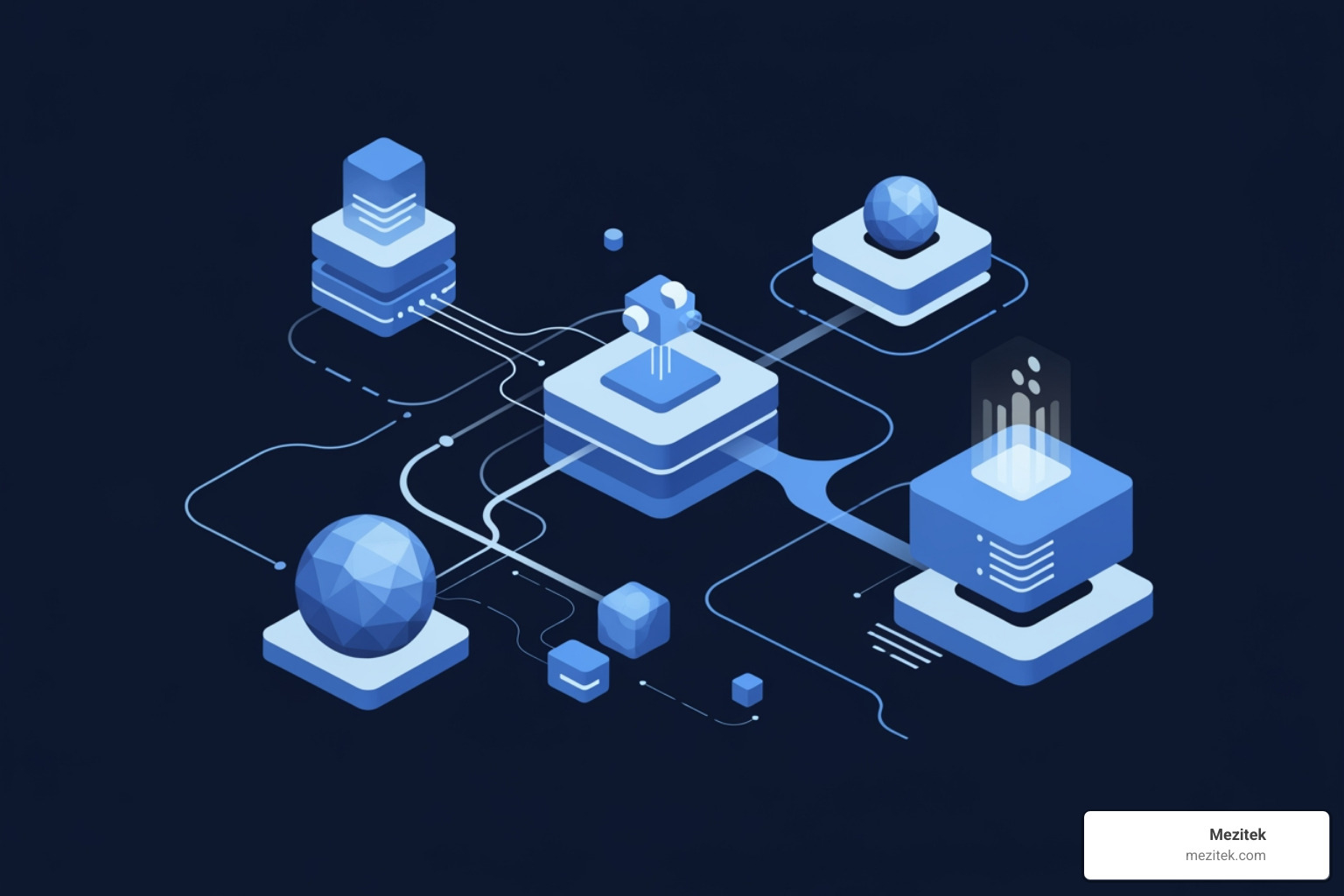
At the heart of this evolution is the rise of API-first development, headless CMS, headless commerce, serverless computing, and edge computing. These architectural web development trends represent a move away from monolithic, tightly coupled systems towards a more modular, composable approach.
API-first development means we design and build our APIs before anything else. This ensures smoother integrations between different software applications and services, creating a solid foundation for any project. When we combine this with a headless CMS, we’re separating the content management system (where content is stored) from the presentation layer (how it’s displayed). This allows us to use any frontend technology our clients prefer, delivering content faster and to any device. The headless commerce market, for instance, is projected to grow at a 22.9% compound annual growth rate between 2023 and 2031.
Serverless computing is another game-changer, enabling us to deploy code without managing servers directly. Cloud providers handle all the infrastructure, allowing applications to scale automatically based on demand. This reduces infrastructure costs and simplifies deployments. The serverless architecture market is experiencing rapid growth, with an estimated CAGR of 25.1% from 2024 through 2033. This means we can deliver highly scalable solutions more efficiently.
Finally, edge computing brings data processing closer to the user, reducing latency and improving performance. By processing data at the “edge” of the network, rather than a centralized data center, we can deliver lightning-fast experiences. Edge computing and serverless architectures have truly moved from buzzwords to standard practice, allowing us to reduce round-trip times from hundreds of milliseconds to mere tens of milliseconds.
The Evolving Frontend and Backend Landscape
The programming languages and frameworks we use are constantly adapting to these new architectural demands. JavaScript remains the undisputed backbone of web development, powering modern front-end frameworks like React and enabling scalable server-side solutions with Node.js. It’s the versatile workhorse of the web.
However, the ecosystem is expanding. TypeScript has solidified its position as the de facto standard for professional JavaScript development, with over 80% of frontend job postings requiring TypeScript expertise. Its type safety helps us catch errors early and build more robust applications.
On the backend and for specialized tasks, other languages are gaining momentum. Python continues to lead in AI, data science, and machine learning, making it indispensable for data-intensive projects. Languages like Rust, known for its focus on memory safety and concurrency, are becoming a go-to for systems programming and performance-critical applications. Go’s simplicity and efficiency make it a favorite for cloud-native development, powering tools like Docker and Kubernetes.
When it comes to frontend frameworks, React continues to dominate the landscape. However, we’re seeing strong adoption and love for alternatives:
| Feature/Framework | React (2026) | Svelte (5+) | Vue (3.5+) |
|---|---|---|---|
| Philosophy | Compiler-driven, Server-first | Compile-time, No runtime overhead | Approachable, Progressive adoption |
| Performance | Zero runtime overhead, Edge-aware | Smaller bundles, Near-native speed | Reduced memory usage (50% for reactive objects) |
| Developer Exp. | React Compiler, Server Components | Highly loved (90% satisfaction) | Intuitive, Powerful composables |
| Key Shifts | Server Components, Suspense | Reactive primitives, Runes | Reactivity system refactoring |
WebAssembly (Wasm) is another powerful web development trend, maturing from a promising technology to a fundamental building block. It enables near-native performance directly in browsers, executing at speeds 10–20 times faster than equivalent JavaScript for computation-heavy tasks. This opens up possibilities for complex browser-based applications like video editing or gaming. Finally, utility-first CSS frameworks like Tailwind CSS are changing the design and development process by providing low-level utility classes directly in our HTML, allowing for rapid and consistent UI development.
Modern WordPress Development Trends
For many of us, WordPress remains a cornerstone of our work. The platform itself is evolving rapidly, embracing many of these broader web development trends.
Block-first development has matured significantly. Most modern WordPress themes are now built as block themes, fully supporting the Full Site Editor (FSE). This allows us to design and manage entire websites using blocks, offering unprecedented control and flexibility. We’re increasingly relying on theme.json and block.json for design control, and custom blocks built with tools like ACF Blocks or even React and InnerBlocks are becoming standard for dynamic layouts.
Headless WordPress adoption is accelerating. By leveraging the WordPress REST API or WPGraphQL, we can use WordPress purely as a content management system while powering the frontend with modern frameworks like React, Vue, or Next.js. This gives us the best of both worlds: WordPress’s robust content management capabilities combined with cutting-edge frontend performance. Platforms like the WP Engine Headless Platform are making this easier than ever.
Beyond traditional websites, WordPress Multisite is seeing significant growth as a base for SaaS products, client portals, and educational platforms. This allows us to offer scalable, multi-tenant solutions to our clients, all managed from a single WordPress installation.
Enhancing User Experience: Key Web Development Trends for Engagement
In today’s crowded digital landscape, user experience (UX) isn’t just a nice-to-have; it’s a critical differentiator. Users expect fast, seamless, and intuitive interactions. Our focus, therefore, must be on user-centric design, performance optimization, and creating genuinely engaging experiences.
Mobile-first design is no longer optional—it’s an absolute imperative. Mobile devices generated 62.54% of website traffic in Q4 2024, and data from Adobe shows that mobile devices drove 51% of online sales in 2023, projected to rise to 53% in 2024. This means the majority of our clients’ customers are interacting with their websites on a phone. If the mobile experience isn’t stellar, we’re losing out. More than 60% of users never return to sites with poor responsiveness, and around 90% of visitors leave after a substandard user experience. We need to prioritize mobile from the very beginning of any project.
Performance and Mobile-First Imperatives
Progressive Web Apps (PWAs) are a prime example of how we’re meeting mobile-first demands. PWAs combine the best of both worlds: the accessibility of websites with the app-like functionality, speed, and reliability of native mobile applications. They load most content in less than two seconds and offer offline capabilities. The PWA market was estimated at $1.46 billion in 2023 and is anticipated to expand with a 31.1% compound annual growth rate through 2030. Companies like Twitter Lite saw a 65% increase in pages per session after implementing a PWA.
Core Web Vitals (CWV) have become essential benchmarks for website success and SEO. These metrics—Largest Contentful Paint (LCP) for loading speed, Interaction to Next Paint (INP) for interactivity, and Cumulative Layout Shift (CLS) for visual stability—directly impact how users perceive a site and how search engines rank it. Meeting these targets is crucial for keeping users engaged and improving search visibility. It’s no longer enough for a site to look great; it has to move fast, too.
Creating Seamless and Interactive Experiences
Single-Page Applications (SPAs) are another key web development trend for creating seamless user experiences. Think of Gmail or Google Maps: content updates dynamically without full page reloads, providing a fluid, app-like feel. Leveraging SPAs is essential to meet public expectations that you shouldn’t have to click through many pages of a website to find the information you need.
Voice search optimization is rapidly changing how users interact with the web. With 75% of US households expected to have some form of voice-activated smart speaker by the end of 2025, and over 50% of internet searches shifting toward voice-based interactions, optimizing our clients’ websites for natural language queries is vital for findability.
To combat cart abandonment (which stands at nearly 70% for online carts), one-click checkout solutions are becoming indispensable. These minimize friction, allowing customers to complete purchases quickly. Shopify’s Shop Pay, for example, boosts conversions by 50% compared to a guest checkout system.
Finally, Augmented Reality (AR) is changing online shopping. AR-powered websites allow customers to visualize products in their real-world environments, which is incredibly beneficial for industries like furniture or fashion. AR enthusiasts typically have a high annual household income, making this a particularly valuable segment to target. The Internet of Things (IoT) also opens up new possibilities for web-powered interactive experiences, connecting physical devices to web applications for richer, more integrated user journeys.
The Growing Importance of Security, Democratization, and Sustainability
As we push the boundaries of what’s possible with web technology, we also face increased responsibilities. Security threats are more sophisticated than ever, data privacy is a global concern, and there’s a growing imperative to build a more sustainable digital world. Alongside this, new tools are democratizing web development, empowering more people to create.
Integrating Security and Privacy by Design
DevSecOps is no longer just a concept; it’s becoming a cybersecurity mainstay. This approach embeds security practices directly into every stage of the development lifecycle, from planning to deployment. It means security isn’t an afterthought but an integral part of our process. Automated tools for vulnerability scanning, static code analysis, and dependency management are critical components, allowing us to identify and address issues early. Solutions like Snyk and Checkmarx help us scan open-source libraries and application code for potential risks.
Data privacy is a global priority, and heightened regulatory scrutiny is expanding to more sectors in 2025. Regulations like the EU’s General Data Protection Regulation (GDPR) have already reshaped how organizations handle user data. For us, this means building websites and applications with privacy by design: implementing features like cookie consent management, opt-in/opt-out mechanisms, and robust data encryption.
Decentralized web technologies, including blockchain and peer-to-peer networks, are set to move from niche adoption to widespread implementation. These technologies address critical challenges in data security, privacy, and control. Decentralized identity systems, such as Microsoft’s Azure AD Verifiable Credentials, empower users to securely authenticate without third-party intermediaries, reducing the risk of data breaches and giving users more control over their personal information.
Democratizing Development and Building a Greener Web
The rise of low-code/no-code (LC/NC) platforms is one of the most exciting web development trends for freelancers and small business owners. These tools democratize application development by empowering non-technical users to build websites and applications through visual interfaces and pre-built components, significantly reducing reliance on traditional coding expertise.
LC/NC solutions complement traditional development by automating routine tasks, enabling faster time-to-market. Low-code platforms can reduce development time by up to 60% and enable 80% faster deployment for customer-facing applications. The projection that citizen developers will outnumber professional developers by 4 to 1 by 2025 illustrates this shift. For WordPress users, low-code solutions like Advanced Custom Fields (ACF) and Gravity Forms, along with the block editor and Site Editor, streamline content creation and customization without extensive coding.
Benefits of low-code development include:
- Faster time-to-market: Quickly launch MVPs and test ideas.
- Reduced costs: Less reliance on highly specialized developers for certain tasks.
- Increased agility: Rapidly adapt to changing business needs.
- Empowered business users: Non-technical teams can build solutions.
- Reduced technical debt: Often results in cleaner, more standardized code.
Alongside this, there’s a growing awareness and implementation of sustainability and green hosting practices. Clients are increasingly asking about the environmental impact of their websites. This drives us towards performance optimizations that use less energy, minimalist design, and the use of carbon-neutral data centers by hosting providers. Building a greener web isn’t just good for the planet; it’s becoming a competitive advantage.
Frequently Asked Questions about Web Development Trends
What is the most significant web development trend for 2025?
Without a doubt, Artificial Intelligence (AI) is the most significant web development trend for 2025. Its impact spans the entire development lifecycle, from boosting our productivity with AI coding assistants and debugging tools to changing user experiences through personalized content and AI-powered chatbots. AI is not just automating tasks; it’s enabling new capabilities like predictive analytics and dynamic content generation, making websites smarter and more responsive than ever before. It’s challenging us to think creatively and strategically about how we build for the future.
How can a small business keep up with these trends?
For small businesses and freelancers, keeping up with these rapid web development trends might seem daunting, but it’s entirely achievable with a focused approach. Our advice is to:
- Prioritize User Experience: Always put the user first. Focus on fast loading times, intuitive navigation, and mobile responsiveness.
- Adopt Mobile-First Design: Given the dominance of mobile traffic, ensure your (or your client’s) website is designed primarily for mobile devices.
- Leverage Low-Code/No-Code Platforms: These tools democratize development, allowing you to build and iterate quickly without deep coding expertise, or to empower clients to manage certain aspects themselves.
- Use Quality Hosting Solutions: Opt for managed hosting that prioritizes performance, security, and includes features like CDNs and caching to handle Core Web Vitals effectively.
- Focus on Performance & Core Web Vitals: Tools like Google Lighthouse can help you identify and address performance bottlenecks, which are crucial for SEO and user retention.
You don’t need to be an expert in every single technology. The key is to strategically adopt trends that offer the most tangible benefits for your specific projects and client needs.
Is learning to code still valuable with the rise of AI and low-code?
Absolutely, learning to code remains incredibly valuable, even with the rise of AI and low-code platforms. While these tools can automate routine tasks and empower non-developers, a fundamental understanding of coding provides crucial advantages. It allows us to:
- Understand the “Why”: We can comprehend how these tools work under the hood and troubleshoot when things go wrong.
- Build Custom Solutions: For complex or unique client requirements, AI and low-code often reach their limits. Coding skills enable us to create bespoke features and integrations.
- Strategic Implementation: We can make informed decisions about when to use AI/low-code versus traditional coding, optimizing for efficiency, scalability, and cost.
- Oversight and Refinement: As mentioned, not all AI output is perfect. Our coding knowledge allows us to review, refine, and debug AI-generated code.
The focus shifts from simply writing lines of code to understanding architecture, problem-solving, and strategically implementing technology. AI and low-code are powerful tools in our arsenal, but they don’t replace the foundational knowledge of a skilled developer; they augment it.
Conclusion
As we look beyond the horizon, the web development trends of 2025 and beyond paint a picture of an incredibly dynamic and exciting future. We’ve seen how AI and Machine Learning are revolutionizing everything from code generation to personalized user experiences, making our workflows more efficient and our websites smarter. Composable architectures, driven by API-first development, headless CMS, serverless computing, and edge computing, are giving us unprecedented flexibility and scalability. And, perhaps most importantly, the unwavering focus on user experience, performance, and mobile-first design continues to be paramount for engagement and success.
The future outlook for web development points towards even greater decentralization, more immersive experiences through AR/VR, and the pervasive integration of AI at every layer. For freelancers and small businesses, adaptability is key. Embracing these shifts, understanding their practical applications, and continuously honing our skills will be crucial for staying ahead.
At Mezitek, we understand these challenges and opportunities. We’re dedicated to helping freelancers and small business owners steer this evolving landscape, leveraging low-code solutions to build modern, high-performance websites that meet the demands of today and tomorrow. Our goal is to empower you to create exceptional digital experiences without getting bogged down in unnecessary complexity.
Learn more about our low-code web design services