
Why Content Marketing for Leads Is Your Most Powerful Growth Tool
Content marketing for leads is the strategic creation and distribution of valuable content designed to attract, engage, and convert your ideal customers into qualified leads. Instead of interrupting people with ads, you earn their attention by solving their problems and building trust.
If you are new to the concept, the Content marketing article on Wikipedia gives a helpful high-level overview of how this approach fits into modern digital marketing.
Here’s how content marketing generates leads:
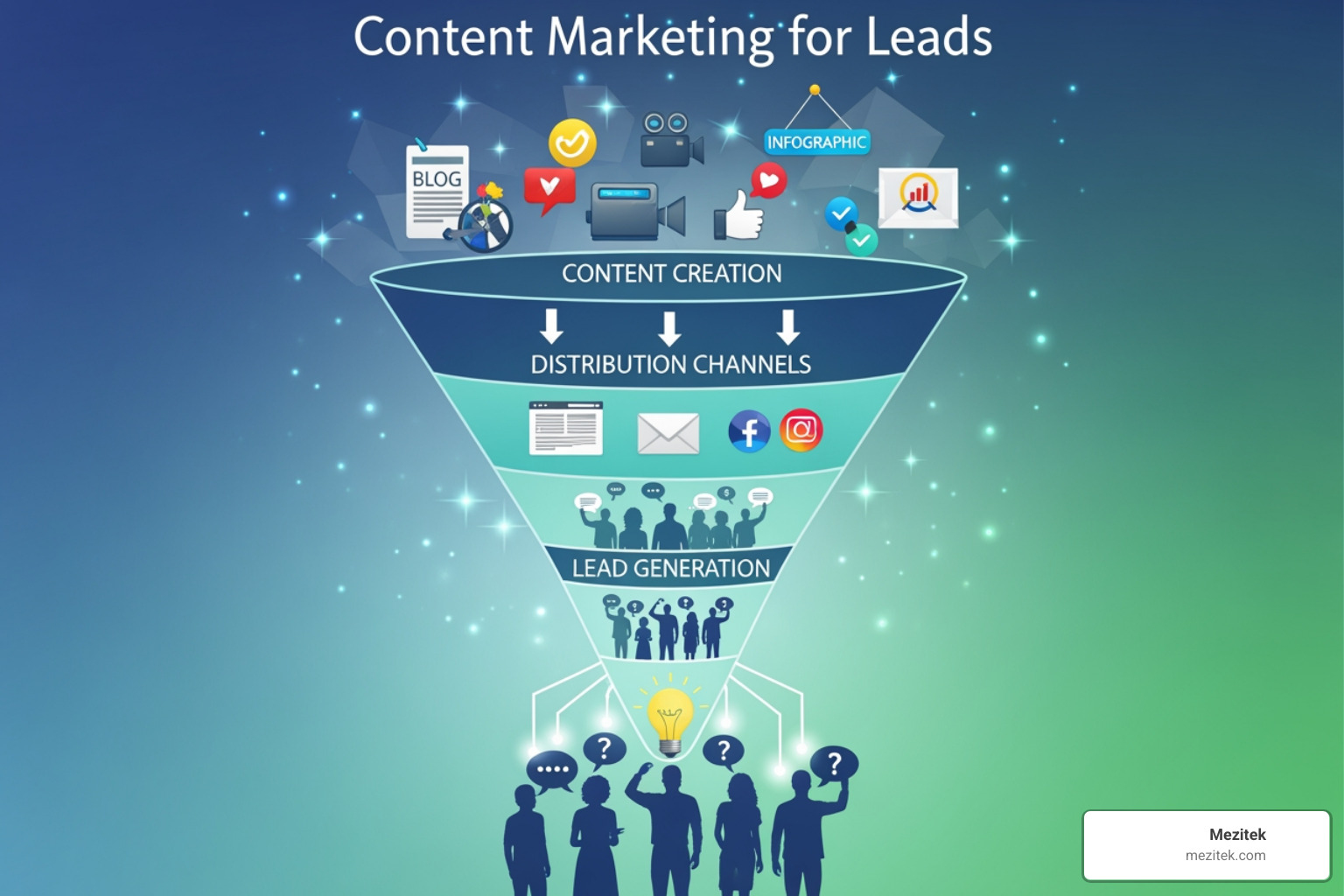
- Attract – Create helpful content (blogs, videos, guides) that answers your audience’s questions.
- Engage – Offer premium resources (ebooks, webinars) in exchange for contact information.
- Convert – Use strategic CTAs and landing pages to capture lead details.
- Nurture – Follow up with targeted content that moves leads toward a purchase.
The numbers tell a compelling story: Content marketing costs 62% less than traditional marketing while generating three times more leads. For freelancers and small agencies with tight budgets, this is a game-changer.
However, most content doesn’t generate leads. Research shows that 63% of web pages get zero organic traffic. The difference between content that works and content that sits ignored comes down to strategy. You need a documented approach that aligns with your ideal customers’ needs and buying journey. The good news is you don’t need a massive team or budget—just clarity, a structured approach, and the right tactics.
The Foundation: Building Your Lead-Generating Content Strategy
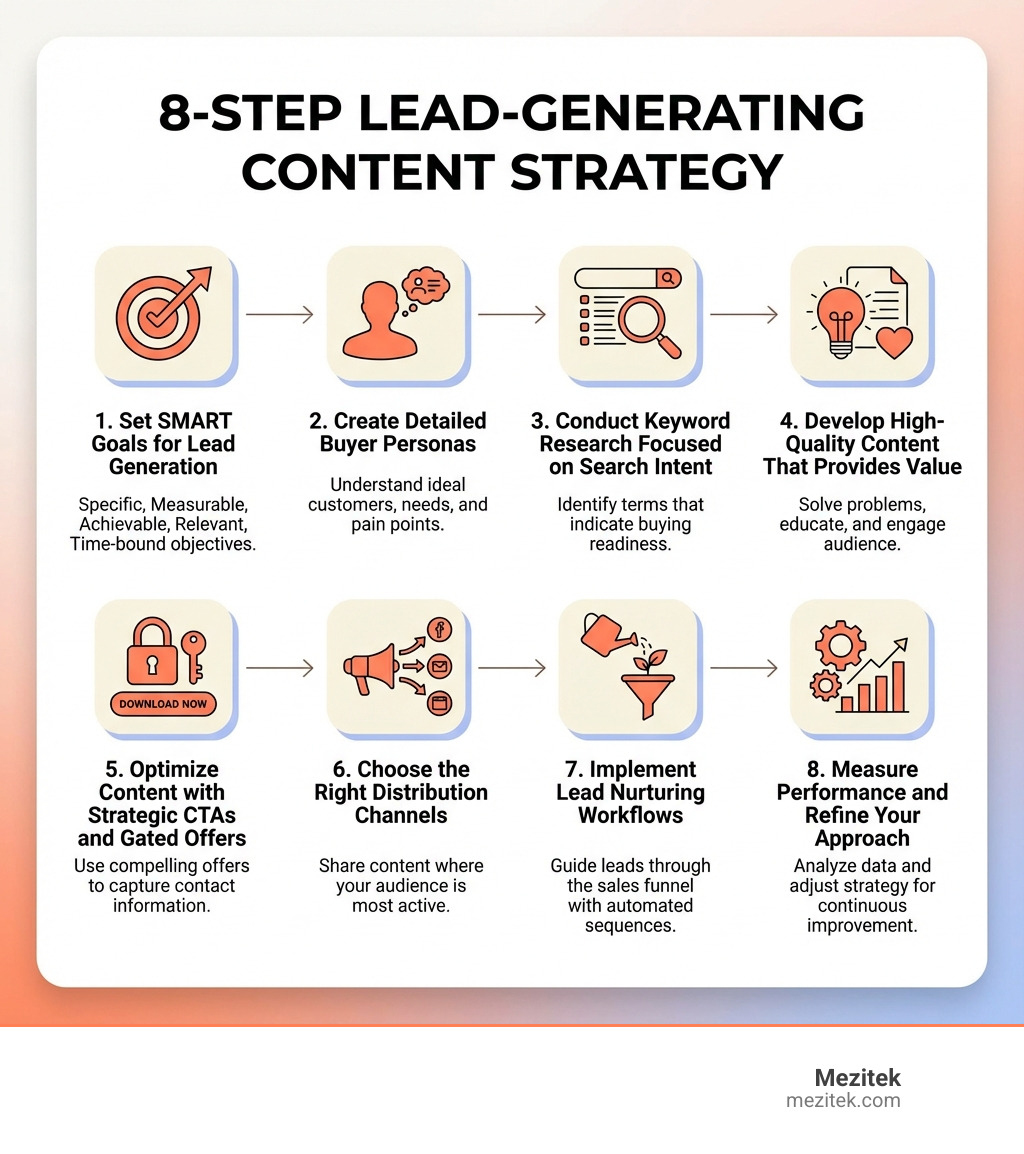
Before writing a single blog post, we need a solid plan. A documented content strategy is our blueprint for success in content marketing for leads. In fact, more than half of the most successful marketers have a documented content marketing strategy. This isn’t just about knowing what to create; it’s about knowing why we’re creating it and who it’s for. Our strategy should be rooted in clear goals and a deep understanding of our audience, ensuring every piece of content is a strategic asset, not just noise.
Define Your Goals and Audience
First, what are we trying to achieve? “More leads” isn’t specific enough. We need SMART goals (Specific, Measurable, Achievable, Relevant, Time-bound), like “generate 25% more qualified leads from content over the next two quarters.”
Next, we identify our ideal customer with buyer personas. These semi-fictional profiles are based on market research and real client data. To create them, ask:
- What are their demographics, job roles, and responsibilities?
- What are their main pain points that our services can solve?
- Where do they get their information (websites, social media)?
- What is their role in the purchase decision?
Understanding these aspects helps us tailor content that resonates and map it to the buyer’s journey:
- Awareness Stage: Prospects identify a problem. Our content should educate them with blog posts, infographics, and videos.
- Consideration Stage: Prospects research solutions. Our content should build trust with case studies, webinars, and in-depth guides.
- Decision Stage: Prospects are ready to buy. Our content should support their decision with demos, testimonials, and free trials.
Aligning content with each stage meets prospects where they are, nurturing them toward conversion. This is a core component of effective marketing funnel optimization.
Document Your Strategy
A written strategy keeps the team aligned and ensures consistency. It should include:
- An editorial calendar: To plan topics, formats, and publication dates.
- Planned content formats: A mix of blogs, videos, and guides to cater to diverse preferences.
- Distribution channels: Where and how we’ll share content.
- Content audits: A plan to regularly review existing content for performance and gaps.
This level of planning makes our content marketing more effective and efficient, leading to more low-cost leads.
Creating High-Impact Content That Attracts Leads
With our strategy in place, it’s time to create high-quality, engaging content that resonates with our target audience. With billions of web pages competing for attention, our content must be exceptional to stand out. High-quality content is valuable, relevant, and well-presented. It answers questions, solves problems, and positions us as experts, which is crucial for building trust in content marketing for leads.

Key Content Formats for Content Marketing for Leads
Content marketing offers a wide array of formats, each with unique strengths for generating leads:
- Ebooks: Explore complex topics in-depth to showcase expertise. They are a prime example of a “gated” asset used to capture lead information.
- Whitepapers and Guides: More academic and persuasive, these are excellent for decision-makers seeking authoritative sources. They are also commonly gated.
- Blog Posts: The foundation of many content strategies. Optimized for SEO, they attract high-intent visitors and can direct readers to gated content.
- Case Studies: Powerful testimonials that provide social proof by showing how you’ve helped others solve a problem.
- Webinars: Live or pre-recorded seminars that offer real-time interaction and a personal connection. Registration provides valuable lead data.
- Interactive Content (Quizzes, Calculators): This content invites participation and can capture lead data in exchange for personalized results.
- Video Marketing: Videos simplify complex ideas and build an emotional connection. They can be paired with gated offers on landing pages.
For more insights into creating compelling content, check out our resources on content creation.
The Role of SEO in Attracting Prospects
Creating great content is only half the battle; it needs to be findable. Search Engine Optimization (SEO) is critical for content marketing for leads because it helps your content rank high on search engines, attracting organic traffic from people actively seeking solutions.
Here’s how to leverage SEO:
- Keyword Research: Identify the terms your audience uses to search online. Tools like Google Ads Keyword Planner can help you understand search intent.
- Search Intent: Understand the purpose behind a search. Focus on Informational Intent (users looking for answers) and Commercial Intent (users researching products).
- On-Page SEO: Optimize page elements like headlines, subheadings, internal links, and natural keyword usage.
- Long-Tail Keywords: Use longer, more specific phrases (e.g., “how to build a low-code website for small business”). They have lower volume but higher conversion rates.
- Topic Clusters: Organize content around core topics with a central pillar page and supporting cluster content to signal authority to search engines.
By focusing on these SEO strategies, we ensure our high-quality content is findable by the right people at the right time.
Optimizing for Conversion: Turning Readers into Leads
Attracting readers is the first step; the next is converting them into leads. In content marketing for leads, this means capturing their contact information to continue the conversation. This process relies on gated content, clear calls-to-action (CTAs), and optimized landing pages.
Designing High-Converting Landing Pages and CTAs
A landing page is a dedicated page designed to capture lead information. A high-converting page is clear, focused, and persuasive. Key elements include:
- Compelling Headlines: Immediately state the value proposition.
- Concise Copy: Be clear, benefit-oriented, and address objections.
- Trust Signals: Use testimonials, security badges, or client logos to build credibility.
- Minimal Form Fields: Ask only for essential information to reduce friction.
- Action-Oriented CTA Text: Use clear, action-oriented language like “Download Now” or “Get Your Free Guide.”
It’s crucial to A/B test landing page elements to continuously improve conversion rates. For more guidance, explore our insights on website landing page optimization.
Using Gated Content as a Lead Magnet
Gated content is premium content accessible only after a user provides their contact information. It’s a win-win: your audience gets valuable resources, and you get a qualified lead.
Effective gated content includes:
- Ebooks and Guides: In-depth resources that demonstrate expertise.
- Templates and Toolkits: Practical assets that save your audience time.
- Webinar Recordings: Offer recordings to those who missed the live event.
- Whitepapers: Authoritative documents highly valued by B2B audiences.
The key is ensuring the content is valuable enough for someone to willingly provide their email address.
Amplifying Your Reach and Nurturing Your Leads
To maximize the impact of content marketing for leads, we must actively distribute our content and nurture the leads we capture. Content won’t promote itself, and a systematic approach is needed to build relationships and guide leads toward a purchase.
Effective Content Distribution Channels
A multi-channel distribution strategy ensures our content reaches our target audience wherever they are:
- Owned Media: Our website, blog, and email list are channels we control.
- Shared Media: Social media platforms (LinkedIn, Facebook, X) and online forums (Reddit, industry communities) are great for engagement and driving traffic.
- Paid Media: Sponsored content, social ads, or search engine marketing can amplify reach.
- Content Syndication: Partner with other platforms to distribute your content to new audiences.
- Repurposing Content: A smart strategy to maximize content lifespan. Turn a webinar into video snippets, a blog post into an infographic, or compile posts into an ebook.
Nurturing Leads with Automated Workflows
Converting leads into customers requires a robust lead nurturing strategy, often powered by marketing automation. Not every lead is ready to buy immediately, so we must build trust over time.
- Email Drip Campaigns: Automated email series triggered by a lead’s actions (like downloading an ebook) that provide additional value and guide them down the funnel.
- Personalization: Use collected data to tailor communication, making leads feel understood.
- Segmentation: Group your audience by interests, behavior, or buyer’s journey stage to deliver highly relevant content.
- Progressive Profiling: Gradually collect more lead data over time to reduce initial friction and gain richer insights.
By blending channels and automating nurturing, our messaging stays consistent and timely, moving leads closer to a purchase.
Measuring Success and Overcoming Challenges in Content Marketing for Leads
Measuring the success of our content marketing for leads campaigns is crucial for understanding what works and how to improve. A data-driven approach allows us to iterate and optimize our strategies for a better ROI.
How to Measure the ROI of Your Content Marketing for Leads
Here are the key metrics and KPIs to monitor:
- Traffic Sources: Where are leads coming from (organic, social, paid)? This helps focus distribution efforts.
- Conversion Rates: What percentage of visitors convert into leads on landing pages?
- Cost Per Lead (CPL): How much does it cost to acquire each lead?
- Lead Quality: What is the lead-to-customer conversion rate? Sales team feedback is invaluable here.
- Customer Lifetime Value (CLV): What is the total revenue a customer generates over time?
- Engagement Metrics: Time on page, bounce rate, and social shares indicate audience interest.
Use A/B testing on headlines, CTAs, and layouts to identify what resonates best and consistently improve results.
Overcoming Common Problems and Staying Ahead
Even with a solid strategy, challenges will arise. Here’s how to stay ahead:
- Creating Consistent Quality Content: This requires dedicated resources and a clear editorial calendar. Outsourcing can help maintain quality and efficiency.
- Cutting Through the Noise: Stand out with high-quality, SEO-optimized, and highly relevant content. Effective distribution is key.
- Securing Budget and Resources: Highlight the cost-effectiveness of content marketing to justify investment.
- AI in Content Creation: Use AI tools to boost efficiency, but remember they are a tool, not a replacement for human creativity and strategy.
- Voice Search Optimization: Optimize content for conversational, question-based queries.
- Privacy-First Marketing: Adopt transparent, privacy-first practices to build trust and ensure compliance with regulations like GDPR.
By continually adapting, leveraging data, and focusing on value, our content marketing for leads will remain a powerful growth engine.
Frequently Asked Questions about Content Marketing for Leads
How does content marketing differ from traditional lead generation?
Content marketing is an inbound strategy that pulls audiences in with valuable content, building trust over time. It attracts customers by solving their problems. Traditional lead generation is often an outbound approach that interrupts audiences with promotional messages like cold calls or ads. Content marketing earns attention, while traditional methods often buy it.
What are the most effective types of content for generating B2B leads?
For B2B lead generation, content that demonstrates expertise and addresses specific business challenges is most effective. This includes:
- Ebooks and Whitepapers: Offer comprehensive insights and are excellent for gating to capture lead information.
- Case Studies: Provide strong social proof by showing how your product solved a client’s problem.
- Webinars: Allow for direct interaction and expert insights, and can be gated for lead capture.
- In-depth Guides: Highly valuable for prospects in the consideration stage.
These formats are valuable because B2B decision-makers spend significant time researching before making a purchase.
How can I generate leads without a large budget?
Generating leads on a limited budget is achievable with smart, strategic efforts:
- High-Quality, SEO-Optimized Blog Content: Create articles that answer your audience’s questions to attract organic traffic.
- Repurpose Existing Content: Maximize the value of every piece by turning it into different formats (e.g., blog post to social media graphic).
- Engage in Online Communities: Participate in relevant forums (like Reddit), LinkedIn groups, or Q&A sites to share expertise and link back to your content.
- Guest Blogging: Write for other blogs in your niche to reach a new audience and drive referral traffic.
- Free Tools/Templates: Offer simple, useful tools like checklists as gated content to capture leads.
The key is to provide immense value and leverage organic channels effectively.
Conclusion
In today’s online world, content marketing for leads is a fundamental strategy for sustainable growth. By understanding your audience, setting clear goals, creating high-quality content, and optimizing capture and nurturing processes, you can transform visitors into valuable leads. This approach costs less than traditional advertising while building lasting relationships and establishing market authority.
For low-code freelancers and small business owners, mastering these strategies means attracting the right clients, demonstrating expertise, building trust, and driving revenue. It’s about earning attention, not buying it, and providing genuine value at every step.
Ready to turn your website into a lead-generating powerhouse? Let us help you create a digital presence that not only looks great but also works tirelessly to attract and convert your ideal clients. Get a custom-designed business website that converts and start building your pipeline today.