Why Your Business Can’t Afford to Be Invisible Online
Build strong online presence means making your business easy to find, trust, and engage with online. This includes:
- A solid website – Your digital storefront that you fully own.
- Strategic SEO and content – So people can find you on Google.
- Active social media presence – Meeting your audience where they hang out.
- Regular analysis and improvement – Using data to get better results.
The reality is stark: over 80% of people search online before buying, and 53% of shoppers always research first. If you don’t appear in those searches, you’re practically invisible.
This phenomenon is called “online ghosting“—when businesses are ignored simply because their digital profiles are hard to find or forgettable. It’s a critical business survival issue.
Your online presence is your digital reputation. It’s what appears when someone Googles you and how potential clients decide whether to trust you. It works for you 24/7—or against you.
The good news? You don’t need to be everywhere. You just need to be intentional. Build the right foundation, show up consistently where it matters, and let your presence compound over time.
What is a Strong Online Presence (And Why It’s Non-Negotiable)
For a low-code freelancer or small business, a strong online presence is more than a website and social media. It means being findable, credible, and authentic across all digital touchpoints, ensuring potential clients not only find you but also connect with and trust your brand.
A good online presence makes your brand “searchable” for relevant keywords and allows users to interact with your business, whether they become buyers or simply engage with your content.
Why is this crucial? Because that’s where consumers are. The number of digital buyers has soared, and global e-commerce sales are projected to surpass $7 trillion by 2024. To capture a piece of that pie, you must be visible.
A strong online presence builds trust before a client ever books a call. It helps attract values-aligned leads who need what you offer. It’s about developing a clear digital identity and ‘why’ for your business. What do you want people to find when they search for you? Answering this helps define your mission and unique value.
This clarity and consistent visibility foster a reputation for reliability and expertise, ensuring you’re seen as a go-to resource in your niche. This proactive approach helps avoid “online ghosting” and turns hard work into tangible success. Building this foundation is paramount for every low-code freelancer and small business owner. Find more about how we can help you with your digital identity by exploring our innovative web solutions.
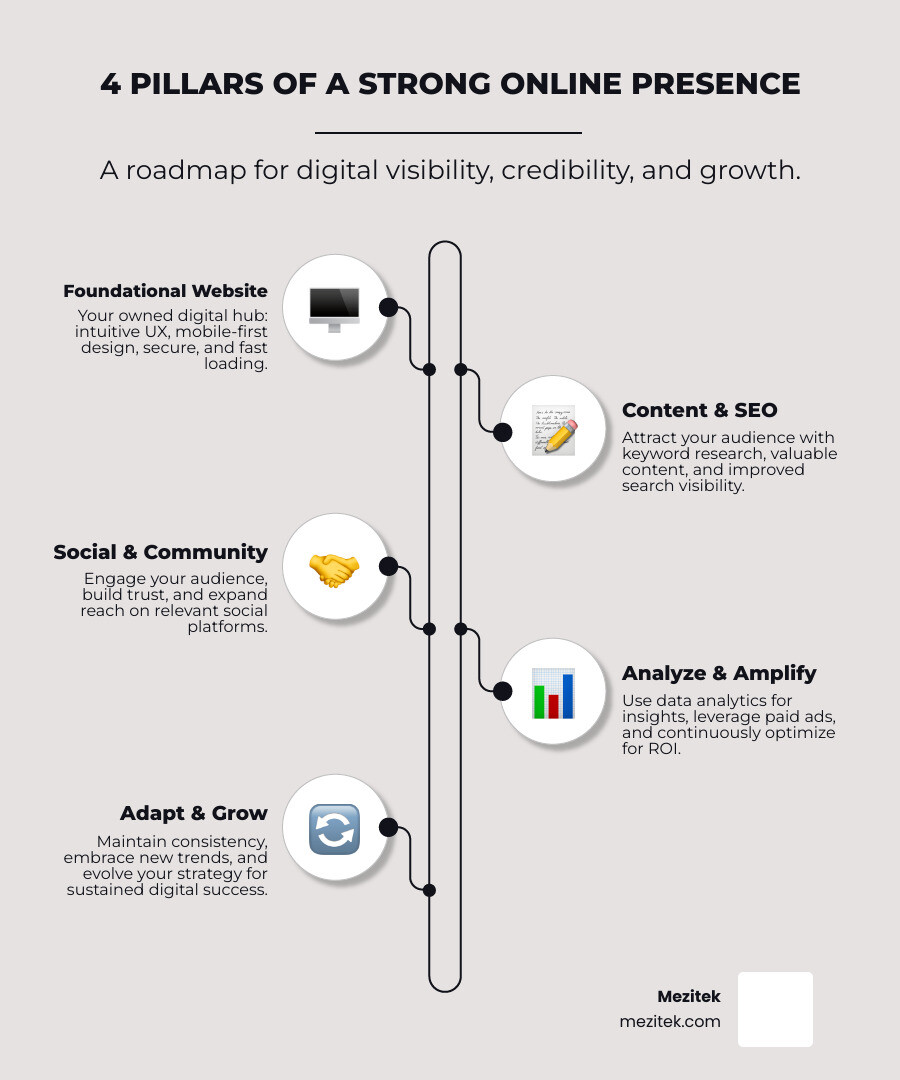
Phase 1: Building Your Digital Foundation – The Website
Your website is the cornerstone of your strong online presence—your digital headquarters. Unlike social media’s rented space, your website is an asset you fully own, giving you complete control over your brand’s narrative.

For low-code freelancers and small business owners, a website must be a functional marketing hub: clear, accessible, and user-friendly (UX). With 76% of Americans using smartphones for online purchases, mobile optimization is essential. Pages must load quickly and be easy to steer on small screens.
Website security is also non-negotiable. Customers expect their data to be safe. Displaying trust signals like SSL certificates builds confidence. Your site should also feature clear navigation so visitors can easily find your services and contact info. You have less than 10 seconds to capture attention online; a confusing or slow site will lose visitors instantly. Learn more about effective website structure in our guide to Best Practices for Website Architecture.
Essential Elements of a User-Friendly Website
Every effective website needs these core pages:
- Home Page: Your digital welcome mat. It must clearly state who you are, what you do, and who you serve to capture interest instantly.
- About Page: This is where you build trust by sharing your ‘why,’ your values, and what makes your business unique.
- Services/Work With Me Page: Clearly outline your offerings, the problems you solve, and the value you provide.
- Blog/Resources Page: A place to share your expertise, educate your audience, and position yourself as an authority.
- Contact Page: Essential for leads. Include multiple contact methods and a clear Call-to-Action (CTA) to book a consultation.
Every page should have a soft CTA guiding visitors on what to do next. Prioritize accessibility in your design with clean layouts, readable fonts, and clear hierarchies. Dive deeper into creating an impactful online presence with our insights on web design.
Showcasing Your Products and Services Effectively
Once your site foundation is solid, effectively showcase what you offer with high-quality visuals and compelling descriptions.
- High-Quality Images: Professional photos are paramount. They grab attention and convey quality.
- Product Descriptions: Go beyond features; highlight the benefits. How will your product or service solve a customer’s problem? Use clear language that speaks to your target audience.
- Online Portfolios and Interactive Galleries: For freelancers, a portfolio is your most powerful selling tool. Curating your own gallery lets you control how your work is perceived. Make your galleries aesthetically pleasing and interactive, allowing users to easily explore your best work.
By presenting your offerings thoughtfully, you build credibility and turn visitors into clients. For more detailed guidance, check out our comprehensive resource on how to build a website.
Phase 2: How to Build Strong Online Presence with Content and SEO
Once your website is live, content and Search Engine Optimization (SEO) are essential to build strong online presence and ensure people can find you. Without a solid SEO strategy, even the best website can remain invisible. Since most shoppers research online before buying, you need to be where they’re looking.

Mastering SEO to Improve Search Visibility
SEO is the process of optimizing your website to rank higher in search engines like Google. The goal is to land on the first page, which gets over 71% of all search traffic, while the second page gets only 6%. If you’re not on that first page, you’re missing out.
Here’s how to master SEO:
- Keyword Research: This is the foundation. Identify the phrases your audience uses to find solutions like yours. Use tools to find these keywords and incorporate them naturally into your website content, titles, and headings. Learn more about adding keywords for SEO.
- On-Page SEO: This involves optimizing individual web pages.
- Page Titles: Craft compelling, keyword-rich titles that describe the page’s content.
- Meta Descriptions: Write unique, concise descriptions (under 150 characters) for each page, including the main keyword. They significantly influence click-through rates.
- Alt Text: Add descriptive alt text to all images for accessibility and to help search engines understand your image content.
- Internal Linking: Link your website pages together where relevant. This helps visitors steer and shows search engines the structure of your content, improving ranking potential.
By consistently using keywords, internal links, and creating educational content, you can significantly improve search visibility. For additional insights, explore our resources.
Using Content Marketing to Establish Expertise
Content marketing, especially blogging, is a powerful way to build strong online presence by establishing expertise. Google rewards sites that post high-quality blogs consistently. These articles are long-term assets that drive traffic for years at no extra cost.
Create valuable content that answers your audience’s questions, positioning you as a trusted authority. Here are some blog post ideas:
- How-to guides: “How to Build a Simple E-commerce Site with No Coding.”
- Problem/solution articles: “5 Common Website Mistakes Small Businesses Make (and How to Fix Them).”
- Industry insights: “The Future of Low-Code Development for Solopreneurs.”
- Client success stories: “How a Solopreneur Launched Their Online Course in a Week Using Our Platform.”
- Comparison posts: “WordPress vs. a No-Code Builder: Which is Right for Your Startup?”
By consistently providing useful content, you attract organic traffic and nurture relationships with potential clients.
How to Build Strong Online Presence by Leveraging Your Internal Team
While hiring freelancers is a valid approach, leveraging your internal team can be more valuable. Your team members have in-depth knowledge and direct client interaction experience.
Their real-world experience is invaluable for creating authentic, compelling content that resonates with your audience. Empowering your team to contribute leads to:
- Authentic Thought Leadership: Sharing unique insights freelancers might not have.
- Content at Scale: Distributing the workload for more consistent content.
- Leveraging In-House Expertise: Who better to explain your services than the people who live and breathe them?
Integrate content creation into your team’s workflow, encouraging them to share their knowledge. This enriches your content and fosters a sense of ownership and expertise.
Phase 3: Expanding Your Reach and Building Community
With your website and content strategy set, it’s time to expand your reach and build a community. Social media, video, and reputation management are key to build strong online presence, increase brand awareness, and foster deeper audience connections.
Utilizing Social Media to Connect with Your Audience
Social media is indispensable for connecting with clients. Mastering it starts with knowing which platforms your target audience uses. Be strategic, not everywhere.
- Choosing the Right Platforms: Research your target demographics. Are they on LinkedIn, Instagram, or Facebook? Focus your efforts on 1-2 platforms that make the most sense for your business.
- Content Calendar & Consistent Branding: Plan your content in advance to maintain a consistent schedule and ensure your messaging aligns with your brand voice. Consistent branding is crucial for recognition.
- Responding to Comments & Engaging: Social media is a two-way street. Over three-quarters of consumers expect a response within 24 hours. Actively respond to comments and messages to build a community, inspire loyalty, and boost engagement.
For a structured approach, check out The Social Media Manager’s Daily, Weekly, Monthly Checklist.
The Power of Video Content
Video is a powerhouse for capturing attention. Many people decide to buy after watching videos, which can drive revenue and build brand identity.
Creating video content doesn’t require a Hollywood budget. Here are some ideas:
- Product Tutorials/How-Tos: Show your audience how to use your solutions.
- Testimonials: Feature satisfied clients sharing their success stories for powerful social proof.
- Behind-the-Scenes: Give a peek into your process to build authenticity.
- Before-and-Afters: Showcase the change your services provide.
- Q&A Sessions: Answer common questions to position yourself as an expert.
Ensure your videos are succinct and informative. Optimize titles, tags, and descriptions with keywords for better findability. Learn more about creating high-quality video ads.
Managing Online Reviews and Testimonials
Online reviews are modern word-of-mouth marketing. They build trust and credibility, with Google, Facebook, and Yelp being top sources for business information.
- Importance of Reviews: A handful of rave reviews can be powerful, free advertising.
- Encouraging Feedback: Actively ask satisfied clients for reviews. Make it easy by providing direct links to your review platforms. Display positive testimonials on your website.
- Responding to Reviews: This is critical for both positive and negative feedback.
- Positive Reviews: Thank the customer and show appreciation.
- Handling Negative Reviews Professionally: Respond courteously, acknowledge the concern, and offer to resolve the issue offline. A professional response can turn a negative situation around.
By proactively managing your online reputation, you build a strong online presence founded on trust. Need help with your server infrastructure or hosting your website? Explore our hosting solutions.
Phase 4: Amplifying and Analyzing Your Presence
Building a strong online presence is an ongoing process. This final phase focuses on amplifying your reach with paid strategies and using data for continuous improvement to ensure you’re getting the best results.
Reaching a Wider Audience with Paid Advertising
While organic strategies are crucial for long-term growth, paid advertising offers immediate visibility and can amplify your reach.
- Google Ads (PPC): Pay-per-click campaigns on Google let you target specific keywords, appearing when clients are actively searching for your services. Google Ads often provide a high return on investment.
- Social Media Ads (e.g., Facebook Ads): Platforms like Facebook and Instagram offer powerful targeting to reach specific demographics, interests, and behaviors, which is excellent for brand awareness.
- Retargeting Campaigns: These are incredibly effective. Retargeting shows ads to people who have already visited your website. These warm leads are more likely to convert, and these campaigns are often more cost-effective.
Strategic paid advertising can fast-track getting your message in front of the right audience. It’s a key component of a robust SaaS lead generation strategy.
How to Build Strong Online Presence through Continuous Improvement
The digital landscape is always evolving, so your strategies must adapt. Continuous improvement means analyzing performance and iterating your approach.
- Key Performance Indicators (KPIs): Define what success looks like. This could include:
- Website Traffic: How many visitors are coming to your site and from where?
- Conversion Rates: What percentage of visitors take a desired action (e.g., booking a call)? The average is 2-5%.
- Engagement Metrics: On social media, track likes, comments, and shares. On your website, track time on page or bounce rate.
- Analytics Tools: Use tools like Google Analytics to track website performance. This data shows how your content is resonating and which channels drive the most traffic.
- A/B Testing: Experiment with different headlines, calls-to-action, and ad creatives to see what performs best.
- Review and Refresh Regularly: Your business evolves, and your online presence should too. Regularly review your website content, social media, and SEO efforts.
By consistently analyzing data and iterating, you ensure your efforts to build strong online presence are always optimized. Learn how to harness the power of data with Using Google Analytics and find ways to improve your website’s effectiveness with tips on how to increase landing page conversion rate.
Frequently Asked Questions about Building an Online Presence
How long does it take to build a strong online presence?
Building a strong online presence is a marathon, not a sprint. While paid ads offer quick visibility, organic strategies like SEO and content marketing are long-term plays. You might see initial results in 3-6 months, but significant impact often takes 6-12 months. Consistency is key. The more consistently you publish quality content and engage with your audience, the faster your results will compound.
Can I build an online presence with no budget?
Yes, you can build strong online presence with no budget, but it requires a significant investment of your time. Focus on organic strategies:
- SEO: Learn the basics of keyword research and on-page optimization.
- Content Creation: Start a blog or create simple graphics and videos with free tools.
- Social Media: Choose 1-2 platforms and engage authentically.
- Email Marketing: Build an email list using free platforms.
The trade-off is time for money. Be prepared to dedicate consistent hours to these efforts.
What’s more important: a website or social media?
Your website is your owned digital hub. It’s the one place online where you have complete control. Social media platforms are rented spaces, subject to changing algorithms and policies.
Therefore, your website is your primary digital asset. Social media should be used strategically to drive traffic to your website. Think of social media as the billboard that points people to your storefront (your website). Both are important and work best together, but your website should always be the center of your online ecosystem.
Conclusion
Building a strong online presence is a manageable journey when broken down into strategic phases. We’ve covered establishing your website, using content and SEO to become findable, expanding your reach with social media, and analyzing your results for continuous improvement.
This is a marathon, not a sprint. It requires intentionality over ubiquity. You don’t have to be everywhere—just in the right places, consistently delivering value and connecting authentically with your audience. A strong digital foundation allows you to be seen, remembered, and chosen in a crowded online world.
Ready to take the first step towards a professional and impactful online presence? Let us help you build the digital foundation your business deserves. Explore our Custom Designed Business Websites and let’s craft an online home that truly represents your brand.