Why Web Conversion Optimization Matters for Your Business
Web conversion optimization is the process of improving your website so more visitors take the actions you want them to take—whether that’s buying a product, signing up for a newsletter, or requesting a quote.
Quick Answer: What is Web Conversion Optimization?
- Definition: A systematic process of testing and refining your website to increase the percentage of visitors who convert
- Goal: Turn more of your existing traffic into leads and customers
- Method: Analyze data, understand user behavior, create hypotheses, test changes, and learn from results
- Key Benefit: Get more value from the traffic you already have instead of spending more on acquisition
- Core Formula: Conversion Rate = (Number of Conversions / Total Visitors) × 100
When I first started focusing on my website’s conversion rates, I felt stuck. I was getting traffic, but visitors weren’t taking action—no sign-ups, no purchases, just clicks that led nowhere.
Sound familiar?
Here’s the truth: bringing visitors to your website is only half the battle. The other half is converting them into customers. For every $92 spent on customer acquisition, just $1 goes toward conversion rate optimization—yet improving your conversion rate by even half a percent can make a meaningful revenue difference.
Think of CRO as your digital marketer’s test kitchen. You’re constantly experimenting with different ingredients—headlines, button colors, form lengths, page layouts—to find the recipe that works best for your specific audience.
The average conversion rate across industries hovers around 2.9%. That means for every 100 people who visit your site, only about 3 take action. But the top-performing sites? They convert at rates 2-3 times higher. That’s not luck—it’s strategy.
This guide will walk you through everything you need to know about web conversion optimization, from understanding the basics to implementing advanced strategies that drive real results.
The Foundations: Understanding Conversions and Analytics
At its heart, web conversion optimization is about getting more from what you already have. We’re talking about maximizing the value of every visitor who lands on your site, turning them into leads, customers, or fans. This process starts with a clear understanding of what a “conversion” actually is, and how we measure it.
According to Harvard Business School, when you convert more of your users, you may be expanding your reach, driving more sales, or acquiring new customers. Conversion rate optimization in digital marketing boosts sales and drives profit. This is why one in three marketing leaders listed their website’s conversion rate as one of the key performance indicators (KPIs) they prioritized tracking in HubSpot’s 2023 State of Marketing Report. It’s a buzzworthy topic, and for good reason!
If you’re just starting your online journey, you might want to check out our guide on how to build a website to lay a strong foundation for your CRO efforts.
Calculating and Benchmarking Your Conversion Rate
Let’s get down to brass tacks: how do we actually calculate this magical number? The formula is simple:
Conversion Rate = (Number of Conversions / Total Visitors) * 100
So, if your e-commerce store had 100 sales last month and 2,000 visitors, your conversion rate would be (100 / 2,000) * 100 = 5%. Not too shabby! But what if you improved to 120 sales with the same 2,000 visitors? Your conversion rate jumps to 6%, translating to a meaningful revenue difference.
While it’s helpful to compare your performance against industry benchmarks, a “good” conversion rate varies wildly. Digital Marketer’s Ecommerce Data Benchmark Report 2023 states the average conversion rate for e-commerce websites was 2.9% in 2022, but this varies across product types. Instead of chasing an arbitrary industry average, our advice is to focus on improving your own rate incrementally. The key is to understand your baseline and work on making continuous improvements toward your business goals.
Understanding the Fundamentals of Web Conversion Optimization
Not all conversions are created equal, and this is where the concepts of micro and macro conversions come into play.
| Type of Conversion | Definition | Examples | Role in CRO |
|---|---|---|---|
| Macro-conversions | The primary, big-picture goals of your website or app. These are typically directly tied to revenue or core business objectives. | – Completing a purchase – Signing up for a free trial – Filling out a contact form – Subscribing to a paid service |
The ultimate desired action; the end goal of the user journey. |
| Micro-conversions | Smaller, interim steps that visitors take on their way to completing a macro-conversion. These indicate engagement and progress. | – Downloading a PDF brochure – ‘Liking’ a social media post – Viewing a product page – Adding an item to a cart – Signing up for a newsletter – Watching a demo video |
Crucial indicators of user intent and engagement; optimizing these smooths the path to macro-conversions. |
Macro-conversions are your website’s main event—the big win! For us, as low-code freelancers or small business owners, this might be a client booking a consultation or purchasing a template. Micro-conversions, on the other hand, are the little victories that lead up to the grand finale. Think of them as breadcrumbs guiding your users down the path to a purchase or inquiry.
For example, for an e-commerce site, micro-conversions might include viewing a product page, adding an item to the cart, or initiating checkout. Each of these steps, while not a final purchase, signals intent and moves the user closer to the macro-conversion. It’s essential to execute conversion analysis and improve micro-conversions because they build trust, reduce friction, and keep users engaged, ultimately increasing the likelihood of that big sale.
By mapping out the user journey and understanding these smaller steps, we can identify exactly where visitors might be getting stuck or dropping off. This helps us optimize each stage, ensuring a smoother, more enjoyable experience for our potential customers.
The Core Components of a Web Conversion Optimization Strategy
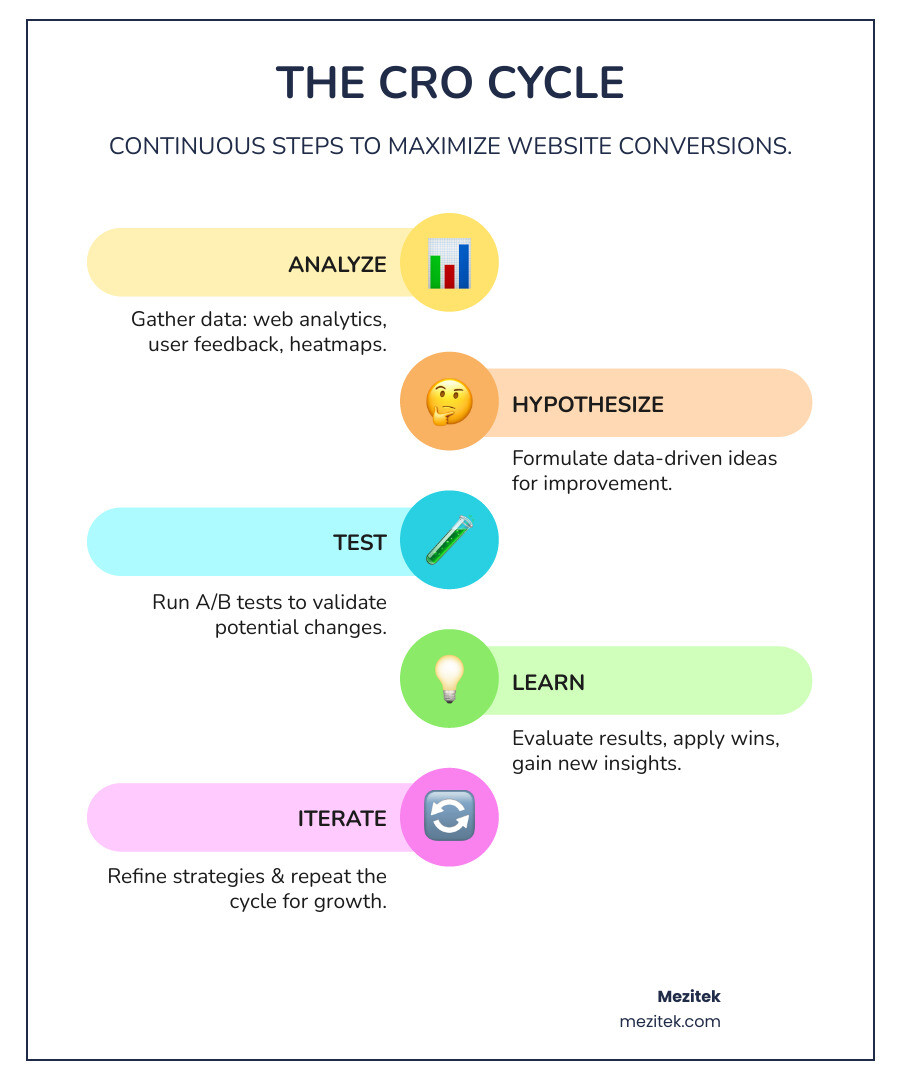
A successful web conversion optimization strategy isn’t just about throwing spaghetti at the wall to see what sticks. It’s a structured, data-driven approach that helps us understand our users, identify bottlenecks, and make informed decisions.

Our strategy relies on several key components:
- Data Collection and Analysis: This is where we gather all the juicy details about how users interact with our site. We look at traffic sources, user behavior, bounce rates, abandonment rates, and click-through rates.
- User Feedback: Sometimes, the best way to know what users want is to ask them! Surveys, interviews, and user testing provide invaluable qualitative insights.
- Funnel Analysis: We trace the typical path a user takes to complete a desired action, identifying any points where they might drop off.
- Hypothesis Creation: Based on our data and feedback, we form educated guesses about what changes might improve conversions. For example, “Changing the CTA button color to orange will increase clicks by 10%.”
- Prioritization Frameworks: Since we can’t test everything at once, we use frameworks like PIE (Potential, Importance, Ease) to prioritize which hypotheses to test first, focusing on those with the highest potential impact and feasibility.
Using Web Analytics to Uncover Opportunities
Web analytics tools are our best friends in web conversion optimization. They help us peek behind the curtain and understand what’s really happening on our websites. Tools like Google Analytics, Hotjar, Lucky Orange, and Crazy Egg provide a wealth of information.
Here’s how we use them:
- Heatmaps and Session Replays: These visual tools show us exactly where users click, how far they scroll, and even record their entire journey through our site. Imagine watching a video of a user struggling to find the “Add to Cart” button – that’s a goldmine for optimization!
- Identifying Drop-off Points: By analyzing our conversion funnels, we can pinpoint pages or steps where a significant number of users abandon their journey. Is it a lengthy form? A confusing product description? Analytics helps us find the “why.”
- Understanding User Behavior: We look at what drives visitors to our site, what barriers they experience that cause them to drop off, and what “hooks” increase the likelihood of conversion. This includes understanding buyer personas, their needs, and pain points.
And speaking of user data, it’s crucial to handle it responsibly. If you’re collecting any user data, our cookie consent guide for web designers can help you ensure compliance.
Avoiding Common CRO Pitfalls
Even the most seasoned optimizers can stumble. Here are some common CRO mistakes we strive to avoid:
- Testing without a Hypothesis: Changing things just because they “feel right” is a recipe for wasted time. Every test should start with a clear, data-backed hypothesis.
- Ignoring Qualitative Data: Numbers tell us what happened, but user surveys, feedback forms, and session replays tell us why. Both are crucial for effective optimization.
- Changing Too Many Variables at Once: If you change the headline, image, and button color all at once, how will you know which change caused the improvement (or decline)? Test one element at a time!
- Not Running Tests Long Enough: Patience is a virtue in CRO. Ending a test too early can lead to misleading results due to insufficient data or statistical significance.
- Misinterpreting Statistical Significance: Just because a test shows a difference doesn’t mean it’s statistically significant. We need to ensure our results are reliable and not just random chance.
- Not Establishing a Clear Conversion Goal: Before we even begin, we need to know what we’re optimizing for. Is it sign-ups? Purchases? Downloads? Without a clear goal, our efforts are aimless.
Implementation: Design, UX, and Testing for Higher Conversions
Once we’ve gathered our data and formed our hypotheses, it’s time to put our plans into action. This phase focuses on the tangible changes we make to our website, guided by principles of User Experience (UX), effective design, and rigorous testing.
The Critical Role of UX and Accessible Design
A seamless user experience (UX) is the backbone of any successful webpage. It ensures effortless navigation and action without frustration. Our goal is to make our websites so intuitive, users barely have to think.
- Intuitive Navigation: Clear menus, logical layouts, and a search bar are non-negotiable. Users should always know where they are and how to get where they want to go. Our guide on best practices for website architecture can help with this.
- Mobile-First Design: With about two-thirds of online retail purchases occurring on mobile devices according to Statista, a responsive design isn’t just nice to have; it’s essential. Our websites need to look good and function perfectly on any device, or we’re leaving conversions on the table.
- Page Speed: Impatient visitors bounce. Research shows we should aim for page load times of no longer than four seconds. Even within that range, the shorter the time, the better for conversions. We use tools like Google’s Lighthouse to quickly assess and improve our website’s load time.
- Accessibility for All Users: This is often overlooked but incredibly important. In the United States alone, nearly 7.3 million people use screen readers to browse the internet. Making our websites accessible means more users can engage and convert. This includes clear, descriptive headers (as screen reader users often begin navigation by reading headings), sufficient color contrast, and keyboard navigation. An accessible website isn’t just good karma; it’s good business.
Effectively Implementing A/B Testing
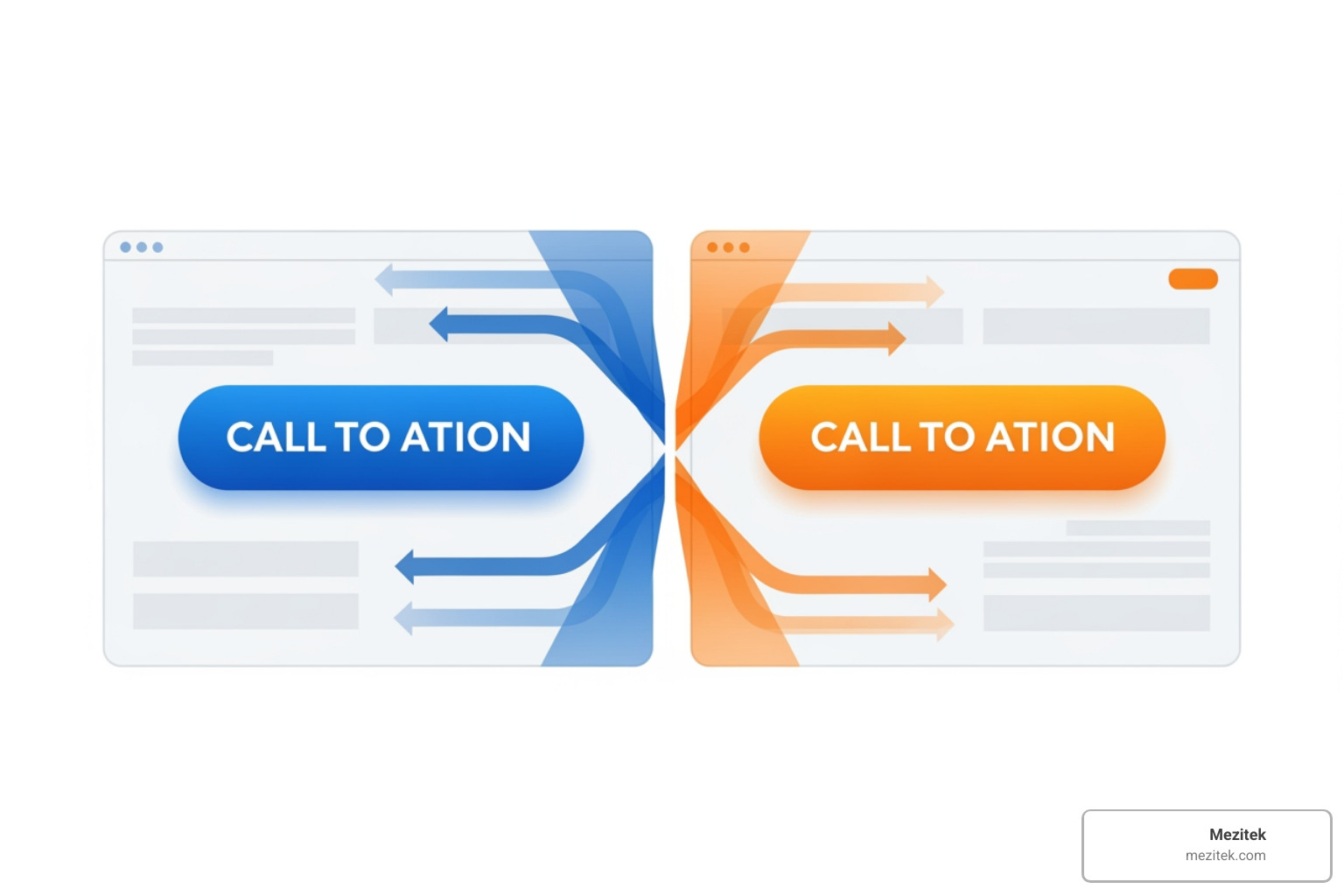
A/B testing is our secret weapon in web conversion optimization. It allows us to compare two (or more) versions of a webpage or element to see which performs better.
Here’s how we make it effective:
- Control vs. Variation: We always test a new version (the variation) against the original (the control). This allows for a clear comparison.
- Statistical Significance: We don’t declare a winner until the results are statistically significant, meaning the difference isn’t due to random chance. This ensures our changes are truly impactful.
- Testing One Element at a Time: This is crucial. If we change multiple things, we won’t know which specific alteration led to the conversion increase.
- What to Test: Almost anything!
- Headlines: China Expat Health increased their lead conversion rate by 79% by swapping out a headline that immediately conveyed a value proposition.
- Images: Does a lifestyle shot convert better than a product-only image?
- CTA Copy: Unbounce shared a case study where A/B testing “Sign up for free” vs. “Trial for free” led to a 104% month-over-month increase in conversions. Bombas updated their login CTA from an icon to text, increasing logins by 36% and orders by 4.1%.
- Form Length: Is our form too long, hindering conversions?
- Page Layouts: Does a different arrangement of elements guide users more effectively?
A/B testing helps us move beyond guesswork and make data-driven decisions. As low-code freelancers and small business owners, this allows us to continuously refine our websites for maximum impact.
Optimizing Landing Pages and CTAs
Landing pages and Calls-to-Action (CTAs) are critical touchpoints for conversions. Since landing pages are inherently designed for people to take an action, they have the highest average conversion rate of all signup forms at 23%. This makes optimizing them a high-impact activity.
- Message Matching: Before someone lands on our website, an event often triggers their visit—an ad clicked, a Google search, or a video. That pre-visit context is central to conversions. Our landing page content needs to sync up with that backstory to meet user expectations. If an ad promises “business plans in 15 minutes,” our landing page better deliver on that promise immediately!
- Clear Value Proposition: Our value proposition should come across through our headlines, images, and copy, primarily featuring our Unique Selling Point (USP). Marketing experiments recommend that our USP should be summarized in 10 words or less.
- Compelling Copy: Our words need to persuade, inform, and guide. Focus on benefits, not just features.
- Visual Hierarchy: Use size, color, and placement to draw attention to the most important elements, especially our CTAs.
- Button Design and Color: CTAs are where the magic happens—they’re the gateway to conversions. Our CTAs should be prominently placed, visually distinct (contrasting colors work wonders!), and clearly communicate the action we want the user to take.
- Urgency and Scarcity: Phrases like “limited stock” or “offer ends soon” can create a sense of urgency, encouraging immediate action.
- Social Proof: Featuring glowing reviews from loyal customers, testimonials, or case studies can help build trust and encourage conversions among potential new customers. According to SCORE, a non-profit partner of the U.S. Small Business Administration, testimonials can inspire sales. Tools like Yotpo can embed ratings, and Fomo can bolster social proof by sharing real-time purchases from other users.
Advanced Strategies and Measuring Success
Once we’ve mastered the fundamentals, we can explore more sophisticated techniques to further boost our conversion rates. These often involve leveraging technology and integrating our CRO efforts with other marketing disciplines.
How Personalization and AI Can Boost Conversions
It’s no secret that users today expect highly personalized digital experiences. In fact, 73% of consumers prefer doing business with brands that use personal information to make their shopping experiences more relevant. Generic messaging tends to yield average conversion rates.
- Tailoring Content and Dynamic Offers: Personalization allows us to deliver content, offers, and even entire user flows that are specifically relevant to individual users or segments. This can be based on their past behavior, demographics, location, or how they arrived at our site.
- User Segmentation: By dividing our audience into smaller, more specific groups, we can craft highly targeted experiences. This leads to higher engagement and significantly improved conversion rates.
- Impact on Revenue: Personalization isn’t just about making users happy; it’s about making money. McKinsey found that personalization can generate as much as 40% more revenue for companies.
- AI’s Role: AI is becoming increasingly important in streamlining CRO, especially for personalization. AI tools can analyze vast amounts of user data, identify patterns, predict user behavior, and even automate the delivery of personalized content, making the process faster and more efficient. Our guide to best AI tools for web designers explores how these technologies can be integrated into your workflow.
The Symbiotic Relationship Between CRO and SEO
While conversion rate optimization and Search Engine Optimization (SEO) have distinct primary goals—CRO focuses on turning visitors into customers, and SEO focuses on getting visitors to your site—they are far from separate entities. In fact, they share a beautiful, symbiotic relationship.
- Improved User Signals: When we optimize for conversions, we inherently improve the user experience. This leads to better user signals like increased dwell time (how long a user stays on a page), lower bounce rates (users leaving after viewing one page), and higher click-through rates (CTR) from search results.
- How Good UX Impacts Rankings: Search engines, especially Google, increasingly use these user signals as ranking factors. A website that provides a great user experience, is fast, easy to steer, and relevant to user intent is more likely to rank higher.
- Page Speed as a Ranking Factor: We know that fast loading speeds are crucial for conversions. Tools like Google’s Lighthouse help us achieve this. Moz confirms that site speed is also a factor Google considers for search engine ranking. Improving our site speed for CRO also directly benefits our SEO.
By making our websites more user-friendly and effective at converting, we’re also making them more appealing to search engines, creating a virtuous cycle of increased visibility and higher conversions.
Measuring the Impact of Your Web Conversion Optimization Efforts
So, we’ve implemented our strategies and run our tests. How do we know if it’s all working? Measuring the impact of our web conversion optimization efforts is crucial for understanding our return on investment (ROI) and guiding future decisions.
- Tracking KPIs: Beyond just the overall conversion rate, we track specific Key Performance Indicators (KPIs) relevant to our tests. This might include click-through rates on CTAs, form submission rates, average order value, or lead-to-customer conversion rates.
- Conversion Lift: This refers to the percentage increase in conversions directly attributable to our optimization efforts. For example, if a new landing page design converts at 10% compared to the old one’s 8%, that’s a 25% conversion lift.
- Calculating ROI: CRO is about profitability. We need to calculate how much revenue our optimized changes are generating compared to the resources (time and money) invested in the optimization. This helps us justify our efforts and prioritize future projects.
- Attributing Success: With various marketing channels and multiple CRO tests running, it’s important to have attribution models in place to understand which specific changes are driving which results.
- Reporting Tools: Modern analytics platforms provide robust reporting capabilities that allow us to visualize our data, track progress over time, and share insights with our team or clients.
By carefully measuring and analyzing our results, we ensure that our CRO strategy is constantly evolving, delivering tangible business growth.
Frequently Asked Questions about Web Conversion Optimization
We hear a lot of questions about CRO, so we’ve compiled some of the most common ones to help clarify things.
What is a “good” conversion rate?
This is like asking “how long is a piece of string?” A “good” conversion rate is highly relative. As mentioned, the average conversion rate for e-commerce websites was around 2.9% in 2022. However, this number can vary significantly based on your industry, the type of conversion (e.g., newsletter signup vs. purchase), traffic source, audience, and even the season.
Instead of fixating on external benchmarks, we recommend focusing on your own historical data. A good conversion rate for your business is one that is consistently improving over time. If you’re currently converting at 1% and implement changes that bring you to 2%, that’s a fantastic improvement, regardless of what competitors might be doing.
What’s the difference between CRO and SEO?
Think of it this way:
- SEO (Search Engine Optimization) is about getting more people to your website. Its primary goal is to increase visibility in search engine results and drive organic traffic.
- CRO (Conversion Rate Optimization) is about getting more people to act once they are on your website. Its primary goal is to increase the percentage of visitors who complete a desired action.
While their goals are distinct, they are deeply intertwined. As we discussed, good CRO practices often lead to better user experience, which in turn can positively impact SEO rankings. They’re two sides of the same coin, both aiming for a successful online presence.
Where is the best place to start with CRO?
Starting your web conversion optimization journey can feel overwhelming, but we’ve found a few high-impact areas to focus on first:
- Customer Research: Get to know your audience inside and out. Who are they? What are their pain points? Why do they come to your site? Why do they leave? Surveys, interviews, and analyzing chat transcripts can provide invaluable insights.
- Funnel Analysis: Map out your typical user journeys and identify where users are dropping off. Is it on the product page, during checkout, or after clicking a specific CTA? Tools like heatmaps and session replays are fantastic for this.
- High-Impact Pages: Focus your initial efforts on pages that receive a lot of traffic and are critical for your business goals. This often includes your homepage, pricing page, and key landing pages. Small improvements here can yield significant returns.
CRO is an iterative process. Start small, test your hypotheses, learn from the results, and then iterate. You don’t have to overhaul your entire site at once!
Conclusion: Start Optimizing for Growth
Web conversion optimization is not a one-time project; it’s an ongoing journey of continuous improvement. For us, as low-code freelancers and small business owners, it’s about making every click count and maximizing the value of the traffic we work so hard to acquire.
We’ve explored the foundations of understanding conversions, the power of web analytics, the art of A/B testing, and the nuances of design and user experience. We’ve also touched on advanced strategies like personalization and the beautiful synergy between CRO and SEO.
The core takeaway is simple: accept a data-driven mindset, continuously test your assumptions, and always put your users first. By doing so, you’ll not only improve your conversion rates but also build a more robust, user-friendly, and profitable online presence.
Ready to roll up your sleeves and start tinkering with your own website? We believe in the power of continuous improvement, and small changes can indeed lead to big results.
Explore our web design resources to build higher-converting sites