Why Building a High-Converting Website Matters More Than Ever
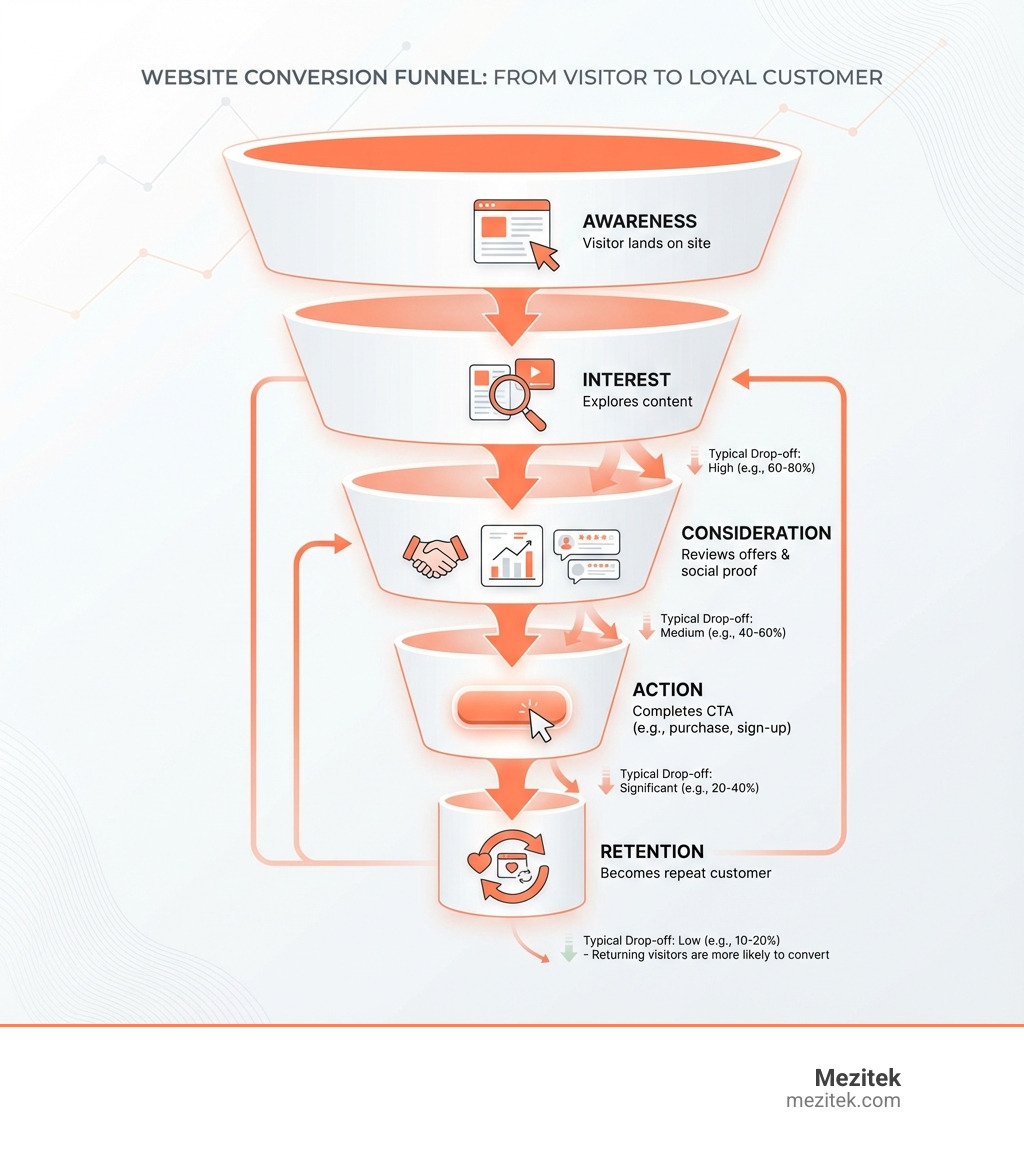
How to build a high-converting website starts with understanding what a conversion is: a visitor taking a desired action, like making a purchase, signing up for a newsletter, or booking a call. It’s the moment a browser becomes an active lead or customer.
Quick answer: To build a high-converting website, you need to:
- Define clear conversion goals for each page
- Understand your target audience deeply—their problems, needs, and motivations
- Design for clarity and action with intuitive navigation and prominent CTAs
- Build trust through social proof, testimonials, and professional design
- Optimize for speed and mobile so visitors don’t bounce before they convert
- Test and iterate continuously using A/B testing and analytics
Your website is your most powerful growth engine. With 97% of consumers researching businesses online, simply having a site isn’t enough. The average website converts just 2-5% of its visitors, meaning 95-98 out of 100 people leave without taking action. The difference between average and excellent isn’t luck; it’s about applying core conversion principles.
Even small improvements have a huge impact. Increasing your conversion rate from 2% to 3% is a 50% boost in leads or sales from the same traffic, without spending more on ads. For freelancers and agencies, mastering conversion optimization is a high-leverage skill. Since design drives 94% of first impressions, getting it right turns your website into a 24/7 sales machine.
The Foundation: Aligning Brand Strategy with User Needs
Before touching pixels or code, a solid brand strategy is essential. It’s the prerequisite for a high-converting website, ensuring every element is purpose-driven to solve your audience’s problems and drive business growth. This strategic alignment guides your design and messaging to speak directly to ideal customers, creating a site that not only looks good but performs brilliantly. For a deeper dive, check out our guide on How to Build a Website.
Define Your Target Audience and Their Problems
A website that converts is built on a deep understanding of its target audience. This involves user research into their demographics (age, location, profession) and psychographics (values, interests, lifestyle). A high-converting website isn’t about you; it’s about them.
Identify the specific pain points your product or service solves. Are they short on time? Overwhelmed by options? Seeking a trustworthy solution? Pinpointing these problems allows you to position your website as the answer.
To do this effectively, create detailed customer personas or “client profiles.” These semi-fictional representations of your ideal customers, based on data, should have names, motivations, and frustrations. This helps you tailor every aspect of your website to resonate with their needs, reducing friction and increasing the likelihood of conversion.
Craft Compelling Brand Messaging That Resonates
Once you know your audience, craft brand messaging that speaks directly to them. Your brand voice should be clear, concise, and consistent across the entire site.
Start with killer headlines that grab attention and clearly state what you offer and how it benefits the visitor. Most visitors decide in seconds if a page is useful. Following the headline, keep your copy concise. Focus on benefit-driven language, emphasizing what your product does for them rather than just listing features. For example, instead of “Our software has X feature,” try “Our software saves you Y hours a week.” This approach connects directly with their pain points.
By crafting clear and compelling brand messaging, you answer the visitor’s core question: “What’s in it for me?” For those looking to hone their writing skills, our guide on Writing It Yourself offers valuable insights.
Designing for Action: UX, Psychology, and Persuasion
Now we translate strategy into a design that guides visitors toward action. This is where User Experience (UX), User Interface (UI), and human psychology intersect. We’re not just making things look pretty; we’re designing for conversion.
This approach is often called Conversion-Centered Design (CCD), a framework that blends design principles with psychology to gently guide visitors toward taking specific actions. It’s about making every step of the user journey smooth and intuitive.
UX focuses on the overall feeling a user has, while UI is the visual design of the interactive elements. Together, they dictate how effectively your site communicates its value. A key aspect is visual hierarchy, which uses size, color, and spacing to prioritize what a user sees first. By emphasizing key elements like your value proposition or Call to Action (CTA), you direct the user’s attention. Ample whitespace is also vital, preventing clutter and improving focus. Our UX/UI Basics guide offers more foundational knowledge on this topic: UX/UI Basics.
Create an Intuitive User Experience and Navigation
An intuitive user experience is paramount. If visitors can’t easily find what they’re looking for, they’ll leave. Simple navigation and a logical site structure are your best friends. Place primary navigation links prominently and ensure crucial information is no more than a few clicks away. Limiting the number of main navigation items helps avoid overwhelming users.
Logical site structure also means arranging content in a way that makes sense, often by following established web conventions like the Z-pattern or F-pattern layouts. This helps users scan content easily. Good readability, achieved through font choices and spacing, ensures your message is absorbed. A smooth experience leads to more engagement and conversions. For more on structuring your site, explore our Best Practices for Website Architecture.
Leverage Social Proof and Trust Signals

In the digital world, trust is everything. With 84% of people trusting online reviews as much as a friend’s recommendation, social proof is incredibly powerful for increasing conversions.
Prominently feature customer reviews and testimonials on your website. They are powerful evidence that you deliver on your promises. Video testimonials can be especially authentic. Case studies offer a more in-depth look at how you’ve solved specific problems for clients.
Further build trust by including trust badges and security seals, especially for e-commerce. Displaying logos of well-known clients or industry certifications also boosts credibility. When visitors see that others have had positive experiences, their confidence grows, moving them closer to conversion. People buy from those they trust. Dive deeper into the power of reviews here: 84% of people trust online reviews.
Master the Call to Action (CTA)
The Call to Action (CTA) is your website’s moment of truth. A strong CTA is unambiguous, compelling, and impossible to miss.
Effective CTAs use strong command verbs like “Get Your Free Quote” or “Start Your Trial.” Visual prominence is also key. Use contrasting colors to make your CTA buttons stand out. Place them strategically, such as above the fold and throughout relevant content.
To motivate immediate action, you can create urgency with phrases like “Limited Time Offer.” Finally, each page should have a single, primary CTA to avoid decision paralysis. To ensure your CTAs are effective, continuously use A/B testing to see what resonates best with your audience.
How to Build a High-Converting Website: Technical Optimization and Testing
Beyond design and messaging, your website’s technical performance profoundly impacts its ability to convert. A slow or mobile-unfriendly site is a guaranteed conversion killer. Prioritizing speed and a seamless experience across all devices is essential for today’s on-the-go user. For those just starting, learning How to Set Up a WordPress Site is a great first step.
Prioritize Website Speed and Mobile Optimization
Patience is a virtue few website visitors possess. A 1-second delay in site speed can cause a 7% drop in conversions, as most users expect a site to load in under 3 seconds. Mobile optimization is equally critical. With 83% of landing page visits happening on mobile, a non-optimized site alienates the majority of your potential customers.
To optimize your website for all devices:
- Use responsive design: Ensure your layout automatically adjusts to any screen size.
- Compress images and media: Large files are a primary cause of slow load times. Our Image Optimization Best Practices guide can help.
- Implement caching: Store static versions of your pages to load them faster for return visitors.
- Minimize HTTP requests: Reduce the number of files a browser needs to download.
- Test regularly: Use tools like Google’s PageSpeed Insights to find and fix speed issues.
Prioritizing speed and mobile optimization ensures a smooth user experience, which directly impacts conversion rates.
Implement A/B Testing to Continuously Improve
Building a high-converting website is an ongoing process of refinement. A/B testing, or split testing, is your secret weapon for this.
A/B testing involves creating two versions of a webpage element (like a headline or CTA button) and showing each to a segment of your audience to see which performs better. This data-driven approach replaces guesswork with informed decisions. It helps you identify winning elements, reduce friction, and understand user preferences.
You can test almost anything, including headlines, images, CTAs, form fields, and page layouts. By continuously running experiments and analyzing the results with analytics tools, you can make incremental improvements that compound over time, leading to significant boosts in conversions. For more guidance, check out A/B Testing with Mezitek’s recommended tools and strategies.
Use Content Marketing and SEO to Attract Converting Traffic
A high-converting website needs qualified traffic—people already interested in what you offer. This is where content marketing and Search Engine Optimization (SEO) work together.
Content marketing attracts and educates your target audience. By creating high-quality content (blog posts, guides, videos) that addresses their pain points, you build trust and establish authority. This naturally pulls in visitors who are actively searching for solutions you provide.
SEO ensures this content gets found. Key practices include:
- Keyword research: Identifying the search terms your audience uses.
- On-page SEO: Optimizing content, meta descriptions, and headings. Our guide on Title and Meta Descriptions is a good starting point.
- Local SEO: Optimizing your Google Business Profile to help local customers find you.
When you combine content marketing and SEO, you attract visitors who are educated about your offerings and therefore much more likely to convert.
Avoiding Conversion Killers: 10 Common Mistakes to Sidestep
Even with the best intentions, it’s easy to fall into traps that sabotage your website’s conversion rates. Recognizing these common mistakes is the first step to fixing them. Here are 10 conversion killers to avoid:
- Unclear Value Proposition: If visitors don’t immediately get what you do and why it matters, they’ll leave.
- Complicated Navigation: A confusing site structure frustrates users. If they can’t find it, they can’t buy it.
- Slow Load Times: A 1-second delay can cost 7% of conversions. Slow sites are abandoned sites.
- Not Being Mobile-Friendly: With most traffic coming from mobile, a non-responsive site is a massive missed opportunity.
- Weak or Hidden CTAs: Your call to action must be prominent, compelling, and clear.
- Too Many Form Fields: Long forms create friction. Keep them as short as possible.
- Lack of Social Proof: Without reviews or testimonials, you’re asking visitors to take a leap of faith. Provide proof that others value your work.
- Poor Quality Images: Blurry or generic images look unprofessional and fail to engage. Use high-quality visuals.
- Ignoring A/B Testing: Relying on assumptions leads to stagnation. Test continuously to find what truly works.
- Inconsistent Branding: A disjointed brand experience across your marketing materials erodes trust and credibility.
Frequently Asked Questions about Building a High-Converting Website
Here are answers to some of the most common questions about building a high-converting website.
How do you calculate a website’s conversion rate?
The formula is (Number of Conversions / Total Number of Visitors) * 100. For example, if you had 50 sales from 1,000 visitors, your conversion rate is 5%. You can track this using tools like Google Analytics.
What defines a high-converting website?
A high-converting website effectively turns a significant percentage of its visitors into leads or customers. It’s characterized by clear goals, deep audience understanding, intuitive design, and strong trust signals.
What is a good conversion rate for a website?
The average website conversion rate is 2-5%. However, a “good” rate varies by industry and traffic source. Rates above 5% are generally considered strong, with top-performing sites reaching 10% or more. The average landing page converts around 4.02%; if you’re beating that, you’re doing well.
What are micro-conversions and macro-conversions?
- Micro-conversions are small steps indicating progress toward a larger goal (e.g., signing up for a newsletter, adding an item to a cart).
- Macro-conversions are the ultimate goals (e.g., making a purchase, submitting a lead form).
Tracking both is crucial because micro-conversions help identify friction points in the user journey and provide insights into user behavior.
How can live chat features improve website conversion rates?
Live chat allows for real-time customer support. With 41% of customers expecting live chat, it can lead to a significant increase in conversion rate. By providing instant answers, live chat reduces friction and encourages immediate action.
What are the key metrics to track for landing page performance?
Key metrics include Page Views, Conversion Rate, Bounce Rate, Sessions by Source (to see where traffic comes from), and Session Duration (to gauge engagement). Tracking these helps identify what’s working and what needs optimization.
How long does it take to see results from conversion optimization?
Results vary. Small A/B tests on a high-traffic site might show an impact in days. Larger strategic changes, like a redesign, may take several weeks or months to show a stable lift in conversions. Conversion optimization is an ongoing process.
Conclusion: Turn Your Website into a Growth Engine
Building a high-converting website is not just about aesthetics; it’s about strategic design, deep user understanding, and relentless optimization. We’ve explored how aligning brand strategy with user needs, designing for action with intuitive UX and persuasive elements, and prioritizing technical performance are all critical components. From defining our audience to mastering the CTA, every step contributes to changing passive visitors into active customers.
This isn’t a “set it and forget it” endeavor. The digital landscape is always evolving, and our website should evolve with it. The importance of an iterative process and continuous improvement cannot be overstated. By consistently testing, analyzing, and refining, we ensure our website remains a powerful, efficient growth engine for our business.
At Mezitek, we’re passionate about empowering freelancers and small business owners to build websites that don’t just exist but thrive. Your website truly is your most powerful growth tool, and with the right principles and practices, it can open up incredible potential.
Ready to take your web design skills to the next level? Explore our Web Design resources for more tips and start building websites that convert!