Why E-commerce Businesses Are Breaking Free from Old Platforms
Headless e-commerce solutions are changing how online stores work by separating what customers see (the front end) from what runs the business (the back end). This gives you complete freedom to build unique shopping experiences on any device or channel.
Key benefits of headless e-commerce:
- Faster websites – Better performance means higher conversion rates
- Complete design freedom – Build any customer experience you can imagine
- Easy updates – Change your storefront without touching your back-end systems
- Future-proof – Add new sales channels (apps, voice assistants, IoT) without rebuilding
- Better for developers – Use modern frameworks like React, Vue, or Next.js
Customer expectations are rising fast. Nearly three-quarters of customers expect companies to understand their unique needs. Even a 100-millisecond delay in load time can reduce conversion rates by 7%.
Traditional e-commerce platforms can’t keep up. Only 5% of organizations can make changes within minutes, while 63% must wait days or longer. That’s why the global headless commerce market reached $1.7 billion in 2023 and is projected to grow at 22.5% annually, hitting $13.2 billion by 2035.
For freelancers and small agencies, this shift creates huge opportunities. You can now build custom, high-performance stores for clients without massive budgets or teams. The decoupled architecture means your design work doesn’t depend on back-end developers, and vice versa.
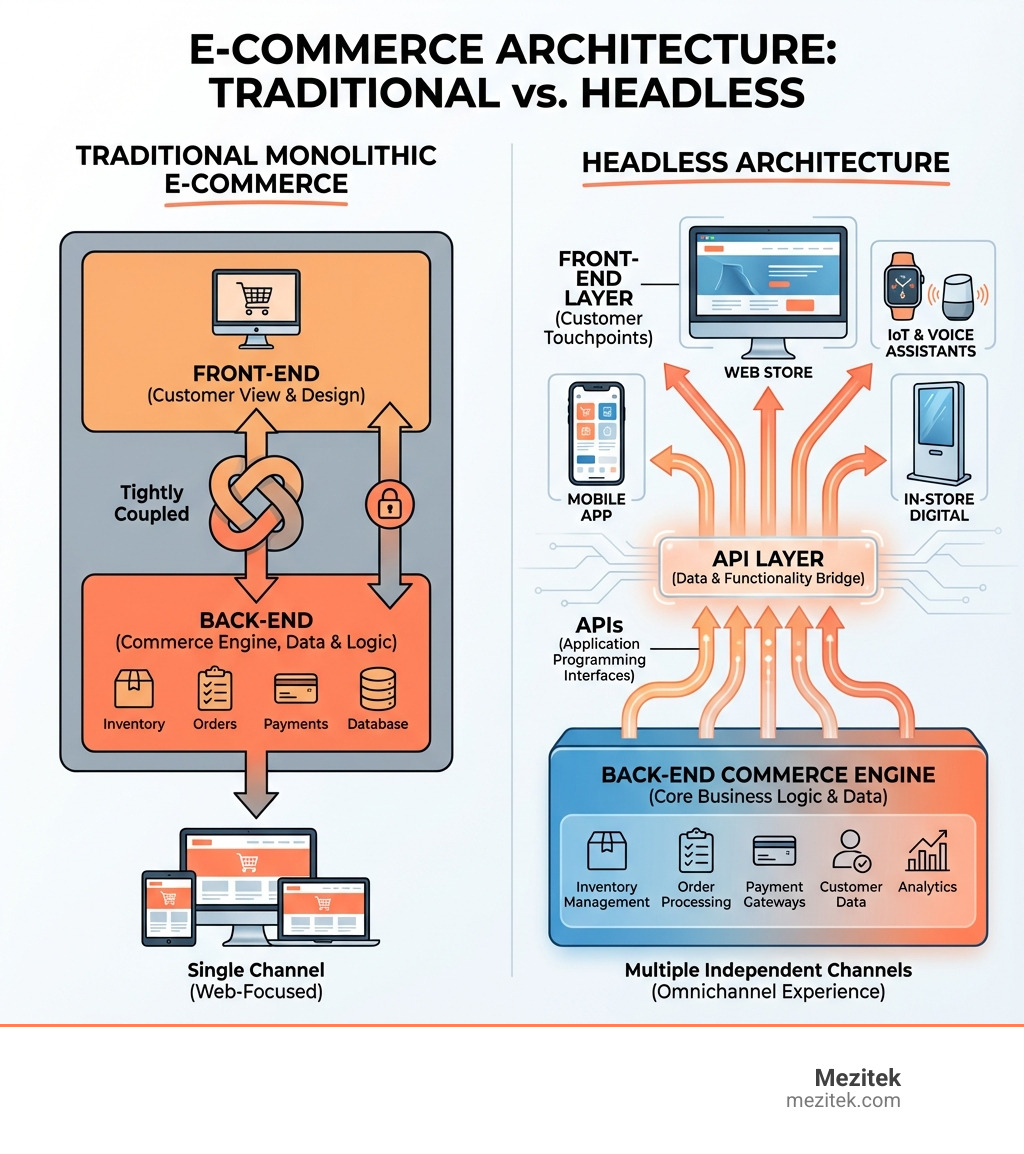
The core difference: Traditional e-commerce tightly links your front-end design to your back-end systems. Make one change, and you risk breaking something else. Headless commerce uses APIs to keep them separate. Your marketing team can update content instantly. Your developers can rebuild the front end without touching inventory management. Everything works independently but talks to each other perfectly.
What is Headless Commerce and Why Does It Matter?
Imagine a mannequin (the “head” or front end) and a stockroom full of clothes (the “body” or back end). In traditional retail, the mannequin is always attached to the stockroom, meaning you can only display what’s directly connected. If you want to change the display, you might have to rearrange the entire stockroom!
Headless commerce breaks that connection. The mannequin (your website, mobile app, smart speaker, or any other customer touchpoint) can be swapped out or redesigned independently of the stockroom (your inventory, pricing, order processing, and payment systems). They communicate via a digital “language” called APIs (Application Programming Interfaces). This decoupling is the essence of headless e-commerce solutions.
This approach is particularly powerful for omnichannel retail, allowing you to deliver consistent experiences across every channel where your customers interact with a brand. From a sleek website to a voice assistant, all can draw from the same reliable back-end commerce engine.
Here’s a quick comparison to highlight the difference:
| Feature | Traditional E-commerce | Headless Commerce |
|---|---|---|
| Flexibility | Limited by platform templates and tightly coupled systems | Unlimited design and experience possibilities |
| Speed | Slower development cycles, potential performance bottlenecks | Faster load times, quicker updates, independent optimization |
| Customization | Constrained by pre-built themes and modules | Full creative control over front end, custom user journeys |
| Developer Exp. | Can be restrictive, limited tech stack choices | Freedom to use modern frameworks, faster iteration |
Understanding the Core of headless e-commerce solutions
At its heart, headless commerce relies on APIs – those digital messengers that allow different software systems to talk to each other. Whether it’s REST (Representational State Transfer) or GraphQL, these APIs become the communication backbone. They enable content delivery, product information, and customer data to flow smoothly between independent systems.
Consider your content. A traditional Content Management System (CMS) might tightly couple your content with your website’s design. With headless, your content can live in a dedicated headless CMS and be delivered via API to any “head” – your website, a mobile app, even a digital billboard. If you want to dive deeper into how a CMS works, check out our guide on What is a CMS? Content Management Systems Explained.
Meanwhile, the back-end commerce engine handles all the critical business logic: inventory management, pricing, promotions, customer accounts, order processing, and payment gateways. These functions operate independently, ensuring stability and efficiency, no matter how wild your front-end experiments get.
How Headless Differs from Traditional E-commerce
Traditional e-commerce platforms typically employ a monolithic architecture where the front end (what the customer sees) and the back end (the business logic) are tightly coupled. Think of it like an all-in-one appliance – great for simplicity, but if one part breaks, the whole thing might stop working. Changes to the front end often require updates to the back end, leading to slower development cycles, rigid template limitations, and a frustrating lack of creative freedom.
This tight coupling can severely hinder a business’s ability to adapt. When the future of retail is expected to be heavily online, with projections showing e-commerce making up nearly 24.5% of all retail sales by 2025, clinging to outdated, monolithic systems is like trying to win a Formula 1 race in a horse-drawn carriage. Headless commerce, in contrast, offers the speed and agility needed to not just compete, but to lead.
The Transformative Benefits of a Headless Architecture
Adopting a headless architecture isn’t just about technical jargon; it’s about open uping a new level of business agility and customer satisfaction. For us as freelancers and small business owners, this means we can offer clients cutting-edge solutions that truly stand out.
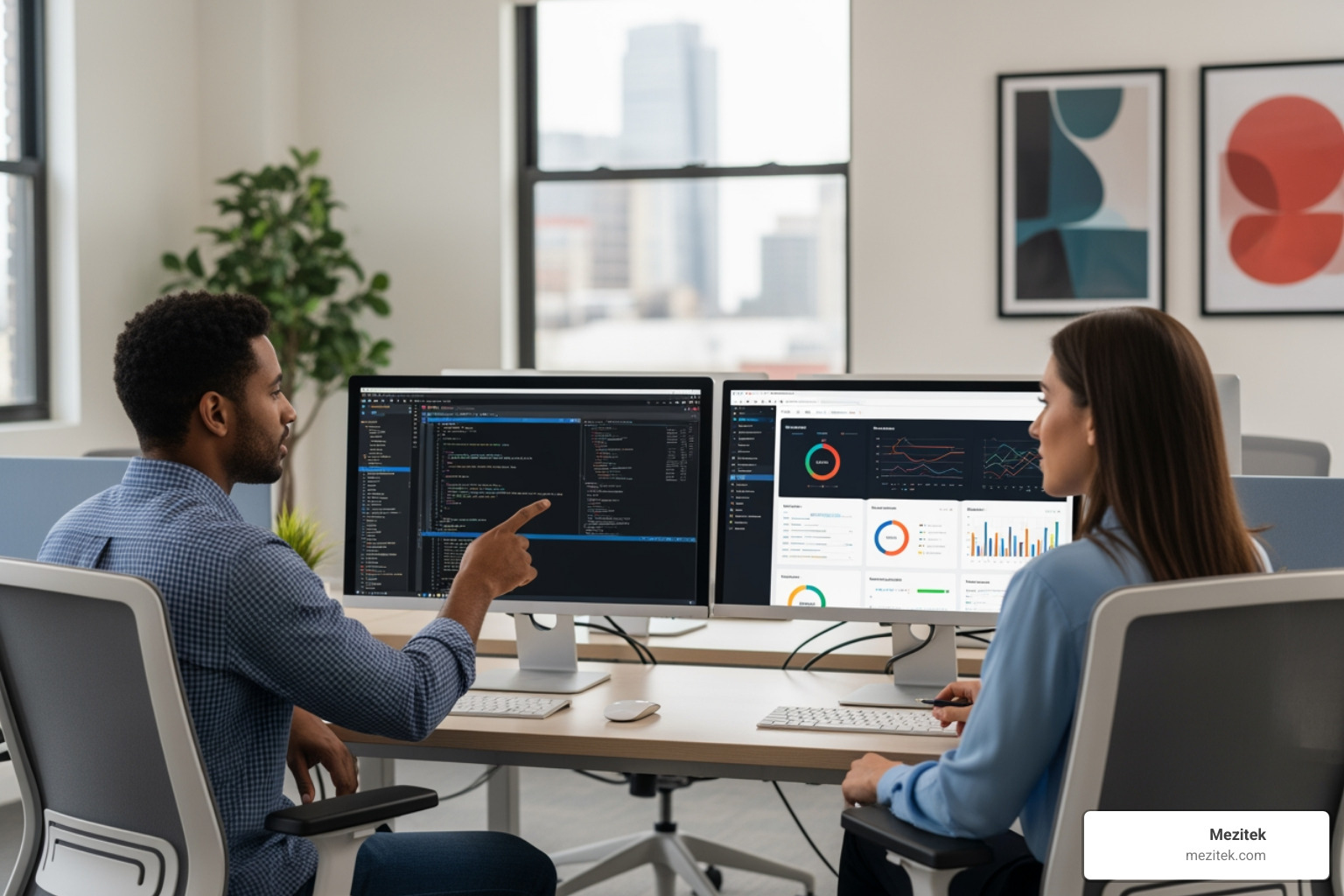
One of the most immediate benefits is a faster time-to-market. Because the front and back ends are separate, development teams can work in parallel. Marketers can push out new content without waiting for developers, and developers can build new features without worrying about breaking existing campaigns. This parallel workflow means we can launch new products, promotions, or even entire storefronts much more quickly than with traditional platforms.
Best Flexibility and Customization
With headless, your creativity is the only limit. We gain complete freedom of expression over the user experience. Instead of being confined by restrictive platform templates, we can choose any front-end framework (like React, Vue, or Angular) to build truly unique user experiences. This is where our web design skills really shine! If you’re passionate about crafting beautiful and functional interfaces, this approach is a dream come true. For more insights on design, check out our Web Design resources.
This flexibility also translates to a superior customer experience. Imagine being able to update a product page’s design based on real-time trends or A/B test different layouts without touching the complex back-end inventory system. This is the power of headless. Nike, for example, saw a 30% increase in page load speed after implementing a headless CMS, directly impacting user experience and likely conversion rates. Sephora achieved a 15% increase in customer engagement across their digital channels after adopting a headless CMS, demonstrating the power of custom experiences.
Improved Performance and Scalability
In the digital world, speed is king. Slow websites annoy users and cost money. Studies show that even a 100-millisecond delay in load time can reduce conversion rates by 7%. Headless commerce significantly improves website loading times by allowing independent optimization of the front end. This leads to faster load times, reduced bounce rates (some studies suggest up to 30% reduction compared to traditional systems), and a smoother shopping experience.
Beyond speed, headless architecture offers unparalleled scalability. It allows different parts of your e-commerce system to scale independently. If you experience a sudden surge in traffic during a flash sale, your front end can handle the load without impacting the back-end processing power, and vice versa. This modular approach means your system can handle traffic spikes with grace, ensuring a consistent experience for all customers. In fact, a 2024 WP Engine study found 79% of businesses using headless architecture rate their scalability capabilities as strong, highlighting its robustness for growth.
Key Considerations for Implementing Headless E-commerce Solutions
While the benefits are compelling, diving into headless e-commerce solutions requires careful planning. It’s not a magic bullet, but a powerful tool when wielded thoughtfully. For freelancers and small agencies, understanding these considerations is crucial for guiding clients effectively.
Technical and Architectural Choices
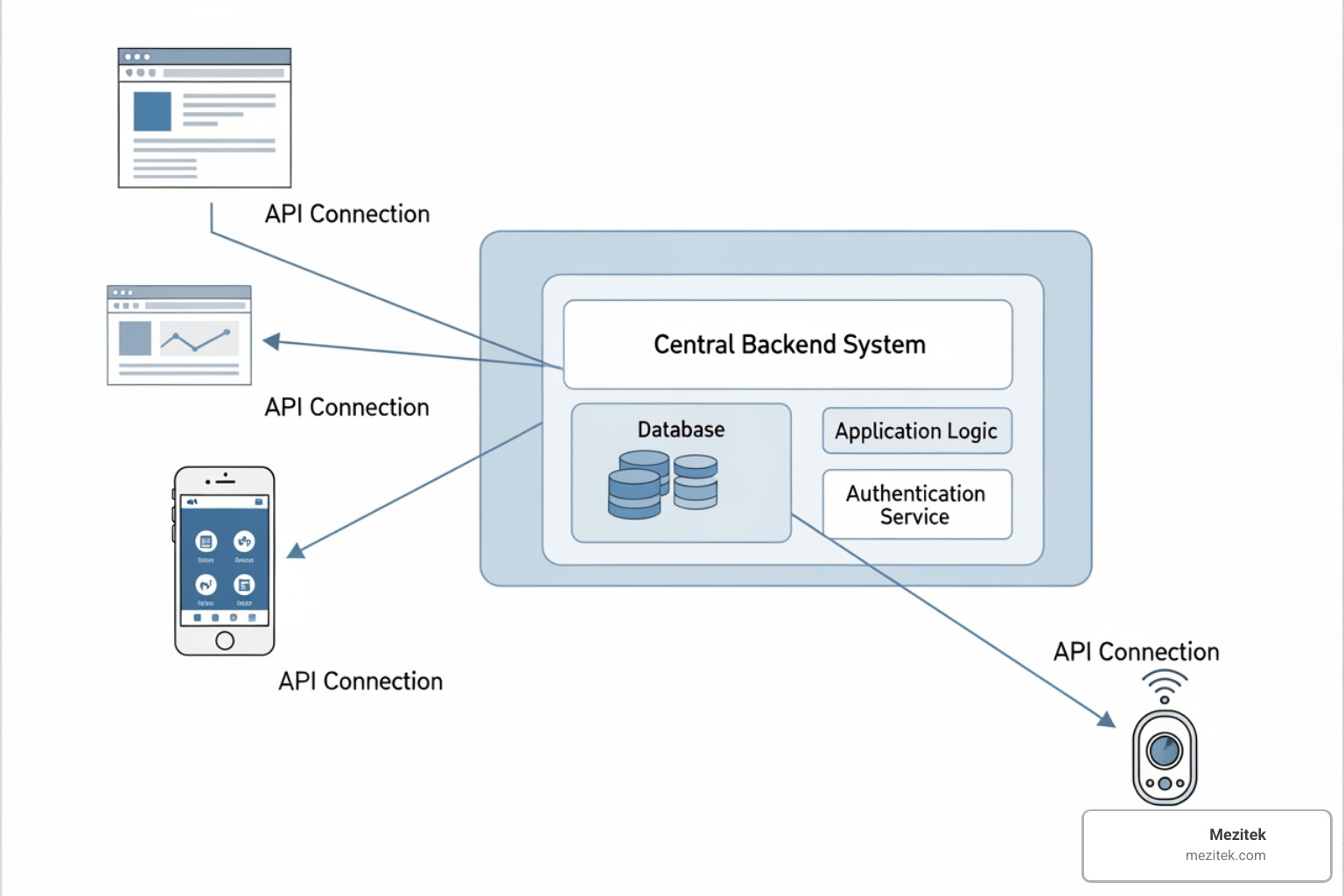
The foundation of any headless setup is its technical architecture. Here, we’re talking about the quality of the APIs that connect everything, the robustness of your security protocols, and how well different systems integrate.
- API Quality: The APIs are your digital glue. They need to be well-documented, reliable, and performant. Consider if they are RESTful or GraphQL-based, and how flexible they are for querying and updating data.
- Security Protocols: Decoupling systems means more points of connection, which can mean more potential vulnerabilities if not managed correctly. Robust authentication, authorization, and data encryption are non-negotiable. Data privacy and compliance, such as GDPR, are also paramount. Our Cookie Consent Guide for Web Designers can offer some initial guidance on this front.
- Integration Capabilities: One of the biggest advantages of headless is integrating “best-of-breed” tools. This means your core commerce platform needs to play nice with other services like a headless CMS, CRM, PIM, or marketing automation tools. Look for platforms with pre-built connectors or flexible APIs that allow for custom integrations.
- Hosting: With a headless setup, your front end and back end might be hosted separately. This gives you more choice in hosting providers, allowing you to select the best fit for each component’s needs. We have resources on Hosting that can help you choose wisely.
- Overall Architecture: Thinking about the entire system, from content delivery networks (CDNs) to caching mechanisms, is vital for performance and reliability. For deeper insights into structuring your online presence, explore our Best practices for website architecture.
Implementation Approaches: Build, Buy, or Hybrid
When it comes to putting a headless solution into practice, you generally have three main paths:
- Build from Scratch: This approach offers maximum customization and control. You select all your components (commerce engine, CMS, front-end framework, etc.) and build the connections yourself. This is ideal for businesses with significant in-house technical expertise and unique requirements. However, it demands a high initial investment in time and resources. For those considering building from the ground up, our guide on How to build a website provides foundational knowledge.
- Buy an Off-the-Shelf Platform: Some traditional e-commerce platforms have evolved to offer headless capabilities through robust APIs. These can be a good starting point if you want some of the benefits of headless without the full complexity of building everything. Examples often include enterprise-level versions of well-known platforms that have exposed their back-end functionality.
- Hybrid Model: This is often the sweet spot for many businesses. It involves leveraging a core commerce platform (either a dedicated headless one or a traditional one with headless APIs) and then integrating best-of-breed services for specific functionalities, like a specialized headless CMS or a powerful search tool. This approach allows for significant customization without the burden of building everything from zero. This is closely related to composable commerce, where every component is independent and can be chosen separately, allowing you to “compose” your ideal tech stack.
Assessing your team’s technical skills and budget constraints is paramount when deciding which approach to take.
Understanding Costs and Challenges
While headless commerce promises long-term benefits, it’s important to be realistic about the initial investment and potential challenges.
- Initial Investment: Setting up a headless architecture often requires a higher upfront cost compared to a traditional, all-in-one platform. This is due to the need for more specialized development work, integrating multiple systems, and potentially higher licensing fees for individual best-of-breed components.
- Maintenance Costs: While headless can lead to lower long-term infrastructure spend, it shifts maintenance responsibilities. You might have multiple vendors and systems to manage, requiring skilled developers to maintain the connections and ensure everything runs smoothly.
- Need for Skilled Developers: Headless solutions demand a higher level of technical expertise. You’ll need developers proficient in modern front-end frameworks, API integrations, and potentially cloud infrastructure. This can be a challenge for businesses with smaller or less specialized IT teams.
- Potential Complexity: Managing multiple decoupled systems can introduce complexity. Ensuring seamless data flow, debugging issues across different services, and maintaining a coherent user experience requires robust planning and ongoing effort.
- Phased Implementation: To mitigate risks and manage costs, a phased implementation strategy is highly recommended. Instead of a “big bang” launch, start by decoupling a single customer touchpoint or a specific part of the user journey (e.g., product pages or checkout). This allows teams to adjust gradually, learn, and optimize before rolling out the full headless experience. Only 5% of organizations can make changes within minutes, and 63% must wait days or longer for changes to their e-commerce platform. A phased approach can help reduce this lag.
Enhancing the Customer and Developer Experience
The true power of headless e-commerce solutions lies in their ability to radically improve both the customer journey and the day-to-day lives of our development teams. It’s a win-win!
Creating Superior Customer Experiences
This is where headless truly shines. Because the front end is fully customizable, we can craft truly unique and personalized customer experiences across every touchpoint. No longer are we constrained by templates; we can design exactly what we want, how we want it.
- Seamless Omnichannel Journeys: Customers don’t just shop on your website anymore. They interact with brands on mobile apps, social media, voice assistants, and even IoT devices. Headless enables a consistent brand experience across all these channels. Imagine a customer adding an item to their cart on their phone, then completing the purchase via a voice command on their smart speaker – all seamlessly connected by the same back-end. This is the promise of headless.
- Personalized Content: With content delivered via API, it’s easier to serve up highly personalized product recommendations, promotions, and content based on individual customer behavior. A PwC study found that 73% of shoppers say customer experience is the top factor when deciding where to buy. Headless empowers us to deliver on this expectation.
- Faster Site Speed: As we discussed, faster load times mean happier customers and higher conversion rates. Headless architectures, by separating the presentation layer, allow for optimized front-end performance, directly contributing to a superior user experience.
The list of potential customer touchpoints is constantly growing:
- Websites and Progressive Web Apps (PWAs)
- Native Mobile Apps
- Social Media Platforms (e.g., Instagram shopping)
- Voice Assistants (e.g., Alexa, Google Assistant)
- In-store Kiosks and Digital Displays
- Wearable Devices
- Augmented Reality (AR) and Virtual Reality (VR) experiences
- Chatbots and Conversational Commerce
Leveraging AI and Advanced Technologies
Headless commerce provides a flexible framework that’s perfectly suited for integrating cutting-edge technologies like Artificial Intelligence (AI) and Machine Learning (ML). Because your front end and back end are decoupled, you can easily plug in specialized AI services without overhauling your entire system.
- AI-Powered Search: Integrate advanced search tools that use AI to understand user intent, provide more relevant results, and even offer predictive search suggestions.
- Personalized Recommendations: Leverage AI algorithms to analyze customer data and offer highly relevant product recommendations, increasing average order value and customer satisfaction.
- Automated Customer Service: Connect AI-powered chatbots or virtual assistants to handle common customer inquiries, freeing up human agents for more complex issues.
- Integrating New Technologies: The API-first nature of headless means you’re always ready for the next big thing. Whether it’s a new AR shopping experience or an IoT device for reordering, your flexible architecture can integrate it seamlessly. If you’re curious about how AI is changing design, check out our Best AI Tools for Web Designers.
AI advances rapidly, and headless gives us the agility to incorporate these innovations quickly, ensuring our clients’ e-commerce stores remain at the forefront of technology.
Frequently Asked Questions about Headless Commerce
We often get asked common questions about headless commerce. Let’s break them down.
What is the main purpose of headless commerce?
The main purpose of headless e-commerce solutions is to gain unparalleled flexibility, speed, and control by decoupling the front-end presentation layer (what your customers see) from the back-end commerce functionality (all the business logic like inventory and payments). This allows businesses to create unique, highly custom customer experiences on any channel – be it a website, mobile app, or smart device – without being constrained by the limitations of a single, monolithic system. It empowers rapid innovation and adaptation to changing market and customer demands.
Is headless commerce only for large enterprises?
Historically, headless commerce was often associated with large enterprises due to its technical complexity and perceived high cost. However, this is rapidly changing! While it still requires a degree of technical resources and expertise, the rise of more accessible headless CMS platforms, ready-to-use API-first commerce engines, and hybrid implementation approaches makes it increasingly viable for freelancers and small business owners. Many platforms now offer solutions that cater to varying levels of technical skill and budget. If you have a clear vision for a unique customer experience and are willing to invest in the right tools and potentially some development expertise (or partner with someone who has it), headless can absolutely be a powerful option, even for smaller operations.
Can I use my existing CMS with a headless commerce setup?
Yes, absolutely! This is one of the key advantages of headless e-commerce solutions. If your Content Management System (CMS) can deliver content via an API (many modern CMS platforms offer this capability), then it can be integrated into your headless setup. In this scenario, your existing CMS acts as the “head” for your content, managing product descriptions, blog posts, marketing copy, and images. A separate headless commerce platform then handles all the back-end e-commerce functions like shopping carts, checkout, inventory, and order management. This allows you to retain your familiar content management workflows while gaining the flexibility of a headless commerce engine.
Conclusion
As we’ve explored, headless e-commerce solutions represent a significant evolution in how online businesses operate. By decoupling the front end from the back end, we open up unprecedented flexibility, allowing us to build lightning-fast, highly customized, and truly omnichannel experiences for our clients. This isn’t just a technical trend; it’s a strategic advantage that enables businesses to adapt quickly, innovate constantly, and meet the ever-rising expectations of today’s digital consumer.
For us, as freelancers and small business owners focused on web design and development, headless commerce is a game-changer. It empowers us to offer bespoke solutions that were once only accessible to large enterprises. We can craft unique digital storefronts using our preferred front-end technologies, integrate best-of-breed tools, and future-proof our clients’ businesses against the rapid pace of technological change. The shift towards a composable architecture, where we can pick and choose the best components for each specific need, puts immense power in our hands.
Taking control of your e-commerce future means embracing this flexibility. It means building resilient, scalable, and customer-centric online stores that are ready for whatever comes next. If you’re ready to dive deeper into managing your content effectively, we encourage you to Explore more about Content Management Systems and find how they fit into this exciting new landscape. The world of headless commerce is waiting, and we’re here to help you steer it.