
Open up Your Potential: How to Achieve Business Objectives
To achieve business objectives effectively, you need more than just good intentions. Many businesses, even large ones, struggle with turning plans into reality. In fact, 90% of senior executives from billion-dollar companies admit they failed to reach all their strategic goals because of poor implementation. This guide is your blueprint for success.
How to Achieve Business Objectives:
- Define SMART Objectives: Make sure your objectives are Specific, Measurable, Achievable, Relevant, and Time-bound.
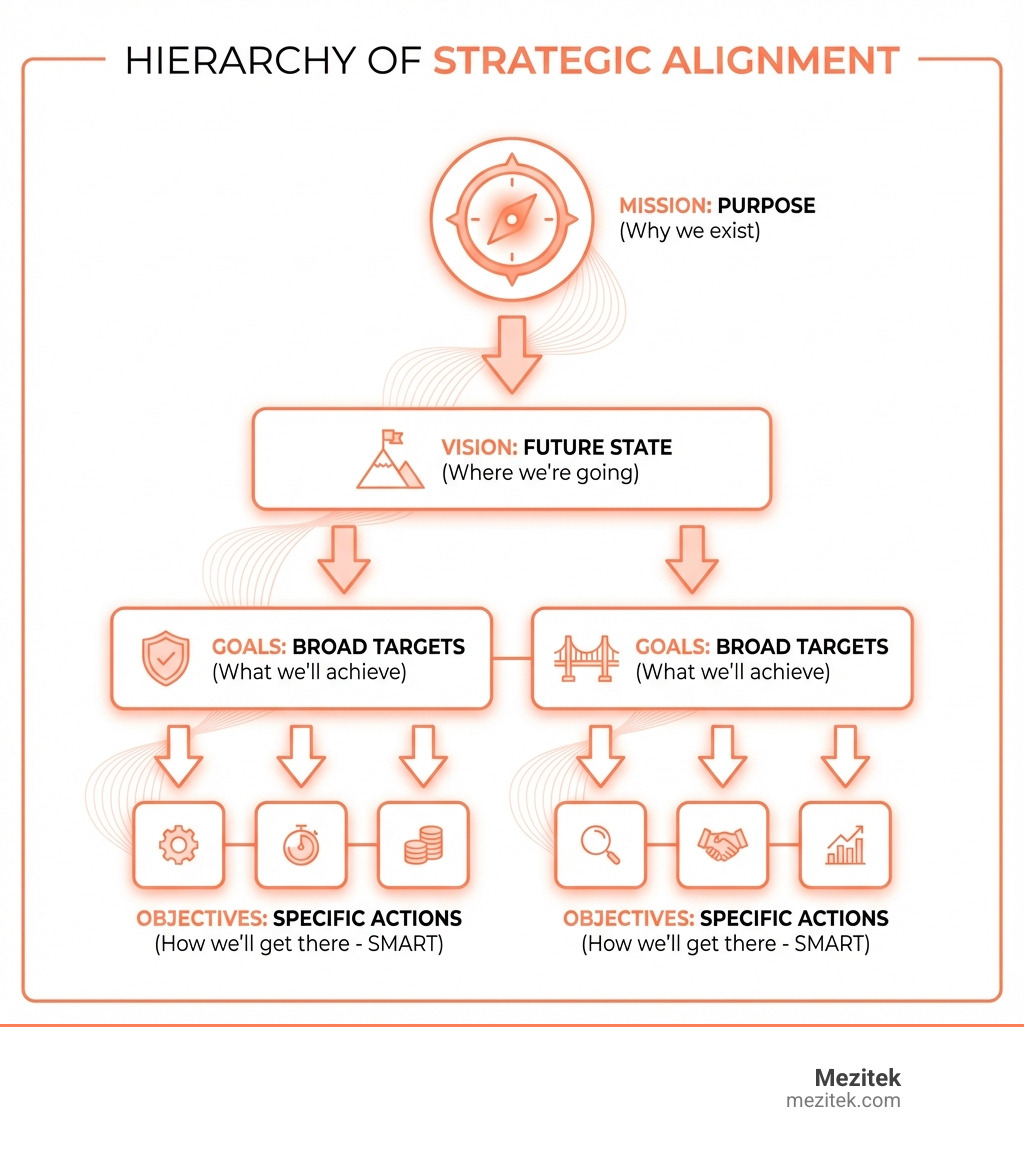
- Align with Your Vision: Connect every objective to your company’s mission and long-term goals.
- Involve Your Team: Get buy-in and accountability from everyone involved.
- Track Progress with KPIs: Use clear Key Performance Indicators to measure how you’re doing.
- Review and Adapt: Regularly check your progress and adjust your plan as needed.
Achieving your business objectives is the core of making your business thrive. It’s about more than just setting targets; it’s about creating a clear path, engaging your team, and consistently moving forward. Clear objectives provide direction, help you manage risks, and ensure every effort contributes to your overall success.
The Foundation: Setting Clear and Effective Business Objectives
To build anything substantial, you need a solid foundation. In business, this means clearly defining what you want to achieve and how you plan to get there. Without this clarity, our efforts can become scattered, and our progress, difficult to measure.

Goals vs. Objectives: Understanding the Crucial Difference
Often, the terms “goals” and “objectives” are used interchangeably, but in strategic planning, they serve distinct purposes. Understanding this difference is fundamental to effectively achieve business objectives.
Think of a business goal as a broad, aspirational statement of what your company wants to achieve in the long term. It’s the destination, the “where you want to end up.” For instance, a goal might be “to become the market leader in innovative web solutions” or “to significantly increase profitability.” These are inspiring and provide a general direction, but they lack specific detail.
Business objectives, on the other hand, are the specific, measurable targets that organizations set to achieve their strategic goals. They are the actionable steps, the “how you plan to get there,” that break down those broader aspirations into concrete, time-bound outcomes. An objective would be “increase organic website traffic by 40% in the next six months” or “reduce operational costs by 10% within the fiscal year.” Objectives provide clear direction, guide decision-making, and are the metrics by which we measure our overall business success. Hitting our business objectives means we’re on the path towards achieving our larger company goals.
Here’s a quick comparison:
| Characteristic | Business Goals | Business Objectives |
|---|---|---|
| Nature | Broad, aspirational, long-term | Specific, actionable, short-to-medium term |
| Focus | Overall direction, vision, desired future state | Measurable targets, steps to achieve goals, tangible outcomes |
| Examples | Become a market leader, improve brand trust | Increase market share by 10% in Q3, reduce customer support response time to 2 hours |
| Measurement | Difficult to quantify directly | Easily quantifiable with specific metrics |
For freelancers and small business owners, this distinction is particularly important. While your goal might be to “grow your business,” your objectives will dictate the practical steps, like “secure 5 new retainer clients by year-end” or “launch a new service offering by Q2.”
The SMART Framework for Powerful Objectives
Once we understand what business objectives are, the next step is to ensure they are effective. The most widely recognized and powerful framework for this is SMART. SMART is an acronym that stands for:
- Specific: An objective should clearly state what needs to be achieved. It should answer the “who, what, where, when, why, and which” questions. Vague objectives like “improve sales” are less effective than “increase sales of our premium web design package by 20% in the next quarter.” For freelancers, this might mean “acquire 3 new clients for Innovative Web Solutions in the next two months.”
- Measurable: If you can’t measure it, you can’t manage it. A measurable objective includes a clear unit of measurement (preferably numerical) that can identify progress and completion. This allows us to track our journey and know when we’ve succeeded. For example, “reduce customer support response times to under two hours by the end of Q2” provides a clear metric.
- Achievable: Objectives should be challenging but realistic. Setting overly ambitious objectives can lead to demotivation and burnout. We need to consider our resources, capabilities, and external factors. An objective like “launch a new product within six months” is achievable if we have the team and resources, whereas “double our global market share overnight” might not be.
- Relevant: An objective must align with our broader business goals and overall mission. It should be worthwhile and contribute to the bigger picture. If our goal is to improve brand trust, an objective to “increase customer satisfaction scores by 15% within one year” is highly relevant.
- Time-bound: Every objective needs a deadline. This creates a sense of urgency and helps in prioritizing tasks. A time-bound objective specifies when the result must be achieved, such as “develop and launch a new WordPress Hosting package by the end of Q3.”
By applying the SMART criteria, we transform vague aspirations into clear, actionable targets, greatly increasing our chances to achieve business objectives.
For a deeper dive into making your objectives SMART, check out A helpful guide to SMART criteria.
Aligning Objectives with Your “Why”
Setting objectives isn’t just about picking targets; it’s about choosing the right targets – those that genuinely propel our business forward in a meaningful way. This means aligning our objectives with our core values, company mission, and strategic vision.
Our company’s mission statement defines its purpose and primary objectives, while our vision statement outlines our desired future state. As Simon Sinek eloquently explains in his famous TED Talk, great leaders inspire action by starting with “why.” Understanding our “why” provides the ultimate filter for our objectives. If an objective doesn’t serve our mission or move us closer to our vision, it might not be the right objective for us. We highly recommend watching How great leaders inspire action for profound insights into this concept.
Before setting objectives, it’s crucial to conduct a thorough situational analysis. This typically involves a SWOT analysis, where we identify our business’s:
- Strengths: Internal capabilities and advantages (e.g., strong technical skills, loyal customer base).
- Weaknesses: Internal limitations (e.g., limited marketing budget, lack of expertise in a new technology).
- Opportunities: External factors we can leverage (e.g., emerging market trends for low-code solutions, increased demand for online services).
- Threats: External challenges that could impede progress (e.g., new competitors, economic downturn).
A situational analysis helps us understand our current market position and identify the most relevant and impactful areas for objective setting. For a freelancer or small business owner, this might involve researching local market needs for web design, analyzing competitor offerings, and assessing our own skills and capacity. This strategic foundation ensures that our objectives are not only SMART but also strategically sound and truly contribute to our long-term success.
The Blueprint: How to Strategically Achieve Business Objectives
Once we’ve laid the groundwork with clear, aligned objectives, the real work begins: execution. This phase is about creating a detailed blueprint for how we will achieve business objectives, involving measurement, team collaboration, and leveraging the right tools.

Measuring What Matters: Using KPIs to Track Progress
To know if we’re truly on track to achieve business objectives, we need to measure our progress. This is where Key Performance Indicators (KPIs) come into play. KPIs are quantifiable metrics that reflect how effectively we are achieving our business objectives. They are crucial for performance measurement and data-driven decisions.
While an objective states what we want to achieve (e.g., “Increase organic website traffic”), a KPI tells us how we’re measuring that achievement (e.g., “Number of unique website visitors per month” or “Search engine ranking for target keywords”). KPIs must be directly linked to our objectives and provide clear, actionable insights.
For Mezitek, focusing on freelancers and small businesses, relevant KPIs might include:
- Website Performance: Unique visitors, bounce rate, time on page, conversion rate (e.g., contact form submissions).
- Client Acquisition: Number of new leads, conversion rate from lead to client, client acquisition cost.
- Financials: Monthly recurring revenue (MRR), project profitability, cash flow.
- Customer Satisfaction: Client retention rate, feedback survey scores.
Regularly tracking these KPIs allows us to:
- Monitor progress: See if we’re moving closer to our objectives.
- Identify issues early: Spot problems before they become major roadblocks.
- Make informed adjustments: Pivot our strategies based on real-time data.
For those managing their own websites, understanding website analytics is paramount. It’s not just about traffic; it’s about understanding user behavior and optimizing for conversions. Learn more about how to set up your website for success in tracking performance with More info about Best Practices for Website Architecture.
Fostering Team Engagement to Achieve Business Objectives
No business objective is truly achieved in isolation. Whether you’re a solo freelancer collaborating with clients or a small business with a growing team, involving others is key. Achieve business objectives requires collective effort, and that means fostering strong team engagement and accountability.
Stakeholder involvement from the outset ensures buy-in. When individuals feel they have a voice in shaping objectives, they are more likely to commit to achieving them. This is particularly true for our team members. When teams can understand how their work ladders up to the organization’s overall goals, better results follow.
Employee empowerment and ownership are also critical. Instead of micromanaging, we should strive to increase the level of autonomy with our staff. As research suggests, increasing the level of autonomy with your staff automatically increases their level of engagement. Empowering our team members to take ownership of initiatives, delegate responsibilities, and find the best ways to achieve their tasks not only boosts morale but also open ups their potential and creativity.
Finally, fostering a culture of accountability is non-negotiable. This isn’t about blame; it’s about shared responsibility and commitment. Clear objectives, defined KPIs, and regular check-ins create transparency. Holding regular meetings with stakeholders to report on status and conducting retrospectives to understand successes and failures are effective ways to build this culture. Transparent communication ensures everyone knows their role and how their contributions impact the overall success.
Leveraging Technology for Objective Tracking
Technology is an indispensable ally in our quest to achieve business objectives. For freelancers and small businesses building and managing websites, the right tools can streamline processes, improve collaboration, and provide invaluable insights.
Various software solutions are designed to support objective setting and tracking:
- OKR (Objectives and Key Results) software: Tools like Asana, Monday.com, or specialized OKR platforms help us define, track, and align objectives across teams. They provide a centralized view of progress, ensuring everyone is working towards shared goals.
- Project Management Tools: Platforms such as Trello, Jira, or ClickUp are excellent for breaking down objectives into actionable tasks, assigning responsibilities, and monitoring deadlines. They facilitate collaboration and keep projects on schedule.
- CRM (Customer Relationship Management) platforms: For customer-centric objectives, CRM systems (e.g., HubSpot, Salesforce) help us track client interactions, manage sales pipelines, and measure customer satisfaction, providing data essential for achieving targets like reducing churn or increasing client lifetime value.
- Content Management Systems (CMS): For businesses focused on their online presence, a robust CMS is crucial. A CMS like WordPress allows us to manage website content, implement SEO strategies, and integrate analytics tools to track web-specific objectives.
The beauty of these tools, especially for low-code freelancers and small business owners, is their accessibility and often intuitive interfaces. They empower us to manage complex strategic processes without needing extensive technical expertise. For more on how these systems can support your online presence, explore More info about What is a CMS? Content Management Systems Explained. By embracing these technologies, we can track our progress in real-time, adapt quickly, and significantly boost our chances to achieve business objectives.
Navigating the Journey: Overcoming Challenges and Ensuring Growth
The path to achieve business objectives is rarely a straight line. We’ll encounter bumps, detours, and unexpected challenges. The key to success lies in our ability to anticipate these obstacles, adapt our strategies, and maintain a focus on continuous improvement and sustainable growth.
Common Challenges When You Try to Achieve Business Objectives
Even with the best intentions and meticulous planning, businesses often face problems. Understanding these common challenges is the first step to overcoming them:
- Poor Implementation: This is a major one. An Economist study found that 90% of senior executives from billion-dollar companies admitted they failed to reach all their strategic goals because of poor implementation. A great strategy is useless without effective execution.
- Unclear or Ambiguous Goals: Objectives that are not SMART leave too much room for interpretation, leading to wasted effort and misalignment.
- Lack of Stakeholder Alignment: If team members, clients, or partners aren’t on board or don’t understand the “why” behind an objective, resistance can derail progress.
- Overly Ambitious or Unrealistic Goals: While stretch goals are good, setting objectives that are genuinely unachievable can lead to demotivation, burnout, and a loss of confidence.
- Insufficient Resources: Attempting to achieve business objectives without adequate budget, personnel, or tools is a recipe for failure.
- Poor Communication: Silos, lack of transparency, or infrequent updates can prevent teams from coordinating effectively and identifying issues.
- Resistance to Change: People naturally resist new ways of doing things. Without proper change management and clear communication about the benefits, new objectives can be met with skepticism.
Overcoming these challenges requires proactive planning, clear communication, and a willingness to adapt. For freelancers and small businesses, this often means being realistic about our capacity, clearly communicating with clients, and investing in the right tools and skills.
The Importance of Regular Reviews and Adaptability
The business landscape is constantly shifting. What was relevant yesterday might not be today. Therefore, to truly achieve business objectives, we must accept a mindset of continuous review and adaptability.
Regularly reviewing our objectives and progress is not just a good practice; it’s essential for survival and growth. This allows us to:
- Assess performance: Are our KPIs moving in the right direction?
- Identify roadblocks: What’s preventing us from progressing?
- Adjust strategies: If something isn’t working, we need to be prepared to change course.
- Stay relevant: Market conditions, customer needs, and technological advancements evolve rapidly. Our objectives must evolve with them.
Research in the Harvard Business Review cautions against getting locked into a strategic plan and forgetting that strategy involves inherent risk and discomfort. A good strategic plan evolves and shifts as opportunities and threats arise.
Many organizations are adopting agile methodologies to foster this adaptability. Agile leadership involves breaking down objectives into short, iterative cycles, allowing for continuous assessment and adaptation. This approach improves flexibility and responsiveness in rapidly changing markets. Implementing agile methodologies has led to a 60% increase in team productivity in organizations that have adopted these practices. For freelancers and small businesses, this means being nimble, open to feedback, and willing to pivot our services or marketing efforts based on what we learn from our data and the market.
Balancing Short-Term Wins and Long-Term Vision
Successfully achieving business objectives requires a delicate balance between immediate results and future aspirations. While short-term objectives (like quarterly targets) provide quick wins and maintain momentum, long-term objectives (annual goals, 5-year plans) ensure sustainable growth and future-proofing.
Short-term objectives give us concrete milestones and motivate our teams. For example, “reduce customer support response times to under two hours by the end of Q2” provides an immediate focus. Achieving such objectives can boost morale and provide valuable data for larger strategic goals.
However, we must not lose sight of the long-term vision. These are the objectives that contribute to our company’s sustainable growth and adaptability in a changing business landscape. An objective to “become the leading provider of low-code web solutions in our region by 2028” will guide our short-term decisions, ensuring they align with this grander ambition.
The challenge is to ensure that our short-term objectives are not only achievable but also consistently contribute to our long-term goals. This requires strategic prioritization and a clear understanding of how each small step builds toward the bigger picture. By balancing both, we create a dynamic strategy that delivers immediate value while securing our future.
Practical Examples of Business Objectives
To make this guide as practical as possible, let’s look at some concrete examples of effective business objectives across different categories. These can help inspire and clarify how you might formulate your own. Remember to make them SMART!
Financial Objectives
These objectives focus on the economic health and profitability of the business.
- Increase annual revenue by 15% through a combination of new client acquisition and upselling existing services by December 31, 2024.
- Reduce operational costs by 10% by optimizing software subscriptions and streamlining workflows within the next two quarters.
- Improve profit margin by 5% within the fiscal year by renegotiating supplier contracts and enhancing service pricing.
Customer-Centric Objectives
These objectives revolve around client satisfaction, retention, and market presence.
- Achieve a 95% customer satisfaction score (CSAT) as measured by post-project surveys by year-end.
- Reduce customer churn by 20% in the next six months by implementing a proactive client feedback system and enhancing post-delivery support.
- Increase market share by 5% in our target demographic (e.g., small e-commerce businesses) by launching a targeted marketing campaign in Q3.
Web-Specific Objectives
Given Mezitek’s focus, these objectives are particularly relevant for freelancers and small businesses building and managing their online presence.
- Increase organic website traffic by 40% in 6 months by implementing a comprehensive SEO strategy, including keyword optimization and regular blog content.
- Generate 50 qualified leads per month via the website’s Contact form by optimizing landing pages and call-to-actions within the next quarter.
- Reduce website bounce rate to below 35% by Q4 by improving website loading speed, mobile responsiveness, and content relevance.
- Launch a new service page for WordPress Hosting by the end of Q2, complete with case studies and clear pricing.
Frequently Asked Questions about Achieving Business Objectives
Why is setting clear business objectives crucial for success?
Setting clear business objectives is crucial because they provide a definitive roadmap for your organization. They clarify what needs to be accomplished, ensuring everyone from leadership to individual contributors understands their role and how their efforts contribute to the company’s overall mission. Clear objectives enable effective resource allocation, facilitate progress measurement, and foster a sense of purpose and accountability, which are all vital for sustainable growth and adaptability. Without them, businesses risk drifting without direction, making it difficult to measure success or adapt to change.
How often should business objectives be reviewed?
Objectives should be reviewed regularly to ensure they remain relevant and on track. A common best practice is to conduct quarterly reviews for strategic objectives, allowing enough time to see progress but also to make necessary adjustments. For more tactical or short-term objectives, monthly check-ins are beneficial. This more frequent review cycle helps in tracking rapid progress, identifying immediate roadblocks, and adapting to dynamic market conditions, especially for agile small businesses and freelancers. The key is consistency and a willingness to pivot based on performance data and changing circumstances.
What is the difference between an objective and a KPI?
An objective is a specific, measurable target you want to achieve – it defines what you want to accomplish. For example, “Improve customer retention.”
A KPI (Key Performance Indicator) is a metric used to measure progress toward an objective – it defines how you will measure success. For the objective “Improve customer retention,” a KPI might be “Customer churn rate” (e.g., reduce churn rate by 15%). KPIs are the quantifiable markers that tell you if you are effectively moving towards achieving your objective.
Conclusion
To achieve business objectives is to transform aspirations into reality. It’s a journey that demands clarity, strategic planning, team engagement, and unwavering adaptability. By understanding the critical distinction between goals and objectives, applying the SMART framework, and aligning every effort with our core mission, we lay a robust foundation for success.
Measuring our progress with relevant KPIs, empowering our teams, and leveraging technology to track our journey are the blueprints for effective execution. And as we steer the inevitable challenges, our commitment to regular reviews and agile adjustments ensures we not only overcome obstacles but also foster sustainable growth in an ever-changing business landscape.
For freelancers and small businesses, a well-designed website is a powerful tool for tracking and meeting key targets, serving as the digital hub for many of your objectives. To learn more about creating a digital presence that drives results, explore our web design resources.